...continued from A tour of Vatapi Chalukyan realm - part1.
Now we almost at the hill top. At the end of the passage is the sixth gateway Badami northern fort. This passage seems like a natural one; or may be it's a natural passage modified to make it man friendly.

The passage has a T-junction; the left side is blocked by trees and few boulders and the right side is paved and fit for easy walking. The passage gradually fades away as we reach the hill top which is a rough surface. At the elevated are these two domes. Each of the domes have a rectangular doorway close to their bases. These are said to be ancient granaries.

Right besides the granaries is a ruined structure which looks like shelters for guards on duty here. In the foreground is a wall with gaps to shoot arrows; in the middle ground is the rock formation with the passage through which we reached here; and in the background is a huge turret and a natural mound which is a good view point.

As you see it was a partly cloudy sky. These low level clouds trap heat. Weather was warm and humid. Heat radiating from these rocks made it even more uncomfortable. It was a relief when it got breezy. A few minutes back, close to Lower Shivalaya, we happened to befriend a tourist from Kalburgi side, he tagged along with us. I guess our friend Praveen was apprehensive of coming here alone. This place has a history of unpleasant incidents, Praveen's hesitation was justified. However when we reached the top we saw an armed guard near Upper Shivalaya. The day-time guard has been posted to discourage treasure hunters from vandalizing monuments on this hill. Also the presence of an armed guard is a consolation for tourists.
As per the Heritage Series booklet on Badami, Upper Shivalaya may be built in the middle of VI Century CE when Chalukyan kings were worshippers of Vishnu. It also mentions that the original deity of this temple was Vishnu, however the sanctum now has only a pedestal but no deity. The temple has several windows with creative grill work. The external walls have relief sculptures depicting depicting scenes from Sri Krishna Charitha, Govardhana Giridhari, Kaliyamardini Krishna, Ugranarasimha and Ganas.

Being situated at a corner and edge of the cliff, this spot has a great view of Agastya Honda, the north fort & cave temples and Badami town. When one stands at this spot, one is bound to wonder how the builders worked. I wonder if safety nets fixed or scaffolding erected to prevent accidents.

Talking about cliffs, here we have a chasm which is 50' to 60' deep. At the bottom-left corner of the picture, the gap is narrow, may be 10' to 12' wide. This is a monkey crossing spot, only the fittest & bravest of monkeys leap across the gap. Other monkeys have to climb all the way down and climb up to the other side.

After spending about 30 minutes at Upper Shivalaya we head back. We squeeze through the narrow gap to reach the kings' meeting place. As you see, here we have two pillared shelters. These shelters are actually quite big, in fact they are so high that climbing on to them is not an easy task. However, centuries ago, there would've been arrangements like ladders or portable steps for the royal members convenience. This spot has sheer drops on all sides and only one way to access hence this is an ideal place for secret meetings.

The return journey through the passage was tougher. It left me warm & sweaty, it was a relief to come out of the passage. From here we went to the museum. The museum has clean restrooms & washbasins, I washed my arms and face, it felt so refreshing. We spent about 15 minutes seeing the exhibits most of which are stone sculptures found in Badami and surrounding places. The Lajja Gowri sculpture here is the most treasured item. Besides sculptures, there are prehistoric artifacts. Then there's a scale model of Sidlapadi, the naturally formed sandstone arch. Sidplaphadi is a prehistoric site situated on the sandstone hill of Badami. After the tour of the museum we rested here a while and headed back to the car parking area. Meanwhile I had invited our friend Praveen to join us to see Shivayogi Mandir, Mahakoota and Pattadakal.
As we drove towards Banashankari I remembered my visits to Ranganatha Swamy Gudi and the rock paintings site. Ranganatha Swamy Gudi is situated in a cleft. One has to climb up a few hundred steps to reach the temple. The prehistoric paintings site is visited only by people who a really interested in prehistory. To reach it one has to walk about a kilometer, part of which is a steep climb through clusters of thorny shrubs. I'm thankful to Dr. Umesh who had introduced his friend here who helped me reach this rare site. The site is rare because of the nature of the paintings.. they depict creatures- humanoid and animals -which seem alien. One of the paintings shows a rocket and an astronaut.
We skip going to Banashanakari temple since it is always crowded. This picture of the lamp tower was shot years ago. During one of the visits, I had climbed it, an experience I won't forget.

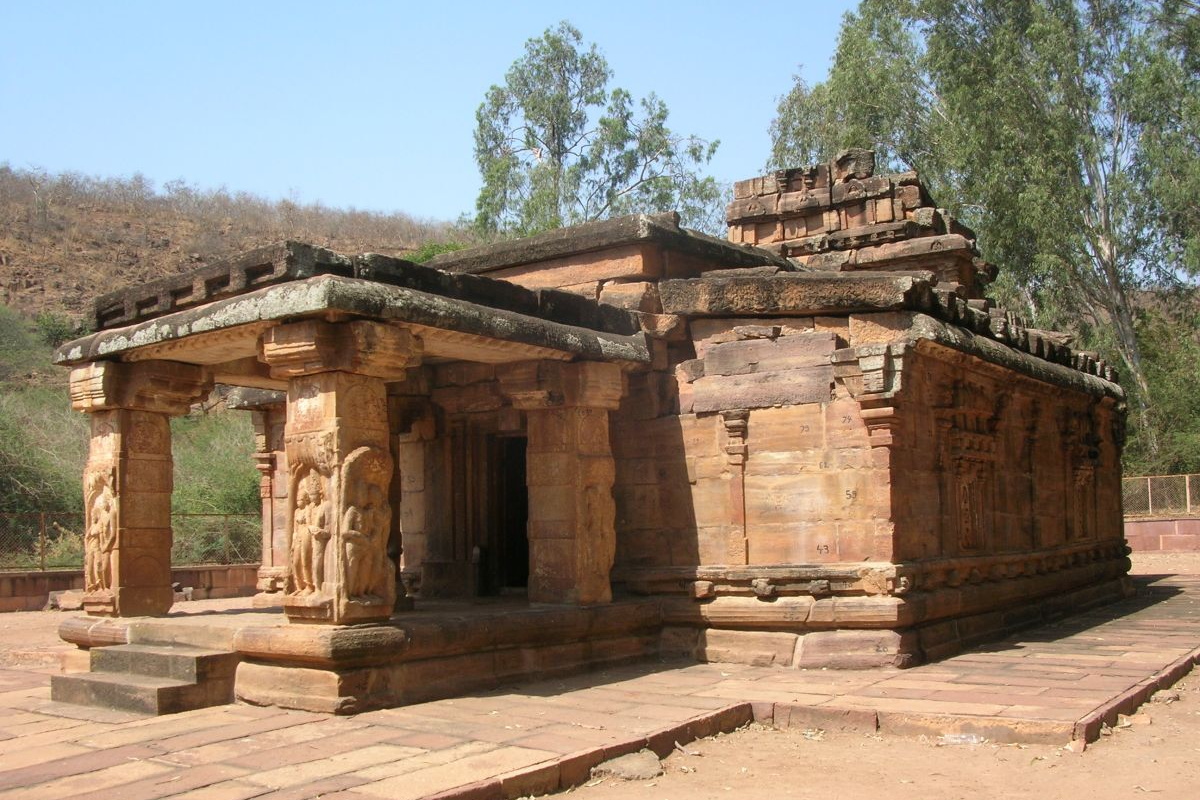
From Banashankari, we head towards Shivayogi Mandir. On the way, one could stop at Naganatha Kolla which is about a kilometer away from the main road. This handsome looking temple is called Naganatha Gudi, one of the many Chalukyan creations of this region. The sculptures of amorous couples on the portico pillars are quite interesting. This spot, where two hills merge or two arms of a hill merge is called a Kolla. Usually a Kolla has a source of flowing water. Since this Naganatha Gudi is situated here this place is called Naganatha Kolla.
We didn't stop at Naganatha Kolla during this trip, we moved on towards Shivayogi Mandira which is situated on the left bank of river Malaprabha. Established in the year 1909 to protect local breed cow, presently Shivayogi Mandir is known for the following: 1. a school to train Matadipathis (Lingayath and Veerashaiva monastery heads), 2. a library of religious scripts including Talegari Shasana (scriptures written on palm leaves), 3. Ayurvedic hospital, and 4. Vibhuti making center. The basic ingredient of Vibhuti is dung of local breed cow. Shivayogi Mandira's annual fair is attended by thousands of people and, it conducts daily Anna Dasoha.

We visited the Samadhis of the founding Swamijis and then proceeded to partake Prasada at monastery's dining hall. After Prasada we purchased a Vibhuti block. We were the last customer for the day. Shivayogi Mandira's Vibhuti has great demand but production is limited, each person/group can buy only one Vibhuti per day. Lastly we saw the Vibhuti making center where most workers are women. It's a simple setup producing the highly revered Vibhuti.

By 1-30 PM or so we left Shivayogi Mandira and headed towards Mahakoota, a group of temples, built during Chalukyan times. For some reason the Chalukyans created two Mahakuta known as Halae Mahakoota (old) and Hosa Mahakoota (new). These places are a few kilometers away, both are situated at the eastern base of Badami hill, a few kilometers between them. Both Mahakoota have natural source of fresh water. Halae Mahakoota has a temple which is apsidal in plan and a group of 4 or 5 smaller shrines. I'd been here in Sept 2012 and the next visit was this day. However, this visit was little disappointing because the historical site was under renovation, it looked like a construction site. So we did not bother getting out of the car, we moved on towards Hosa Mahakoota or simply Mahakoota.
Mahakoota is a very popular place, it attracts huge crowds on holidays, on Amavasya and Hunnime days and festivals like MahaShivaRatri. Unlike Halae Mahakoota, here the freshwater pond & group of temples are enclosed in a quadrangle.

All these temples are of the same architecture, all are built of sandstone, so I guess all were built during the period of Chalukyas. Besides these ancient temples, this site also has a number of ancient trees, they too have the age old look. The presence of trees gives this place a special feel, like we are in another world. This is how I felt during my first visit here in 2010... click on this link to see Mahakuta in 2010.

However, this visit was a disappointment because of the noisy crowd. This spring water pond is the main reason for the crowd. Pushpa and our friend Praveen too were kind of taken back at the lack of sensitivity of the boys who were yelling and diving into water. I observed the crowd several minutes, could hear plenty of Urdu phrases. This noisy bunch wasn't here to visit temples, this was a free resort for them. I was angry, upset... there were so many other people who came as pilgrims, to perform rituals, none of them objected to the outsiders' behavior. Even the temple staff hadn't bothered to intervene. This reminded me of similar incidents at Nagavi and Gangibavi, same Urdu blabbering teenagers creating havoc at a holy place. These 'people' are abusing the accommodating nature of Hindu people. Time to put up resistance and end such nonsense.

Anyway, I would to mention a underwater shrine dedicated to Shiva. One needs to dip into water and pass through a gap in the side wall of the pond to see the shrine. Hopefully I'll come here one early morning and see that shrine, and spend time in the peaceful ambiance.
During my first visit here, we had discovered a pair of strange looking sculptures flanking a gateway. So this structure here is the original gateway of Mahakoota. Flanking the passage is a pair of shriveled characters called Kaala and Kaali, very captivating sculptures. I make sure to see them during every visit. The other thing I would like to say here is a footpath connecting Mahakoota and Badami. The path traverses over the hill, approximately 8 km trek. I really want to do this trek once.

Having spent thirty minutes at Mahakoota, we left the place and headed to Pattadakal. In the meantime, clouds had gathered and air felt humid. Pattadakal, unlike Badami or Aihole, is a closed group of temples in one enclosure, all dedicated to Shiva. In this enclosure there are approximately 17 temples however only 8 of them have names and the remaining are minor structures. Then there are two temples in walking distance outside of the enclosure, at two sites away from each other. The interesting part is that the temple enclosure is situated on the left bank of Malaprabha river, where Malaprabha bends and flows northward. Such a spot is considered holy in Hindu traditions and coronation ceremonies were conducted here. Hence this place is called Pattadakallu.
Most tourist guides at Pattadakllu start their tour by saying that Aihole was the cradle of temple architecture, so it was called as the school; and Pattadakallu was the college. Perhaps one must see Aihole & Pattadakallu a few times to get a hang of school & college idea. Of course, Chalukya builders didn't limit their creations to just the well known tourist spots, there are several less known sites whose history go back to Neolithic times.
The ten temples (eight plus two) are as follows: 1. Kaada Siddeshwara Gudi, 2. Jambulingeshwara Gudi, 3. Galaganatheshwara Gudi, 4. Chandrashekhara Gudi, 5. Sangameshwara Gudi, 6. Kashi Vishwanatha Gudi, 7. Mallikarjuna Gudi, 8. Virupaksha Gudi & Nandi Mantapa. The other two are: 9. Papanatha Gudi and 10. Jaina Narayana Gudi.
Our tour was paused as we approached Galaganatha Gudi, thanks to a heavy downpour which lasted almost an hour. We took shelter in Galaganatha along with few other tourists. Once the rain subsided we resumed the tour but the enthusiasm had waned slightly. We spent another hour checking out the sculptures on both interior and exterior of the structures. This was my third visit, I think, yet I'm left with a dissatisfied feeling. I must make another visit, the tour must start early morning.
 |
| Kaada Siddeshwara Gudi | Jambulingeshwara Gudi Sangameshwara Gudi | Galaganatheshwara Gudi |
Where there are shrines dedicated to Shiva there are idols of Nandi. This is one of the better preserved Nandi idols here. The Nandi idol related to Virupaksha Gudi is the largest, about 5.5' high, it has its own Mantapa. Then the other important relic of Pattadakallu is the inscribed stone pillar. The pillar area was undergoing restoration work and covered, temporarily out of sight for tourists.

We were kind of tired because of the humid weather and the long wait while it rained, we winded up the tour. We did not bother going to Papanatha and Jaina temples. Instead we found a good snacks & tea shop, enjoyed steaming hot bajji and tea. Also, it was time for our friend Praveen to leave, he had a train to catch at Badami station. Pushpa and I had booked a room at KSTDC hotel at Aihole. We checked into the hotel, had refreshing bath and rested.
The plans for the morrow was to tour monuments of Aihole which you can see in the following post... A tour of Vatapi Chalukyan realm - part3.


