..continued from Nagarjuna Sagar and Nagarjunakonda - part 3
Having seen Mahachaitya the largest Stupa on this island we move on and reach the next monument- Aswamedha tank, the sacrificial altar. This too is a restored monument which was originally in river Krishna valley. This monuments has two main structures, both are elaborately designed pits. Then are smaller square shaped pits as well. This pit here looked like a big bathing tank at the first glance. However this is pit used for sacrificing horses. I'm trying to imagine a horse standing in it.
A stone tablet describes the monument as follows-
Aswamedha Tank: The founder of the Ikshvaku dynasty performed the well known sacrifice of the horse kundam 'Aswamedha' This ritual was one among the very elaborate sacrifices prescribed to be performed only by a king of unquestionable authority and who had the recognition of his neighborly kings as their overlord. The tank was intended for the final purification bath and the structure in the shape of a tortoise was known as Kurma Chiti where part of the horse was sacrificed.
The pit has two entrances, this one here is with three steps. A narrow shoulder runs along the perimeter, it looks like a seat but may not be. The pit seems to have a drain hole, not sure its part of the original design or if was created by restorers to let rainwater seep into the ground below.
Lengthwise view of Kurma tank. In this view, the tortoise shape is evident. The projecting part at the right-end is the head and its flanked by two feet. No idea why the pit had to be shaped like this.. why not a simple circular pit. There are articles about Kurma pillars but not much about Kurma pit.
Here's a map of the island showing locations of monuments on it. So you'll get an idea where we are currently- Ashwamesha site.
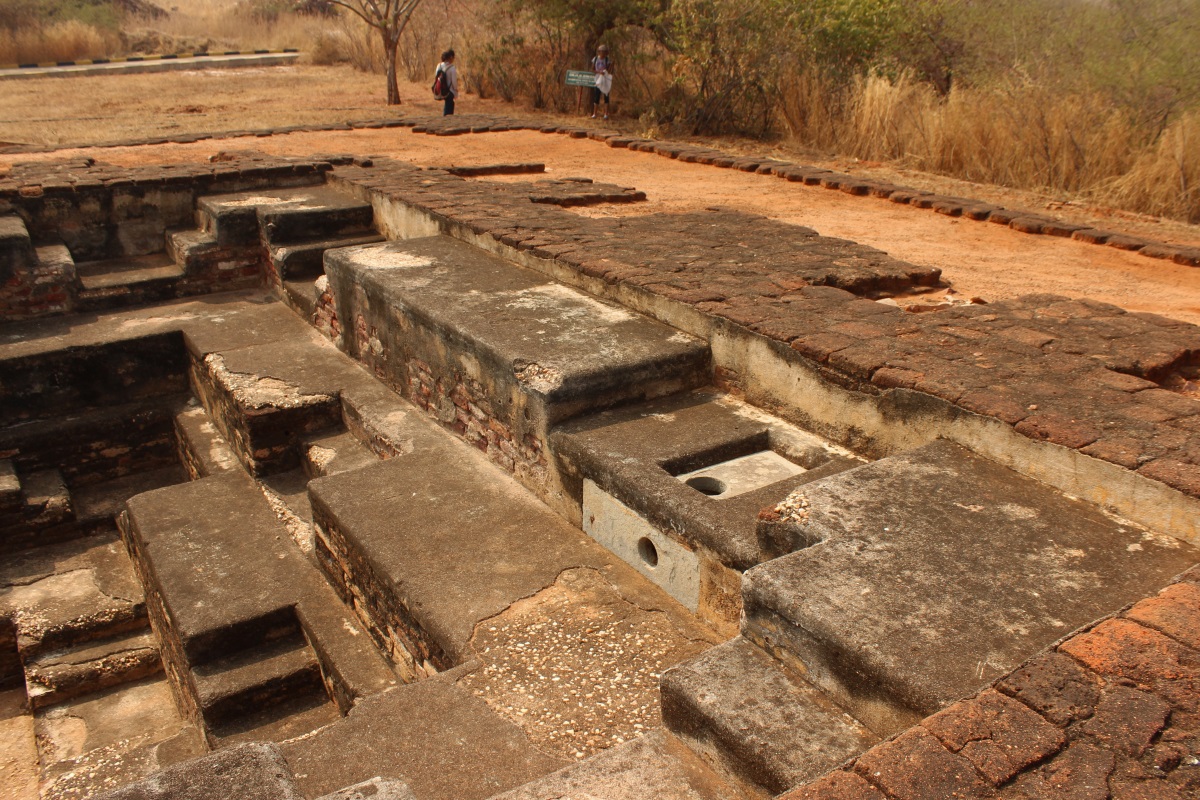
Besides the Kurma pit is this larger pit, a stepped tank with a platform around it. This tank was meant for purification bath.. for those participating in the rituals.
It seems the projections around the tank were individual seats. Probably after the bath, individuals would sit and meditate before initiating the ritual.
Almost symmetrical in plan in either axis except for the circular hole in one corner. I'm guessing water flowed into the tank from that corner.
Closer look at the water hole. Probably there was a canal which fed water to this pit, water would pour into this rectangular pit and flow into the stepped tank. Water had to flow slowly to so that bricks do not wear out quickly. It would be interesting to see the sight back in time. As I took pictures, Pushpa and Bhuvana had taken refuge of the only shaded spot. Pushpa wanted to head back but I wanted to check out the reminder of the path. I suggested they go back and wait for me at Dalai Lama tree near Maha Chaitya.
View of Kurma tank and smaller pits from the stepped tank platform. Wondering if the smaller pits and Kurma tank were inter-connected through underground pipes. Things connected to Vedic culture are usually complicated, of course there would be a purpose to it.
The stepped tank platform gave a glimpse of Nagarjuna Sagar. Beyond the water is another island, much larger, its wild, no signs of human activity. There's lot of wildlife on these island such as boars, rabbits, porcupines, may be wild cats too. This is the general terrain grass, thorny bushes, thorny shrubs and cactus too. Weather is generally warm and arid hence the presence of thorny flora.

Close to the end of the tourist path is this monument- Swastika Stupa. Its about 16' in diameter with a Swastika at its core enclosed in concentric stone rings. Swastika is one symbol common to many faiths across the globe. Quting a para from Wikipedia: In Hinduism, the clockwise symbol is called Swastika, symbolizing Surya, prosperity and good luck, while the counterclockwise symbol is called Sauvastika, symbolizing night or tantric aspects of Kali. In Jainism, a swastika is the symbol for Suparshvanatha — the 7th of 24 Tirthankaras (spiritual teachers and saviours), while in Buddhism it symbolizes the auspicious footprints of the Buddha.

A stone tablet describes the monument as- Swastika Stupa: This transplanted Stupa was originally part of a complex located the Mahavihara Vasin monastery in the valley. The remains of of this structure has interesting arrangement of bricks in the center of the hub in the shape of Swastika from with its arms turning clockwise. The Swastika Stupa is an exceptional example of the Buddhist architecture of Nagarjunakonda valley.

Glad to have seen the Swastika, it gives positive vibes. A security guard has told to turn back after seeing Swastika Stupa, it may not be safe to venture beyond it because of wild animals. Having come so far it, I didn't want to miss seeing what lay beyond the walls.. who knows there might be a unmarked monument. No, such luck but there was an antique trolley parked in the middle of the road. Behind me, to the left are several vacant houses, I think they are staff quarters built for this restoration project. I rested few minutes in the shade and silence.. so peaceful. Wish I could get a job on this island :)

I trek back to Dalai Lama tree where my companions were resting. I too rest, have water and cucumber.. ah refreshing it was! We were hungry but we wanted to have lunch close to the museum itself. I did not want to walk around too much after the meal, hence the plan. Back near the fort wall, Pushpa mentioned that we could see the ancient well before reaching the museum and there was a shortcut. We left the cement path and took this dirt path passing through the fort wall.
A well used passage during those days. Close to this wall, behind us is the ancient well which is really wide.
Here's the ancient well. Its mouth at ground level is 52 meters (170'). A flight of steps descends into its belly. This well seems to be dug before or during the time fort was built here. Probably the hacked out stone was used for building fort walls or the circular pyramid.
Opposite the museum, we found a cool spot under a tree, had idli we had picked up at Vijayapuri, then chatted as we rested 30 minutes. Around the spot we could see patches of disturbed ground which I recognized as wild boars' work. During rain season when soil is soft they dig with their snouts for earthworms. In fact I saw patches near the circular pyramid as well. A very busy island during nights.
Having rested, we made our way to the museum, a stone structure with circular windows with coiled serpent grill. Each of these windows is framed with a Stupa like section which also seems like a Lotus. Whoever designed the building wanted to give it a touch of Buddhism. The museum interior is spacious, with the high ceiling, it has a proper museum ambiance. The artifacts collection is mostly ancient sculptures, rare and valuable items. There was one section for prehistoric stone implements and pottery. A small collection of ancient swords and spears were also displayed. Besides ancient artifacts, there was one room with a 8' x 8' scale model of the Buddhist site in Krishna valley. If I remember correctly, about 60 structures were marked in it. Lot of effort by the team who created the model. Like most museums, photography is not allowed. After walking around 45 minutes, all of us badly wanted to sit, so we had to come out. Very close to the museum is the relocated bathing ghat.. missed taking pictures of it.
We were unsure of the boat timings and not willing to risk missing it, we headed back towards the docking point. The last boat arrived with a load of tourists and gave them an hour on the island. As soon as it was empty, we boarded and occupied seats. By departure the boat was filled beyond its capacity, there were people standing and sitting on the lower deck too.
Last look at the island, ruins of the fort walls on the eastern end.
Terns entertained us during the return journey. Their effortless sweeps, turns, twists, dives and take offs was amazing. We kept on shooting them through my telephoto lens in continuous shoot mode. Not very good pictures, I manipulated some to share them here. They seem to fish more during mornings and evenings and less during midday. In envied their freedom..
The return journey was slightly longer than the onward journey, probably because of the extra load in the boat. It was around 7 by the time we docked and reached the car park. It was a nice experience, the boat, the vast sheet of water, the island, monuments, the silence ..what a package! We drove back to Vijay Vihar, freshened up, early dinner, short stroll and early to bed with plans of visiting Anupu archaeological site in the morning.
.........