Showing posts with label flora. Show all posts

Oct 4, 2025

coconut seller at Chakrathirta, Hampi

On the morning of the 11th December 2024, Sridhar and I arrived at Chakrathirta around 7-45 AM. Close to Yantrodharaka Hanuman Devastana, a local man was setting up his shop. The fresh yellow trumpet flowers, known as Koranekelar in Kannada, caught my attention. Only then I realized that this simple beauty was offered to deities in Hindu temples.

.........

Jul 6, 2024

water lilies at Lalbagh tank

This post is a result of 9 year old memories. On July 5th 2015, I met up with my primary school friends at Lalbagh for a morning walk. That was my preferred way of catching up with friends... an early morning walk followed by a quick breakfast. That morning while walking near the water tank, we accidently discovered a tree named Devil's tree and later surprised to see a flock of the Spot-billed Pelicans. In between, somewhere near the bridge across the tank waters, I noticed a tight cluster of pink water lilies on the shimmering surface. There was no other convenient spot to shoot this cluster, I just a shot with sunlight blazing into the lens. Not a bad picture though.

Here's are two cropped versions of the original. A closer look at these beauties is needed.

Lalbagh is a Nature buff's dream. The variety of plant life and animal life is simply amazing. With every visit, something new could be seen. Lalbagh is home to the rare Ficus with cup shaped leaves, it's called Krishna's buttercup or Krishna Ficus. Then there are gigantic Silk Cottons. The largest of them is truly a giant in terms of girth and spread of branches. Until about a year ago, Lalbagh was home to an African tree as well - the enigmatic Baobab. African Baobabs are gigantic, so are some of the Baobabs in India. However, the Baobab of Lalbagh was small, with tree trunks emerging from one base. A few months back I heard this Baobab was axed spelling its end. I received the sad news from a friend who frequents Lalbagh. Then there was one really tall palm - an Arecanut tree situated close to Lalbagh Main Gate. The tall palm was missing during my last visit, probably sometime 2021. Anyway, there are a plenty to see, admire and be amazed of. For example there's a tree fossil, and the rock hillock is considered as a geological heritage. Lalbagh is not an hour long tourist destination, rather it's a place one needs to visit over and over and over to realize the hidden gems,

.........

May 4, 2024

Krishnae Ficus Bonsai at Shukhavana

2023 May. I was pleasantly introduced to Bonsai version of Baobab through my friend Pramod Potdar. The miniature Baobab Bonsai was seen at Shukavana, a garden of approximately 2500 bonsai plants. This bonsai garden is a part of Sri Ganapathy Sachchidananda Ashrama, Mysuru. Pramod had shared pictures of three Baobabs which can be seen at Baobab Bonsai of Shukavana.

2024 February. I was on a 2-day visit of Mysore to see my school / college friends and also visit Shukavana to see the Baobabs. I was put up at my primary school friend Venugopal's home. I have to mention that Venu's house is situated in a peaceful locality situated centrally, and he's a wonderful host. We went to the ashram on Wednesday morning only to find out that it was the Shukavana's weekly holiday, same for the museum and bird zoo there. So we made another visit Thursday morning. The three places- bonsai garden, bid zoo & museum -are open to public from 10-30 am to 12-30 pm and 3-30 pm to 5-30 pm.

On entering the garden, I was stunned seeing the superbly maintained miniatures of almost every variety of tree an adult might have seen. However my eyes were looking for the miniaturized giants, the Baobabs. When the first one was spotted, I showed it excitedly to Venu. A few minutes later another, followed by another. Then on Venu started spotting Baobabs as well. We spotted nine or ten miniature Baobabs in those 45 minutes we spent here. As we approached the end of the tour I wondered if this collection had a Krishna Ficus. That moment was as though my subconscious mind had sensed its presence. Yes, a Krishna Ficus was spotted - this discovery made my morning!

Almost every plant here is labelled. The Krishna Ficus label read as below:

Dec 17
Ficus benghalensis var. Krishnae
Krishna Fig/Krishna's butter cup माखन कटोरी / कृष्णवड
Rāga : Candrajyōti, चंद्रज्योति
Origin: Indian subcontinent, Indo china
1990 - Root exposed style

I have no idea what Dec 17 signifies. 1990 must be the year this plant was born. Going by that, this little Krishna Ficus is 33 years old.

This is Venugopal with Krishna Ficus. He was fascinated seeing it's cup-shaped leaves. I mentioned the story of Sri Krishna eating butter from cups made of Ficus leaves which eventually retained the cup-shape. Also mentioned about the three fully grown Krishna Ficus at Lalbagh, Bengaluru, he must visit the garden to see those beautiful trees.

For those who are unfamiliar with Krishna Ficus, please take a look at a normal Krishna Ficus and its cup-shape leaf.


Both Baobab and Krishna Ficus are rare plants. The former is native of Africa, saplings were brought by traveling traders in the medieval times. The latter, though a native of the Indian subcontinent are few in number. To my knowledge, there are just five places to see the legendary Krishna Ficus:

  1. Botanical Garden at Karnataka University, Dharwad
  2. Lalbagh Botanical Garden, Bengaluru
  3. Deva Deva Vana, Karnataka Forest Dept garden near Bidar
  4. Discovery Village, a resort situated near Kanakapura
  5. Prakruti Vihara Vana, Karnataka Forest Dept garden at Mari Kanive near Hiriyur

Do see this amazing tree whenever you are nearby any of these places.

......... 

Jan 20, 2024

Taale Gida of Bhogasandra and Bommarasanahalli

During the fourth visit to Bhogasandra, somehow the matter of Taalegari Lipi came into one of the evening chats. Sridhar mentioned that they had some Taalegari strips at home. I think it was our friend Siddaramanna who mentioned about Taalegeri plants close to Sridhar's land. Being a rare plant people from far away places come in search of its flowers during Aug - Sept months which happens to be Hindu festive season. The flower has a unique form and fragrant, it is used as an offering to religious idols at home and temples. A decade ago I'd seen a Taalegari plant in the forest path on the way to Sirle waterfall near Yellapur in Uttara Kannada district. After some discussion with Siddaramanna it was clear that the plant seen near Sirle and the ones here were two different plants. So it's not just one type of leaf was used to make writing medium, different leaves were used. Probably the leaves of Tati Nungu (toddy palm or ice apple) were also used as writing medium. I eagerly waited for daybreak to take a look at the Taale plants here.

The following morning another friend Shivappa showed me the plants which I remember seeing earlier but I'd not paid attention to them. These plants were present along the banks of the stream. Some of the plants are rooted in the streambed itself. Basically this plant requires high moisture hence grows along rivers and streams, maybe near ponds as well.

Taale Gida Kewda Fragrant Screw Pine

Taale is also known as Kewda plant and Fragrant Screw Pine. Taale leaves are long-pointed, dark green, has barbs along the edges. The leaves emerge from the stem like a fountain. Each clump could have 100 to 120 leaves. A mature leaf can be a meter long i.e. about 3' feet. A single plant can have several branches and grows up to 15' tall.

Taale Gida Kewda Fragrant Screw Pine

As per my observation, there are 8 to 10 clusters, each cluster comprising of 5 to 6 plants. These plants flower between July and September. The flowers transform into fruits which resemble small pineapples when raw. On ripening, they turn bright orange. Apparently the screw pine is edible but it must be cooked and eaten.

Taale Gida Kewda Fragrant Screw Pine

We managed to get close to one of the plants which was reachable to our hands. Luckily Shivappa had a kudlu, a long sickle with which he cut a bunch of young leaves. Carrying the bunch from here to the farmhouse was something. I'd hold it up with my arm stretched out fully so that the thorny edges don't tear into my skin or clothes.

Taale Gida Kewda Fragrant Screw Pine

This is the bunch I go home and placed in a water filled pot. That was an attempt to keep it fresh for a day. Leaves could be peeled out easily since their bases formed a cylindrical stack. That gave me an idea of the leaves were separated, then dried out. However, to make them a long lasting writing medium, there must be a an elaborate procedure starting with removing the thorns.

Taale Ele Kewda Fragrant Screw Pine Leaf

Hoping to see a flowered plant this August or September. Or I can ask one of our friends to check out the plant and take pictures of flowers and fruits.

Here's a photo of Talegida flowers shot at Mulbagilu town in Aug 2012. Back I was ignorant of this flower but nevertheless I'd snapped it.

.........

Jul 8, 2023

Baobab trees of Dodda Hunashe Matha, Savanur

April 30, 2011. Until this day, I didn't know that Baobab trees existed in our country and the discovery of Baobabs at Savanur happened by chance. I had come to Savanur to see the fort ruins here. While asking for directions a passerby told us to check out the huge trees at Dodda Hunase Mata. Kannada word Dodda-Hunase means big tamarind. The name generated curiosity and we decided to check out the trees.
The three Baobab trees stand in a triangular enclosure. The collage below shows two pictures.
Going by the sizes of the trees, they could be 500 years old. It is said that Baobab trees were brought from Africa to India by Sufi ascetics. Wherever Sufi caravans camped, saplings were planted and handed over to local people to care for. All Baobab sites in Karnataka are either temple or mosque. Baobabs were considered sacred due to their special qualities. They store huge amounts of water in their trunks and their fruits are highly nutritious. Even its leaves are edible.
Below collage shows an much older photo of Swamiji sitting under one of the Baobab trees here and, a Baobab fruit. This fruit is kept on the Jagali. Since its is considered sacred, it has become an object of worship.
The second visit to this site was on 9th Dec 2012. I was accompanied by my colleague Malatesh. We had come to attend a wedding at Karadgi Veerabhadreshwara Gudi. We were traveling by a car, we visited two temples at Adargunchi and Budarsinghi on the way.
April 15, 2023. Our agenda for the day was to see Siddarameshwara Devastana at Niralgi, Baobab trees at Dodda Hunase Mata and Gange Bavi. We reached Niralgi by 7-15 am, spent about 45 minutes at the temple, had breakfast and then headed towards Savanur. It was around 9-20 when we entered Dodda Hunase Mata. I was seeing this place after 10½ years. The place had changed little... changes not to my liking. A bunch of steel plantings like boards, shelter, etc. were unnecessary, they were an eyesore, they blocked the view of the beautiful trees. This picture below was shot from a side so not much of clutter in the foreground.
The trees are inside a triangular enclosure. Earlier we could walk around the fence and see each of the trees closely. Now the side paths have been blocked. See the number of badly placed boards and shelter. I wish they declutter the place and let visitors experience a clear view of the rare trees.
A few closeup shots. A bunch of buds.
One of the trees has lost a branch exposing the innards. Below is the exposed dry wood. Here you get to see a section of the bark as well. The other picture shows one bud and two spent buds.
These Baobab trees are home to hundreds of bats. I remember shooting a few pictures of a bat wrapping itself with its wings as though it was cold, just the way when a man pulls a blanket while in bed. These bats are quite big. This fellow here seems to be deep in sleep, recharging itself for its nocturnal sojourns.
Even a swarm of bees have chosen to build a honeycomb on one of the trees.
Time to move on. From here we drove to Savanur market area in search of Shivalal Khara shop. The shop hasn't changed at all. It's an old school type of business, only cash payment, UPI payments not accepted. I'm sure even their sweets and savories quality is same as before. We bought khara mixture, sev, soft red halva and one hard sweet. The hard sweet is loaded with sugar and ghee, can't east more 3 or 4 bites. We relished the snacks, I didn't feel much change in the taste. Below are the photos of Shivalal 2012 and 2023. 
2012 and 2023
From Savanur we head towards Gangibavi, a holy well with a natural spring near Shiggaon.
.........

Jun 17, 2023

Baobab Bonsai, Shuka Vana, Mysuru

In the second week of May, I was checking Whatsapp status of a friend from Pune. This friend, Pramod is an avid traveler and an explorer of forts. His status had displayed a series of Baonsai trees, some 20+ plants. Out of curiosity I asked where the Bonsai garden was. It was Shuka Vana which is a part of Sri Ganapathy Sachchidananda Ashrama, Mysuru. The collection was truly impressive and started the slideshow for the second time. I zoomed into one of them and to my surprise it was a Baobab! As it is Baobab is a uncommon tree in India. A Bonsai Baobab would be a rare thing. Of the 20+ trees, 3 were Baobabs and 7 or 8 were varieties of Ficus.

Of the three plants, two have name boards stating that these are Baobab trees. The scientific name is Adansonia Digitata. They have been planted during May 1942 the birth year of Sri Sri Sri Ganapathy Sachchidananda Swamiji. These little plants are 80 years old. Amazing! 

The first plant is bent and crooked. The lower part is a maze of roots and trunk. The upper half has recognizable as a Baobab. The main trunk is slanting so much that it's almost horizontal.
The second one is a perfect scale down model of a Baobab. Its branches have been restrained by threads. Probably this is a technique used to perfect a Bonsai.

The third one, according my understanding is a Baobab. The name plate seems to be on the opposite side. 

I would like to thank my friend Pramod for sharing hires pictures and allowing them to be posted here. Besides historical places we have other common interests- cycling and Hollywood movies :)
Having seen miniature Baobabs, you must see normal trees as well. These three Baobab trees are situated inside the premises of Dodda Hunashe Matha, Savanur. These pictures were shot 15th April 2023. They are bare at this time of the year. New leaves should start sprouting in the month of May.

One of my friends from Mysuru had given an open invitation to his place. He wanted me and another friend Sridhar to spend a couple of days there, we all cold see a few places in and around Mysuru. I recalled that Sri Ganapathy Sachchidananda Ashrama was one of the places. Well, the Baobab Bonsai has worked like a catalyst, I'll be deciding the dates of the trip soon.

While on the topic of Baobab, do check out the Baobab trees of Karnataka & Telangana.

.........

Mar 11, 2023

Ficus Krishnae trees in Karnataka

Until June 2009 I didn't know a tree could have cup-shaped leaf and that tree was called Krishna's Buttercup. The plant belongs to Ficus family hence it's called Ficus Krishna. I learned about this unique plant from a colleague Manjula Umesh; first it was mentioned in a chat window, followed by a weblink in an email. This is one of the plants which has a divine connection... as per our legends, Baby Krishna was fond of butter, he would eat huge quantities. If denied he would even steal butter. Once Krishna was caught by his mother Yashoda, he tried to hide the butter by rolling up in leaves of this tree. Ever since that day, the leaves have retained the cup-shape. So this is the story behind the Buttercup leaves.

I was a frequent visitor to botanical garden in Karnataka University campus and shared pictures in Life at Dharwad. Aware of my visits to botanical garden, Manjula asked me if I'd seen the Ficus Krishnae there. I'd not seen it since I didn't even know about it. So the search began. On September 5th I found the buttercup tree ...I'd passed by it several times but never saw the leaves closely. Seeing it and touching the cup-leaf for the first time was an elating moment. The very next day I shared the discovery news with Manjula, and then published the blog post Krishna's Butter Cup.

Exploring the botanical garden continued, it was almost a Sunday morning routine, yet there were new discoveries, and the garden had a side for every season, the place never stopped surprising me. A few months later, may be year, I discovered there were two more buttercup trees close to the first one. They are much smaller and hidden by other larger trees. So, university garden had three Ficus Krishnaes.

In March 2012, I happened to see a 7' tall young tree and several smaller saplings in the garden's nursery. This was another great discovery since the botany department was breeding this rare tree. Good, more Ficus Krishnae trees need to be planted and people should learn about it.
At some point, I thought this beauty should be present in other places.

1. Ficus Krishnae of Karnataka University, Dharwad - The first two pictures below shot on Sept 5th. The ground is green after a good rainy season. The leaves are matured, foliage is at its best. 

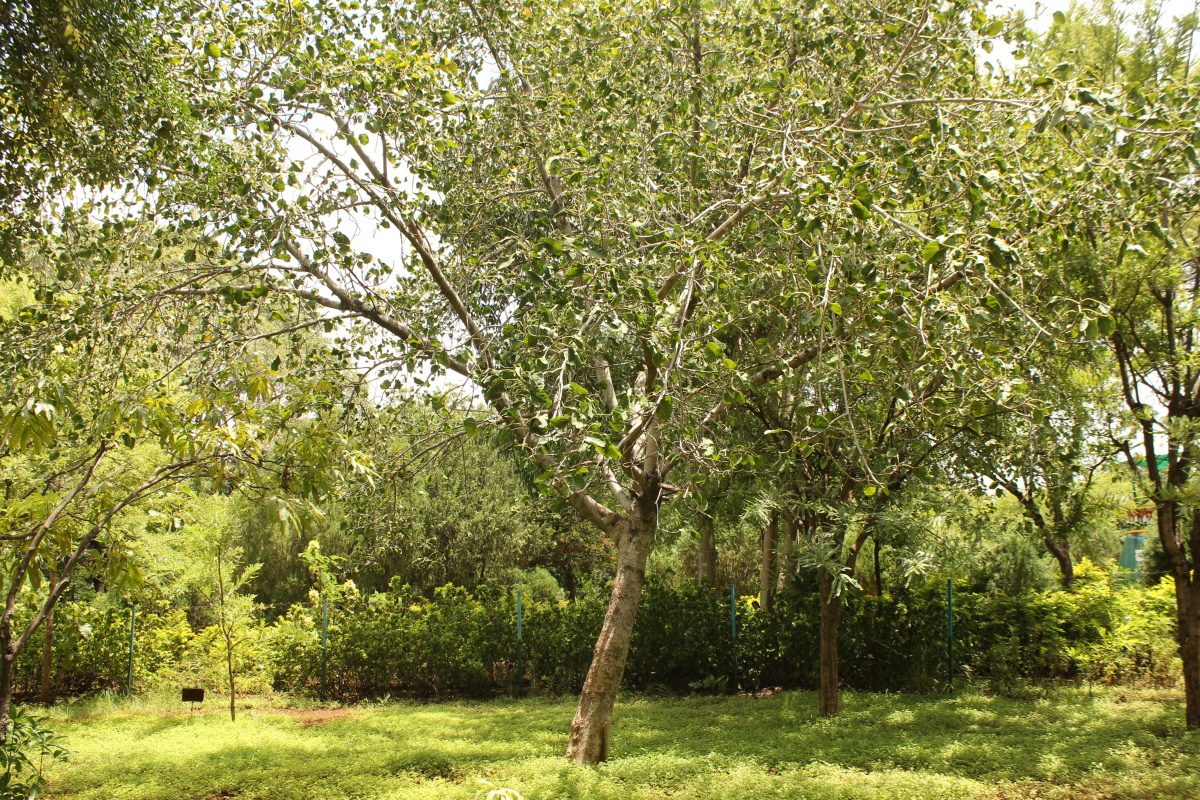
This tree is situated at the center of the botanical garden, right besides a footpath. May 2013 I learned this tree's history from another colleague Shilpa Vernekar that this Ficus Krishnae was 80 years old, it was planted by founder member of Botany Dept. - Prof. Channaverayya. This tree did not grow here on its own, it was planted here. Ficus Krishnae is an endangered species because it does not adapt to new environments. This was info provided to Shilpa by Prof. Chandrashekar Patil of Applied Genetics Dept (Botany) during bird watching program. Well, this tree today is 90YO. Since its an endangered species, all the more reason for us to grow more Krishnae Ficus.

June 16, 2012. After returning from Lalguli Hanumana Kote, we- Sindhoor, Ravi, Malatesh & I-went to the botanical garden to see our beloved tree. None of them has seen a Ficus Krishnae earlier, it was a discovery for them. At this time of the year, the tree is laden with bright red figs, ripe enough to be eaten. I haven't tasted one yet. Surely birds would be feasting on the sweet figs.

This picture is one of my favorites. Here both sides of buttercup leaf can be seen. Also, ripe figs are seen. Like any other fig, Ficus Krishnae figs have velvety skin and yellow inside.

Ground below the tree was littered with dry cups. Sindhoor picked up a lot of leaves to take home. This reminds me of sending a few leaves to Manjula Umesh which had made her ecstatic. That's the least I could do for the wonderful intro. For me, this tree was a sacred shrine, something I loved to show people. July 2021, I brought my brother, niece and Pushpa here during our 35 km bicycle ride around Dharwad.

Besides exploring the wilderness of botanical garden, I would venture into the nursery, the gates would be unlocked most times. The nursery had some amazing plants- cactus, creepers, succulents, and what not. On a Sunday in March 2012 I happened to notice a very young Ficus Krishnae tree, its stem was slender, barely 2" diameter, about 8" tall. With this the total rose to four. Besides the young tree, there were a few very young saplings in grow-bags. Looks like botany department was taking serious steps to preserve Ficus Krishnae. Good work!

2. Ficus Krishnae of Lalbagh Botanical Garden- After the discovery of Dharwad's Krishnae Ficus I always wondered where else this could be present. I felt Lalbagh and Cubbon Park could be the probable places since both parks are known for extensive collection of plants. During my visits to Bangalore, I would go to Lalbagh or Cubbon Park early mornings, often well before sunrise. On December 27th morning a gathering of primary school friends at Lalbagh had been planned. As usual I came early and went around the park once. Once our group of four assembled, we retraced the path. As I was telling about the divine tree, I happened to notice the Ficus' cup-shaped leaves. What a discovery! Looks like the search was destined to end with my friends.

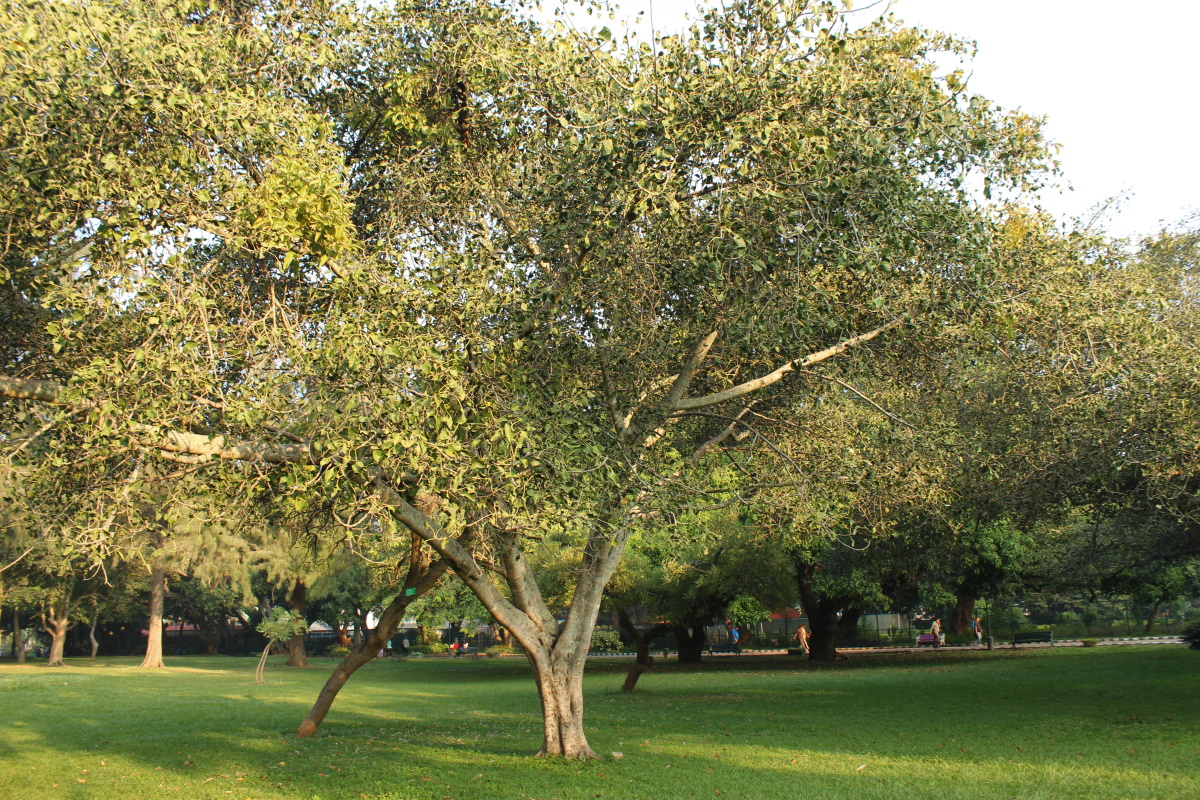
As you see, this Krishnae Ficus has multiple trunks.. its aerial roots have transformed into trunks. I feel this tree is around 200YO. Dharwad's 90YO Ficus doesn't have aerial roots yet, of course there's human and cattle interference there. Ficus needs lot of open space around it for it grow unhindered. If the ground is stepped upon, aerial roots will find it difficult to penetrate the ground. Also the young roots must be isolated, absolutely no human or animal contact. All this is wishful thinking with the present human population.

Presently people climb and sit on the branches, which is harmful to them. There should be a fence around the tree for its own good.

A stone's throw for the multi-trunk Ficus is another single trunk tree. This tree could be 80 to 100 years old. We picked up a few dry leaves as souvenirs. With this discovery, I was hoping to discovery another tree...

3. Ficus Krishnae of Deva Deva Vana, Bidar- Pushpa and I were on a tour of Basava Kalyana and Bidar from September 2nd and 4th. On the morning of 4th we left Bidar, heading back to Hyderabad. ^ km away from Bidar towards Zaheerabad, we saw the forest department owned "Deva Deva Vana." The name was catchy which made me curious and we decided to check out the park. At the entrance is a board showing the park's layout; within this park are themed gardens such as Rock Garden, Medicinal Nursery, Japanese Garden, Rose Garden, Ashoka Vana, Shiva Panchayath Vana, Brahat Pachavati Vana, Rashi Vana, Phala Pushpa Vana, Navagraha Vana, and Nandana Vana. The team behind this idea and those maintaining the park have done a commendable job. We explored the park and finally on the way out we came to Brahat Pachavati Vana which is a small fenced enclosure. I noticed the cup-shaped leaves as we approached its entrance.I went in and confirmed it was a Krishnae Ficus. We looked around and saw three more, that's four trees. What a pleasant surprise! Honestly, I never expected to see Ficus Krishnae in Bidar district, but its real. Many assume that Bidar is a arid place. That's not right. Bijapur and Kalburgi districts are arid but not Bidar. My opinion about Bidar changed after the 13-day biking trip around Karnataka.

This is the entrance to Brahat Pachavati Vana, a board alerts visitors that this place is only to do meditation. Panchavati is spot with five sacred trees namely Bilwa, Shami (Vanni), Ashwattha, Neem, Audumbara (country fig). The purpose of this garden is to provide a comfortable resting place. Such spots can be found in some temples or monasteries. This reminds of the small garden inside Gavisiddeshwara Mata, Koppal.

At the center of this Pachavati is a Ashwattha tree. Around the Ashwattha are the Ficus trees. Honestly, I did not pay attention to other trees but I do remember seeing a Guddada Nellikayi (Amla tree). Anyway, here are a few pictures of our beloved Krishnae Ficus.

Panchavativana Deva Deva Vana

The trees are more or less same height and their trunk girth same. They seem to be young trees, may be 25 to 30 years old.

A slanting Ficus.

The place indeed has a peaceful ambiance. Once could sit here and relax, mentally and physically. Truly the ancient culture of Indian subcontinent is based on the ways of Nature. We need strong political leaders who are connected to our culture. Only such people have the will & ability to protect and nourish our cultural heritage.

4. Ficus Krishnae at Discovery Village near Kanakapura- On the 16th of March 2018, a gathering of friends had been organized at a resort situated between Bengaluru and Kanakapura. I'll quote the lines from the blog post- Having checked in, it was time for welcome drink. The amount of greenery amazed me, I admired the management's attitude towards Nature. I thought of Krishnae Ficus.. I must mention it to the staff here.. Looks like Subbu read my thoughts, he pointed me to the Krishnae Ficus. Wow, what a pleasant surprise! A well grown ficus it was. I fell in love with DV. You can see the thick dark green cup-shaped leaves in the foreground.

So this was another surprise discovery. For some reason I missed taking pictures other than the ones posted below. 

I think this Ficus is quite young, probably planted when this resort was developed. Thanks to the management for their love for Nature and especially for giving this unique touch. This resort truly had a relaxing environment. Late afternoon we went for a cross-country bicycle ride to a small pond and a hillock. Our 'caretaker' Manjunath was a knowledgeable and friendly. A very memorable gathering this was. After check out, each one of us was given a copy of Bhagavat Gita, we could choose between Kannada and English. This is the only resort which said bye with a spiritual touch.

5. Ficus Krishnae trees at Aranya Elakhe Prakruti Vihara Vana, Vani Vilas Sagar- This group was discovered in the last week of Jan 2023 by following a lead from a forest officer, a relative of mine. This group of four trees is situated inside the park developed by Karnataka State Forest Department. However, as of Jan 2023 the park is in a state of neglect, smaller plants have died and, cactus & bigger trees have survived. The park had theme gardens namely  Rose Garden, Japanese Garden, Shiva Panchaya Vana, Nandana Vana, Bruhat Panchavati Vana, and Ashoka Vana. The concept of Bruhat Panchavati Vana has been mentioned earlier, in the paras describing Deva Deva Vana of Bidar. The four Krishnae Ficus are part of this garden along with two Bilva Patri and one Banni tree. Below are pictures of the four Ficus trees.


A few days after discovering the Ficus of Maari Kanive, I heard about two more sites: 1. Acharya Jagadish Chandra Bose Indian Botanical Garden, Kolkata and 2. Calicut University Botanical Garden. That's it for now until other sites are discovered.

While on the topic of flora, I would like to suggest you to take a look at the post on another rare plant life- Baobab trees in Karnataka and Telangana.

.........

Dec 31, 2022

Baobab trees in Karnataka and Telangana

The first time I saw a Baobab tree was on a cinema screen, think it was "Gods must be crazy." Mostly shot in an African country, the cinema was a peep into the wilderness of the dark continent. Like many people I was fascinated by the unique looking tree. With huge bottle shaped trunks and spindly branches sticking out some of them looked like badly made scarecrows. As I remember there weren't many leaves. Probably the scenes were shot when Baobabs had shed leaves. Despite their odd looks, they were beautiful and ever interesting. With the available information back then, for me Baobabs existed only in Africa, I had no clue they existed in our country. The first time I saw a Baobab for real was at Savanur. It was a freak discovery. The purpose of my visit to Savanur was to see the remains of a fort. While inquiring about the scattered ruins, a local man told us to check out the huge trees of Dodda Hunase Mata, the word Baobab was never mentioned. When we reached the Mata, it was a pleasant surprise, happy to be seeing a rare tree.

Savanur Baobabs ignited the research of Baobabs in our country. Online search revealed Baobab sites mostly on the western side and a few deep inside. Apparently there (were) thousands in Gujarat and Maharashtra however the information needs verification. For the southern states, Baobab is a rare tree, the number in all four states can be counted in one or two hands. between 2011 and 2018 got to see 5 of 7 Baobab sites mentioned here. The remaining 2 were visited by my friends and I got to see those Baobabs through their eyes and cameras.

Below are pictures of the Baobabs of the 5 sites I have visited and 2 sites visited by my friends. Going by the forms & sizes of these trees, I feel the climatic & soil conditions have had a major role in the trees' development.

1. Dodda-Hunase Mata, Savanur: Pictures of Savanur Baobabs were taken on Apr 30, 2011. The trees are situated inside Dodda Hunase Mata. The monastery people have fenced the garden and planted boards showing the trees' dimensions. 

Tree no.Girth (m)Height (m)
115.715.5
212.9216.4
312.6215.7

Another board has a mythological story about the trees which cannot be verified. I'm guessing these trees could be 400 to 500 years old which means they were planted during XIV or XV Century CE. During that time Sufi ascetics travelled to Africa and back. It is said that the Sufis carried Baobab seeds & saplings, they planted the saplings as they travelled across the Deccan plateau. BTW, Baobabs have extremely long life spans, they can live upto 3000 years. Normally trees grow new branches but Baobabs grow new stems from the base. The new stems encircle the older ones, increasing its girth and continues to live like a new born tree.

Below is a collage of a grown Baobab and a year old sapling.  Its a nice initiative by the Mata to plant a Baobab sapling here but its has been planted barely two feet away from a building. How is it supposed to grow normally.

African people familiar with Baobabs eat its fruit, it is consumed in the raw form or cooked. Baobab fruit is supposed to be very nutritious, especially Vitamin-C. Here, one of the Mata worker told me that Baobab fruit & leaves have medicinal properties. A fully grown fruit has been kept in the mata pooja room. People here call it Dodda Hunase meaning "big tamarind." Hence the monastery's name. 

2. Yogapur, Vijayapura, Vijayapura district: I could locate the second Baobab (in Karnataka) on July 3, 2016 during our tour of Vijayapura. Again this discovery happened by chance. I had heard about the Baobab near Ibrahim Roza. The ticket collector at the monument told me that the Baobab had died couple years back. I guessed densely packed buildings around the tree must have suffocated it. Sad. Then the collector told us about the Baobab at Ogapur on the opposite side of Vijayapura city, off Vijayapura-Kalburgi highway, situated next to a Dargah. We could locate the Dargah and the tree easily. As you see its an umbrella shaped Baobab, very different from the Savanut Baobabs. Leaves are same.

A local man told us that these leaves and fruits have medicinal properties, He urged us to chew a leaf which I did. It tasted mildly sweet, I can't remember anything sticky or gooey. It felt as though I had had a green leafy vegetable. Also our friend mentioned that this tree was planted by Sufi ascetics. One thing I missed asking is what they called this tree. The tree at Golconda is called Hathiyan because its stem resembles elephant legs.

Here we were lucky to see Baobab buds and flowers. As I took pictures, a bee hovered and landed on the yellow core which I guess is the pollen mat. That bee must've brough pollen from other flowers and when it leaves it would carry pollen from this flower. Then on the left is a bud and fully developed flower. On the right are flowers in their final stages. Probably one or two of these dry flowers might have become fruits.

3. Mahalakshmi Gudi, Martur, Kalburgi district: On February 24th 2021 a comment on  comment on Martur fort and Mithakshara inscription  post gave the news that there was a Baobab at Martur itself. I had visited Martur in Nov 2013, spent one or two hours at the village but I missed the Baobab. The comment was posted by Amit Kumar. He also said that he knew how to make saplings from Baobab seeds. That sounded very interesting. Amit had left his mobile number, I contacted him and spoke about Martur Baobab and his collection of rare plants. He shared some details about germinating Baobab seeds and how to take care of the baby plants. Amit shared pictures and I dedicated a post to Martur Baobab. Thanks to Amit for the beautiful picture of Baobab fruit on the tree.

These four little plants are Baobab saplings which Amit produced. I hope the Baobabs have grown up into healthy young trees.

4. Lalbagh Botanical Garden, Bengaluru: As a school going kid I had spent countless number of hours at Lalbagh. Though I liked greenery, I never really showed deep interest... like looking for rare trees or learning their names and stuff like that. My interest remained a bud until I was 30+ which started blooming in late 2000s. My frequent visits to the botanical garden in Karnataka University, Dharwad introduced me to another rare tree which happens to be Krishna Ficus or Krishna's Buttercup. Thanks to Dr. Umesh Laddi for the clue. This tree with cup-shaped leaves is a divine connection between our legends and botany. Much before Baobab research, Krishna Ficus research had commenced.

During my visits to Bangalore in 2010s, I made it a point to spend one or two mornings at Lalbagh. At times I initiated meetups with school friends for a walk & breakfast. During one such meetup with primary school friends, I discovered the Krishna Ficus trees of Lalbagh - which was a complete surprise. That's the day I wondered if there was a Baobab as well. Someone far away read my thought and posted a comment on the Gigantic Silk-Cotton Trees of Lalbagh in Feb 2019 which said "There is a Baobab tree in Lalbagh near the fish tank building." With this lead I tried to locate the Baobab but the attempt was a failure. The elusive Baobab was located by my high-school friend Anil Prasad on October 29, 2022. Anil shared a few pictures while he was at the site.

Of all the Baobabs seen until now, Lalbagh Baobab is the smallest in terms of height. As you see there are three stems which grow into each other and become one large stem. 

A board planted next to the Baobab gives a few basic facts. Below are the transcripts of the board in Kannada and English.

ಆನೆ ಹುಣಸೆ 
ಸಾಮಾನ್ಯ ಹೆಸರು: ಆನೆ ಹುಣಸೆ ಬೇಯೋಬಾಬ್ 
ಸಸ್ಯ ಶಾಸ್ತ್ರೀಯ ಹೆಸರು: ಅಡನ್ ಸೋನಿಯಾ ಡಿಜಿಟಾಟ
ಸಸ್ಯ ಸಾಂಕ್ರಿಯ ಕುಟುಂಬ: ಬಾಂಬಕೆಸಿ 
ಮೂಲ: ಆಫ್ರಿಕಾ ದೇಶ 
ಈ ಮರವು ಪ್ರಪಂಚದಲ್ಲೇ ಬಹಳ ಬೃಹದಾಕಾರವಾಗಿ ಬೆಳೆಯುವ ಮರ. ಈ ಮರವು ೨೦೦೦ ವರ್ಷಗಳೂ ಮಿಗಿಲಾಗಿ ಜೀವಿಸುವ ಚೈತನ್ಯವುಳ್ಳ ಮರವಾಗಿರುತ್ತದೆ. ಇದರ ಕಾಂಡವು ಉಬ್ಬು ತಗ್ಗುಗಳಿಂದ ಕೂಡಿದ್ದು. ಬಾಟಲಿನ ಆಕಾರದಲ್ಲಿರುವ ಕಾಂಡವು ಬಹಳ ದಪ್ಪವಾಗಿದ್ದು ತುದಿಯಲ್ಲಿ ಮೊನಚಾಗಿ ನಂತರ ಕವಲೊಡೆದು ದಪ್ಪ ಕೊಂಬೆಗಳಾಗಿ ಬೆಳೆಯುತ್ತದೆ. ಇದರ ತವರೂರಿನಲ್ಲಿ ಹಳೆಯ ಮರಗಳ ಕಾಂಡಗಳು ಟೊಳ್ಳಾಗಿ ಸುಮಾರು ೧೨೫೦ ಲೀಟರ್ ನಷ್ಟು ಮಳೆಯ ನೀರನ್ನು ಸಂಗ್ರಹಿಸುವ ಸಾಮರ್ಥ್ಯವಿರುತ್ತದೆ. ಭೀಕರ ಬರಗಾಲದಲ್ಲಿ ಈ ನೀರನ್ನು ಜನರು ಕುಡಿಯಲು ಉಪಯೋಗಿಸುತ್ತಿದ್ದರು ಎಂದು ಉಲ್ಲೇಖಿಸಲಾಗಿದೆ. ಇದು ಒಂದು ಅಲಂಕಾರಿಕ ಮರವಾಗಿದ್ದು ಇದನ್ನು ದೊಡ್ಡ ಉದ್ಯಾನವನಗಳಲ್ಲಿ ಬೆಳೆಸುತ್ತಾರೆ. ಇದರ ಕಾಯಿಗಳು ಹಗುರವಾಗಿದ್ದು ಮೀನು ಹಿಡಿಯುವ ಬಳೆಗಳಿಗೆ ಉಪಯೋಗಿಸುತ್ತಾರೆ.
Baobab tree
Common name: Baobab Tree, Monkey Bread Tree
Botanical Name: Adansonia digitata
Family: Bombaceceae
Origin: Tropical Africa

It is a curious looking giant tree, thought to live more than 2000 years with a swollen bottle shaped trunk suddenly tapering upwards and dividing into a number of large branches. In its native country, the trunk of older trees get hollowed to such an extent to hold rain water as much as 1250 liters, by tapping which people survive over long drought periods. Leaves deciduous, flowers white and scented with purplish stamens. An ornamental tree planted in parks. Dry fruits are used as floats for fishing nets.

5. Naya Qila, Golconda, Hyderabad: I heard of Golconda Baobab after moving to Hyderabad, a trip tp Golconda had formed. On October 26, 2014 we first visited the hilltop fort and then went to Naya Qila which covers the plains adjoining the hillock. The Baobab is situated inside Naya Qila next to an ancient mosque. The tree is enclosed in a fence, a caretaker guarding it during day time. Local people call this Baobab as Hathiyan or Elephant tree since it's bark resembles elephant hide. Also one of the branches looks like elephant trunk and a part of its trunk looks like elephant legs. This tree's girth is 27.4m. Inside the trunk are two "rooms." To reach the rooms, one has to climb up the trunk and then descend in the hollow. Baobabs store huge amounts of water in its trunk.

A closeup of one of the branches. There are 5-lobed and 7-lobed leaves. This is the part of the stem which looks like elephant legs. Going by the girth, this tree could be 600 years or more. I feel Vijayapura Baobab and Hatiyan are similar in terms of foliage. Form-wise the Baobabs of Savanur, Martur, Lalbagh, Nalgonda & Nanakramguda can be one set, while Vijayapura and Golconda Baobabs is another set.

6. Shivalaya, Balachandruni Guttalu, Nalgonda: Besides Golconda Baobab, research had yielded the locations of Baobabs at Nalgonda, Nanakramguda and  Chengicherla Reserve Forests. On December 24, 2017 we visited Nalgonda. First we saw Chaya Someshwara Devalaya, the temple known for its mysterious shadow behind the deity throughout the day. Then we headed towards the hill path leading upto the Shivalaya next to which the Baobab is situated. Close to this hill is another temple, which is dedicated to Durgadevi and a Dargah at the hilltop. As mentioned in the previous para, Nalgonda Baobab is similar to Savanur Baobabs.

Of all the Baobabs this one is special because it has a passage to its hollow trunk. Unfortunately people here have been insensitive- see how close the constructions are. Then the metallic frame & gate have been nailed into the trunk. Then a coat of paint! I wish people treated this rare tree like how they treat themselves i.e. with care. Inside the hollow is a shrine, an idol of an ascetic is the deity. Of all the Baobabs seen, this is the only one situated on a hill, rest are on plain ground.

7. Near Ranganatha Swamy Devastana, Nanakramguda, Hyderabad: As per online sources this Baobab was situated in a ground adjoining Ranganatha Swamy temple. On January 6, 2018 we went in search of the tree. At the temple we learned that the tree was inside a neighboring construction site. A ground with several trees had been cleared and construction activity was in full swing. Its just luck that the Baobab happened to be at the border - hence it was spared. The site security wasn't willing to let me take pictures, I managed to convince them and took a few pictures quickly before the site manager turned up.

A picture of the same tree by Desi Traveler shot sometime 2017. 

Hoping to see more Baobabs in the coming years. Also, I would like to revisit Savanur to check on the sapling. I would also like to get a few saplings from my friend Amit Kumar and plant them near Dharwad.

.........