Showing posts with label Tumkur district. Show all posts

May 16, 2026

remembering Nidgal Betta

I haven't travelled out of town for the past few months, so the past few weeks I have been posting unpublished photos from my photo archives. This time I happened to pick Nidgal Betta. I'd visited Nidgal Betta on Dec 29th 2014. It was one of the toughest treks in my experience. The three boys from the village made my trip, without them I wouldn't have reached even half way the hill. The hill is wild and one needs to be familiar with the paths to reach the fort and eventually the peak. The trek from the fort ruins to the peak sapped me out. However, the view at the top made me forget my physical state. I have to thank those boys again for indulging a total stranger. Do check out the two part Nidgal Betta trek. And, here are some more photos of the morning.

Nidgal village is situated at the base of Nidgal Betta. The trek passed over the smaller hill, then into a valley and then we went up the main hill. This photo was shot on the smaller hill. You can see a bastion in the foreground, and there's a temple Shkhara next to the bastion. Notice the red patches on the slopes of the bigger hill, those are Gulmohar trees.

This is the temple next to the bastion. I guess this structure is the gateway of the temple. We did not go in due to time constraint.

I guess this is in the valley, looks like we had just left the smaller hill and, entered the slopes of the bigger hill. That seems like a tamarind tree. Notice the turret at the top. Wish I had got a closer look at the turret.

This is one of the many gateways on the bigger hill.

Given the remote location and wild terrain, the ruins have been preserved well.

Remains of a mud-wall. The layers give us an idea of how the wall built- layer by layer. I wonder what's the condition of the wall now i.e. after 12 years.

In the wild terrain it's natural for eyes to catch on to the wonders of Nature. There was a plant with balloon like dry pods. Probably there were tiny seeds in them waiting to be carried far away by winds. Close to the bottom-right of this image is an orange colored insect. I don't remember seeing it then. If I had, there would be a close-up image of that crawly creature.

Leaves cast their shadows on a granite rock. Those shadows are like live artwork at the mercy of Sun, and clouds too. Wonder how the live art looks like during a full moon.

This shot was taken on the crazy climb to the peak. While I rested at the lower end of the slope, my friends had perched on the crest. See how comfortable sitting like Ayappa Swamy. And those shadows are enigmatic.

At the peak of Nidgal Betta is a little temple with an idol of Nandi. At that little temple are two inscriptions. Do check out that temple- Basavanna Gudi and the sights from up there.

On the way back, I caught this tree's shadow on the rock. Notice the curvy shadow cast by the trunk. The trunk, rock surface, angle of Sun light - all have a role in that live art. Or do we call it ghost art because it vanishes eventually.

The first thought on seeing this rock formation was a shoe. A gigantic well used shoe. On this hill was so much to see. The different sights and views at different times of the day and, different seasons too.

The peak in the background and a ruined structure. The ground I was standing on can be considered at half-way up Nidgal Betta. On this small shoulder like formation are rampart walls and a few other structures. This little structure seen here is a temple, inside are relief sculptures and an inscription. An unexpected discovery was a huge cannon made of forged steel. Going by the historical evidences seen here, Nidgal was definitely an important place. For reason, Nidgal lost its prominence and faded away. It's become a hidden gem now.

December being a dry month, we get to see dry grass. Dry but beautiful. The contrast of shadows on shiny grass is a sight to behold.

Here's a portion of the cannon lying in a bed of grass. It seems like a XVI century creation, the types that could be seen at Vijayanagara, Kalburgi, Rayachuru, Golconda forts to name a few.

A gateway in the fortification around the shoulder.

The three sisters holding on their positions for centuries defying gravity.

Lastly, a partly burnt log of wood. This reminds me of a hidden shelter on the way to Basavanna Gudi. It was a one chamber shelter below a massive boulder. Whoever made it had constructed two walls with dressed stone blocks and mud. The interior had mud flooring. It could comfortably shelter a couple of adults. It was ideal for anyone who wanted to stay away for a while. It's not a secret hideout or something but it was like middle of nowhere.

Now, after typing out these lines, my heart yearns to visit Nidgal again.

.........

Nov 30, 2024

bird's eye view of Bhogasandra

Sept 2024. Bhogasandra is another home. This visit I wanted to see the place like never before. That's where my DJI Mini 2 comes handy. I launched it from Sridhar's farm and sent it towards the village flying around 40 meters above ground level.

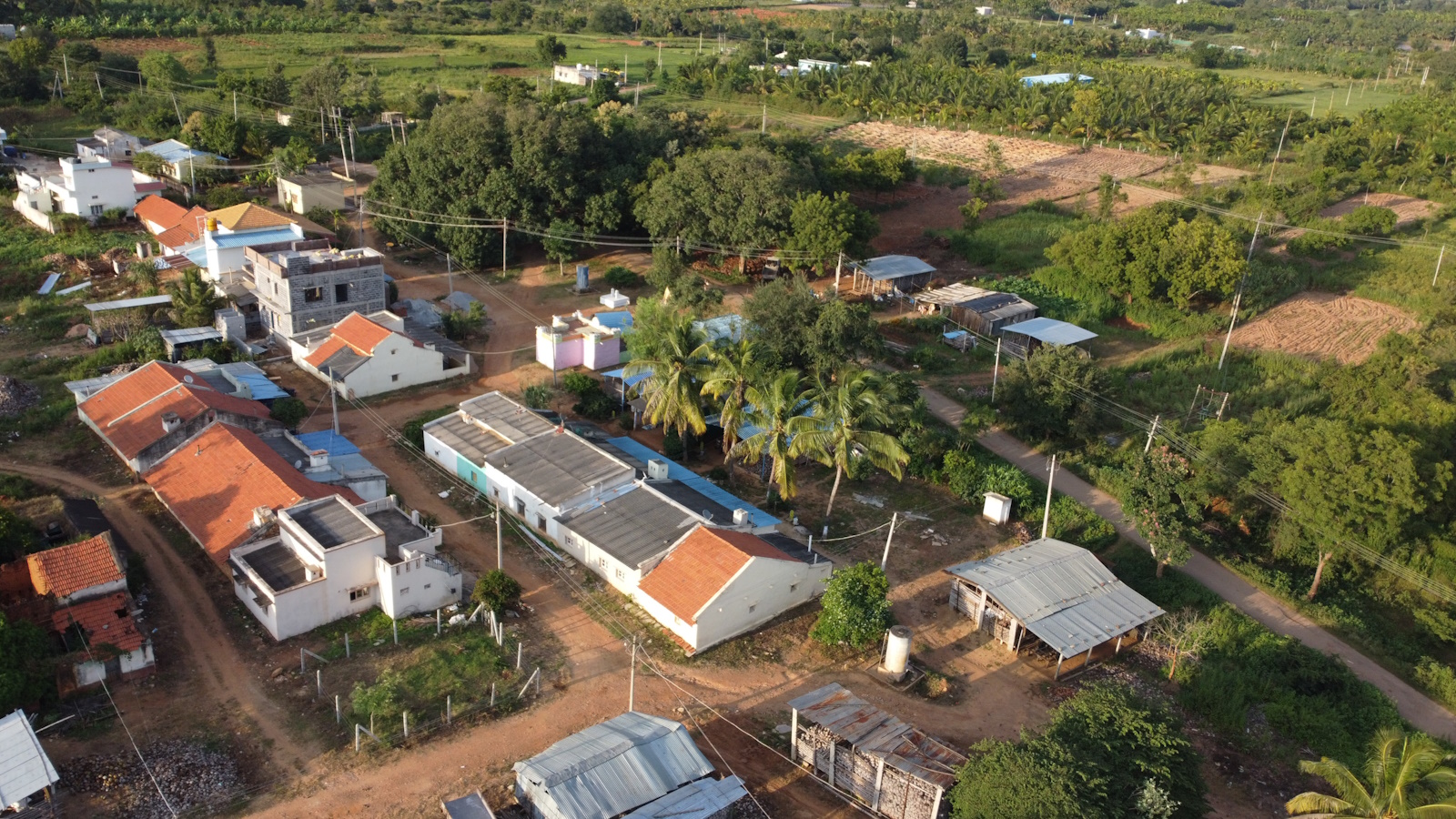
This is Bhogasandra's main junction. The straight line road goes towards Hagalavadi, the slightly curved road to the right leads to Sagasandra.

Pulling back a bit, the village Aralikatte comes into view. It's a Ficus with long curvy branches. Under it a lot of activity happens. The most important being peeling raw betel followed by cooking it. The tree looks pretty aged, hope it lives for many years to come. Talking about Aralikatte, it's an ancient custom which is fading now.

Pulling back again, more houses come into view. Most families of this village are related, it's almost like one big family.

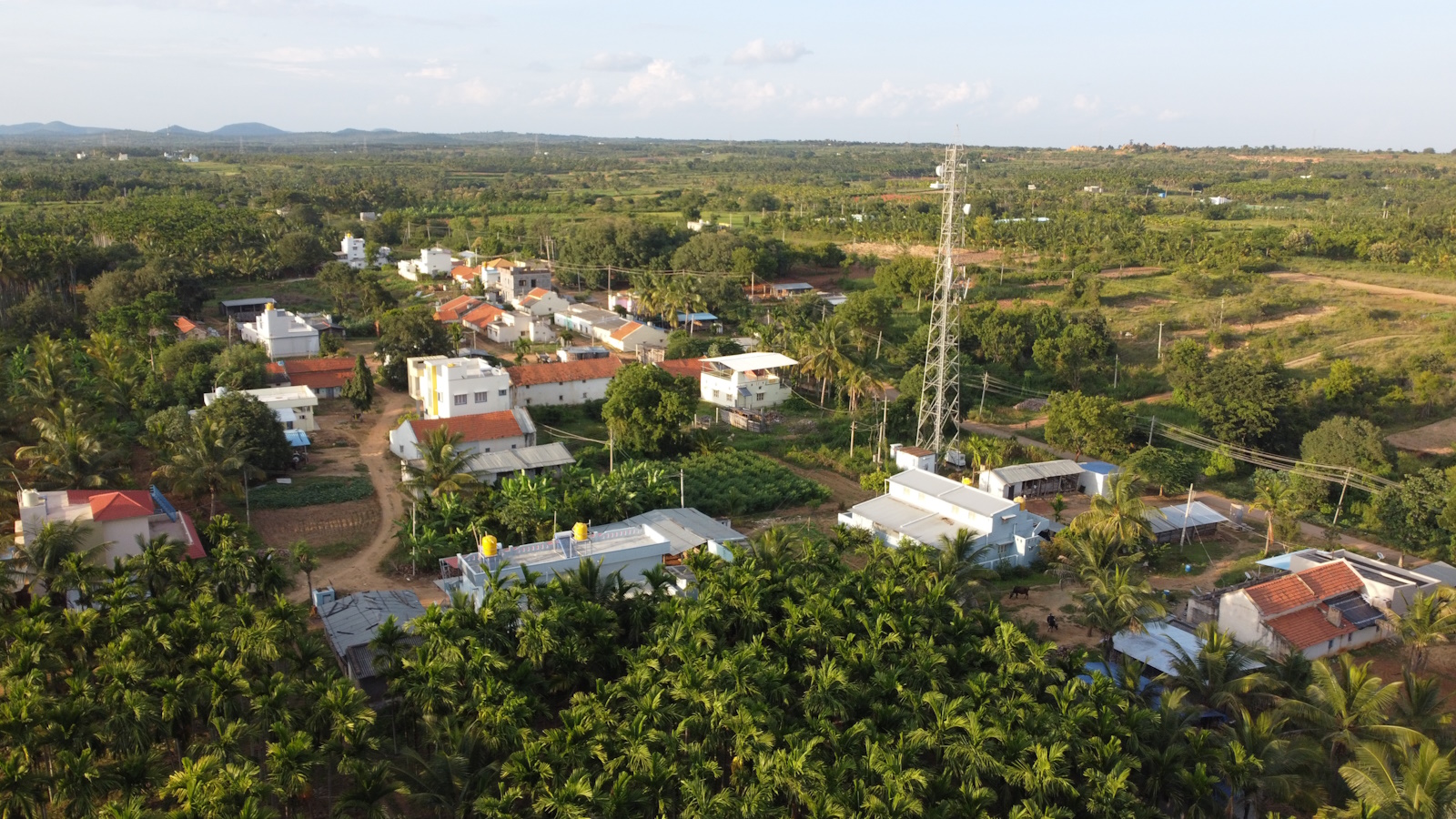
Pulling back more. The mobile tower comes into view, covering the entire village, more or less.

Turning around 150° Bhogasandra Kere comes into view. It's a manmade pond. Part of the road connecting Bhogasandra to the neighboring village Bommarasanahalli runs parallel to the lake 's embankment. On the shore is Siddalingeshwara Devastana which was renovated about two years ago. The white line on the horizon is the aqueduct of Yetthinahole Drinking Water Project.

Now, DJI Mini 2 is hovering over Aralikatte.

Srishar's farm is in the greenery on the top-right of this picture.

The little house sits in Sridhar's farm. Notice the bamboo cluster?

Turning to the west. About a kilometer from here is forest land. In fact a small stream is a marker between farmlands and forest land.

DJI Mini 2 has a flight time of 12 to 13 minutes. So I had get it back and replace the drained battery with a fully charged one and start a new flight. This time I sent it beyond Bhogasandra towards our farmer friend Basavrju's plantation. At the middle of this picture next to the little pond is Basavaraju's betel plantation. I wanted to see a little further but the navigation screen froze with a black n white. The drone and remote controller had lost touch, no communication between the two. It was a tense few minutes when the drone homed in. The 'return to home' feature saved my Mini 2. Back at home I discussed this issue with brother and found the cause. Trees were a barrier between the drone and RC. Basically, Sridhar's farm is a good 10 to 15 meters below the village ground level. With the drone at 30 meters high and 500 meters away, the trees got into the way. While flying longer distances, it's better to maintain higher altitude. We err. Then we learn.

Here's the bamboo cluster. The shoots were swaying gently in the wind. What a beautiful sight that was.

That's Bhogasandra Kere.

Overhead shots of neighboring fields.

A geometric pattern of a well prepared field.

That's Basavraj on his Bajaj Pulsar. Raju and I had ridden that bike to the edge of the forest to see a shrine called Bhutappana Gudi.

This is Sridhar's farm. Another farmer, Siddaramanna is ploughing the aisles. This is one way to control weeds. Unfortunately, two sides of this plantation are vacant and neglected lands covered with all kinds of vegetation which is a big source of weed seeds. Those seeds get thrown into this farmland and thrive.

Raju noticed a peacock. I followed it from a safe height. Judging by it's movements, the peacock was confused... where's that buzzing sound coming from. Not once it looked up but kept moving around,

Sunset seen from an height of 25 meters above the farmhouse.

Lastly a view of us- Srishar, his son, son's friend and I.

Do check out our short visit to Bhutappana Gudi.

......... 

Nov 23, 2024

Bhutappana Gudi, Bhogasandra

Sept 16th 2024. This was my third day at Sridhar's farm at Bhogasandra village. One of the resident farmers Raju turned up at the farmhouse early morning. We had a plan to visit his betelnut farm which happens to be on the other side of the village. A walk would've been great but we had to come back soon so we had to go by bike. It was a five minute ride to Raju's betelnut farm where we spent about twenty minutes. As we looked around and chatted Raju asked if I wanted to see Bhutappana Gudi. I was fine and we hopped on the bike. We were riding on dirt paths which got rougher as we went deeper towards forest land but Raju didn't let up on riding speed. Carrying a load of 160+ kilograms, Raju's Pulsar showed no sign of struggle. The ridable path ended at the base of a hillock where we parked. The tree was a stone's throw away.

Here's the tree sheltering the shrine. This tree is called Tugali Maraa in Kannada. Its Botanical name is Albizia amara , also called Mimosa amara. That's my take based on a hour long research which landed on this page. Tuggali leaves are small and dark green. It bears whitish-yellow powder puffs with long stamens and golden pollen. Tuggali Mara is a live pharmacy; its roots, leaves and flowers are used to treat several maladies including poisonous bites.

Here's the open-air teemple- Bhutappana Gudi. Basically it's a collection of naturally polished stones, probably picked up from a stream nearby. Bhogasandra people come here by walk carrying offerings and perform simple rituals.

People have tied brass bells out of Bhakti.

That's my host for the morning Basavaraju standing next to Tuggali Maraa. His Bajaj Pulsar is somewhere on the right hand side, out of frame.

These are Tuggali leaves. I think this foliage is quite new, matured recently. These leaves can be confused with many trees like Tamarind or Copper pod tree (peltophorum ferruginea) or any other tree with similar leaves. Tuggali Mara doesn't have thorns - this is to be noted.

We must've spent 15 minutes at Bhutappana Gudi. I was taking pictures and Raju had disappeared. To my call he responded that he was looking for Kaadu Bikke Hannu, a seasonal fruit relished by kids and elders alike, even peacocks love it. Bikke Hannu is a fruit of Gardenia latifolia family. Raju couldn't find any since the season was almost done. Perhaps had we moved deeper into the woods, we might've found some. The fruit has thick skin, inside is brown pulp which can be eaten raw. Several videos show up if you search on YouTube.

That's our man- Raju. He's an expert coconut peeler. I've seen him in action. He can dehusk a coconut in 8 seconds. Not just that, he can maintain that pace for hours. One of the other famers told me that he has peeled 3000 coconuts in a day!

Here's a Bikke Hannu tree, a small tree though.

We are on the slope of this hillock. Raju asked if I wanted to explore deeper. I declined, several reasons behind it. This is off our plan. Sun was rising and blazing, we weren't carrying water. We were hungry and supposed to be picking up Ragi Rotti from Raju's home and have it with Sridhar. And last of all, I'd worn a flip-flop. We dropped the idea.

That's the neighboring hill. In the valley between the two hills flows a stream. 

We started our return journey. About a kilometer from Bhutappana Gudi is this smaller stream which feels like an oasis. We stopped for a couple of minutes to shoot pictures. This spot is good for a picnic. Perhaps, next visit we could spend a few hours here.

Bhutappana Gudi is on the other side of this stream. In fact this stream marks the border between farmlands and forest land.

That's Raju on his Pulsar.

We passed by Raju's plantation. Let me talk about it now. Raju's betelnut trees were just two years old but to my eyes they seemed like four. The plantation was almost weed free and the trees were rooted into 4 feet deep pits. The pits will be filled in gradually as the trees grow taller. That's Raju and a neighboring plantation owner.

That's Raju's rocket.

We headed back to the village, picked up Ragi Rotti & Chatni from Raju's home and reached Sridhar's farm by 9-30. All three of us famished, we attacked the box without any delay.

The following post will be dedicated to a few aerial shots of Bhogasandra farmlands, do check it out.

.........