Showing posts with label Anegundi. Show all posts

May 24, 2025

Chintamani temple complex, part-2

...continued from Chintamani temple complex, part-1.

The first half of Chintamani temple complex comprises of Kashi Paduke shrine, Rudrakshi Matha and  Lakshmi Narasimha Devastana among other minor shrines. Shrines of this complex are all ancient and most of them are active. After the morning rituals these shrines remain closed until the following day unless it's a festive day or when there's a request for a special pooja. Now we are well past the half way point of the complex. Here's an unnamed temple..

The boulders mark the arrival of the natural rock shelter which is connected to Rama.

I guess this mantapa was made for pilgrims' convenience. Just imagine this place a few hundred years ago.. a group camping in this lodge on the river bank, a makeshift kitchen, washed clothes hanging between pillars, mats spread on the floor, people resting and chatting while kids are scampering around.

Stepping out of the mantapa, we reach the most revered spot of Chintamani. The two blocks seen on the rock are Rama Padha ~ Rama's feet. Some say that this is the spot from where Rama aimed and shot an arrow at Vali the king of Kishkinda.

Next to Rama Padha is an engraved image of a bow & arrow points the direction in which the arrow went. Of these two Padha, the one on the left seems to be ancient while the one on right is relatively new. The new Padha is made of marble and has a lot of details carved into them. Also there's an inscription n Kannada.

The feet has embossed and engraved images depicting humanoids, serpents, sun, stars, geometric figures and other religious symbols. The Kannada inscription's transcription: ವನವಾಸದ ದಾರಿಯಲ್ಲಿ ಇರುವ ಅನೇಕ ತೀರ್ಥಕ್ಷೇತ್ರಗಳ ಪಾವನ ಧೂಳಿಯಿಂದೊಡಗೂಡಿದ ಶ್ರೀ ರಾಮನ ಚರಣಾರವಿಂದದ ಪೂಜೆ ದರ್ಶನಗಳು ಜಗತ್ತಿನ ಎಲ್ಲ ತೀರ್ಥಕ್ಷೇತ್ರಗಳ ಪುಣ್ಯವನ್ನು ನೀಡುತ್ತವೆಂದು ಶಾಸನಗಳು ಸಾರಿವೆ.

Right besides Rama's feet is the natural rock shelter. At the entrance of the cave is a memorial stone honoring a couple. They don't seem to be warriors, rather they look like a married couple. Going by the look of the stone, it seems to be of Viajayanagara times.

That's Sridhar posing at the cave's mouth.

During my first visit here i.e. in July 2012, a local guy accompanying us told that Rama did penance here after slaying Vali. However, now people say that this is the place of Sugreeva and Rama's first meeting. That colorful painting wasn't there in 2012. Looks like it was made when Anajanadri Betta became popular and tourists started visiting in large numbers.

Our little guide looks at the painting of the meeting of Rama, Lakshmana, Hanuman, Sugreeva and Jambavan. Whoever painted it has created a master piece. I hope the artist maintain the painting since it is bound to fade with time.

That's the cave's mouth. This place is peaceful and quite cool even in hot summers.

The temple and mantapa next to the Rama-Sugreeva cave. It's the same one seen in previous pictures. This place gives a great view of Tungabhadra. I must visit this place during the months of August-September. That's when monsoon fills up the dam at Hospete and water is let out.

Having done with the temple complex, we descend into the river path and look back at the complex. Usually at this time of the year, gates at the dam are shut barring one or two gates to feed irrigational canals. Close by a group of women from Anegundi were washing clothes. We chose a spot to sit and wet our feet. Cool water is so soothing after walking around in blazing sunlight. Also the gurgling sounds of water flowing through rocks was music.

Another ancient mantapa, surely built during Viajayanagara times. It looks nice from here but the inside is untidy, littered with plastic bottles and clothes. Wish our people learn the basics of public etiquette. 

Turning to the right we can see Rudrakshi Matha.

Back at the complex entrance, Sridhar, I and our guide had sugarcane juice. It felt very refreshing and energized, ready to continue the tour of the day. Our next destination was Malyavanta Raghunatha Devastana.

.........

May 17, 2025

Chintamani temple complex, part-1

Dec 10, 2024. The day started with an early trek up Anjanadri Betta. Considered as the birthplace of Hanuman, Anjanadri hill is situated 3.5 km from Anegundi entrance. After spending 30 minutes at the hilltop and getting a relaxed darshan of Anjanadevi, we descended and had good breakfast of idli and paddu at a bandi eatery. Then we headed to Pampa Sarovara, the natural spring pond nestled in the slopes of Rishimukha Betta. It is beleived that Rama & Lakshmana had bathed at Pampa Sarovara during their stay at Kishkinda. The place is also connected to Shabari, and also known for Sri Vijayalakshmi Devastana. Then we headed to Anegundi with a sole objective of visiting Chintamani. Anegundi is an ancient fortified town situated on the left bank of Tungabhadra at the point where the river turns northwards. Here we stand at the gateway to the place. Take left to go to enter the river, and take right to enter Chinatamni temple complex.

The temple complex is an elongated premises consisting of temples and mantapas mostly built on the rocky shore. Straight ahead is the small structure named Ishwara Kashi Paduke, Further ahead is the multistoried structure of Rudrakshi Matha.

Also, there's a small structure on the boulder on the right hand side.

A board planted by Karnataka Tourism department describes this complex as follows:
The Chintamani temple complex is located in the southeast corner of Anegundi. According to the local legends, it is believed to have been established by a sage in the late 15th century, during the reign of Tirumalaraya. The tradition of matha (monastery) was ancient. The River Tungabhadra turns from the south to the north at this point, marking it as a sacred spot for many pilgrims. The Rudraksha Mantapa, Lakshmi Narasimha Temple and the Ganesha temple are prominent temples of this complex. There is a pedestal in the middle part of the garbhagriha and a carving of the Shivalinga on the lintel of the entrance. There are three arch carvings on the mantapa constructed with stucco. The mantapa is erected on square-shaped pillars. Nearly a one-foot height sculpture of a devotee with folded hands (Anjali Hasta) is found in front of the matha along the shore of the river. The terrace is lined with fertility stones - these have carvings of Nagashilpa (cobras in relief). There is a cave nearby which might have been a place of penance for the ancient sages. Further from this terrace is the Rama Pada, where footprints, said to be of Rama, are engraved in stone - this marks the spot from where he hid behind a tree and killed Vali. Further ahead is a cave, which is believed to be the first meeting spot of Rama and Anjaneya.

Side view of Rudrakshi Matha.

The arched gateway of Chintamani complex from Ishwara Kashi Paduke temple. All shrines of this complex face east and the river too.

The simple shrine with an open pillared hall on three sides.

The deity of this temple is a pair of feet, Paduke. Going by the name of the shrine these feet are Ishwara's.

Chintamani gateway, Ishwara Kasi Paduke and the little shrine atop the rock. Notice the window in the Paduke shrine's wall which gives a view of the river.

Here's the staircase connecting the river and Rudrakshi Matha. As I know during a good rainy season, the river swells raising the water level right upto the staircase here.

This is Rudrakshi Matha. As you see the structure has three levels- ground, first and second. The staircases on either sides of the building lead straight to the second floor, to the level where the Rudrakshi Mantapa is housed.

A unique temple indeed.

This is the Rudrakshi Mantapa. Long strings of Rudraksha are wound around the pillars and lintel beams. In the Hindu religious tradition Rudraksha symbolizes spiritual alignment, resonates with positive energy, and promote spiritual development. Inside the Mantapa are idols of Shiva Linga, Ganesha and Annapurneshwari. I regret not inquiring about the mantapa, must do it during my next visit.

The open space and pillared hall offers ample space for at least a couple of hundred people.

A splendid sight from Rudrakshi Matha.. Tungabhadra and Tara hill. The pillared hall sitting in the river is believed to be built in memory of the most popular king of Vijayanagara, Krishnadevaraya. It has 64 pillars set in a 8x8 matrix. It is said that Krishnadevaraya had mastered sixty four subjects required to be become an effective ruler.

Panning to the left.. Ishwara Kasi Paduke shrine comes into view.

This little structure is the highest point of Chintamani complex. Through it's narrow doorway one can see there's a platform. It seems to be a temple.

Moving on, we go deeper into the complex. This must be Sri Lakshminarasimha Devastana.

An ancient Brindavana. I guess all these temples are active, probably rituals are performed every morning, and surely there would be special rituals on festive days.

The path continues.. more temples to be seen. However names and histories of many of these temples are unknown. Perhaps, during my next visit I must make inquiries in Anegundi village.

Chintamani must be a bustling place during Vijayanagara times. This place with flowing water is an ideal place to perform rituals and ceremonies for deceased relatives. Of course, rituals for happy occasions would also be performed.

Here's a collection of Nagashilpa i.e. fertility stones. Maybe these are donations of people who wished for progeny or continuation of their lineage in the future.

There's more to see here. This article will continue in Chintamani temple complex, part-2.

......... 
Mar 10, 2018

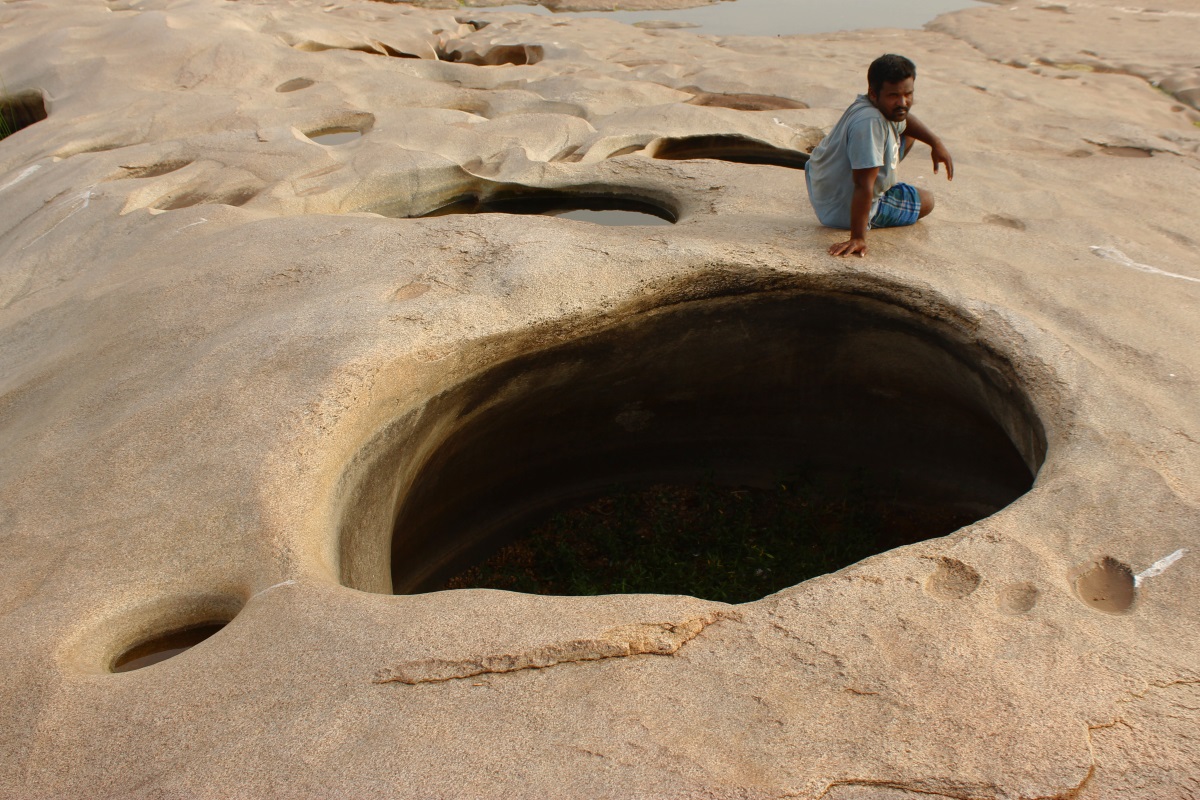
wavy rocks of Tungabhadra, Anegundi

August 14, 2017
The last item for the day was Nava Brindavana. Normally at this time of the year the river would be flowing and a trip to the holy spot would involve a boat ride from Anegundi or Hampi. However this year with less rainfall, water was being stocked at TB Dam and there was hardly any flowing water few days back. Our guide Thimma from Anegundi village said dam authorities released water 2 or 3 days back, we were lucky to be seeing flowing water. Water wasn't deep enough for boats, so we will be going by foot. From Anegundi, would be a 600 meters trek on the riverbed.

The path has three landmarks- first we pass by Sri Krishnadeveraya's tomb, then a big rock bed on which is Suryanarayana temple and a dolmen. Next comes the second rockbed which has is silvery white color. More than the color its surface is breathtaking.. like sea waves.

The sight is amazingly beautiful. It was around 5 PM, sun was still high. Wonder how it looks when Sun is low, say 7 in the morning. The golden red rays would have a magical effect.

In bird's eye view the rock is an obtuse triangle, about 120 meters at its longest and 40 meters at its widest. Treading barefoot on this surface was a new experience for me.. smooth, slippery and piercing.

This is the first time I'm seeing such a surface, makes me wonder how this was formed. Obviously water movement but there are so many places where water has sculpted rocks but nothing quite like this. Besides waves there are deep grooves too. Simply amazing!

The grooves are parallel, flowing in one direction. Was it sand-water mixture that  carved these grooves and polished these surfaces?

Then there are pits too. Is this stone softer compared to other stones? The color of this stone reminds me of Mudgal granite. Mudgal is a historic village in Raichur district. The stone is covered with horizontal lines, as thought lot of rectangular blocks were joined together.

The largest pit of this rock. The pit's bottom wider than its mouth. The pit's bottom was sandy. I guess the bottom is not flat but curved, like a bowl. Oh the creations of Nature.

In this view, the ridges' are darker, brownish. This reminds me of Google Terrain map.

Pair of grooves form a row of teeth.

It would be interesting to see water flowing on this rock.. graceful turns and twists, creating its own ragas. Imagine the sight in moonlight.. it would be mesmerizing.

A row of similar shaped pits. Next time when I'm in Anegundi, I'll shoot these stones in all possible light. If possible I'll plan a trip during full moon.

Hampi and Anegundi, Hope to see you soon again.

.........

Jan 6, 2018

Kallagasi, Anegundi

August 14, 2017
The second morning at Anegundi I went for a short drive and walk while Pushpa got ready at the home-stay. Barely 300 meters from Anegundi village entrance, I saw this ancient stone structure. A simple mantapa. What seems like a mantapa could be a temple gateway.
A stone sign calls this structure as Kallagasi. Kallu means stone in Kannada. No idea what Gasi means. Actually there are two structures here, one is the mantapa and the other is the door frame in the front.

Also, notice the image of Gajalaxmi on the door frame. Normally Gajalaxmi is present on entrances. So, this could be a gateway to a temple ..but there's no temple in the vicinity. Perhaps next time when I'm here, I'll explore the area beyond the coconut trees.

A closer look at Gajalaxmi.

 The Mantapa is has eight columns of two types, four of each type. Of the farthest columns, the left side one seems incompletely done. Looks like work was abandoned before completion.

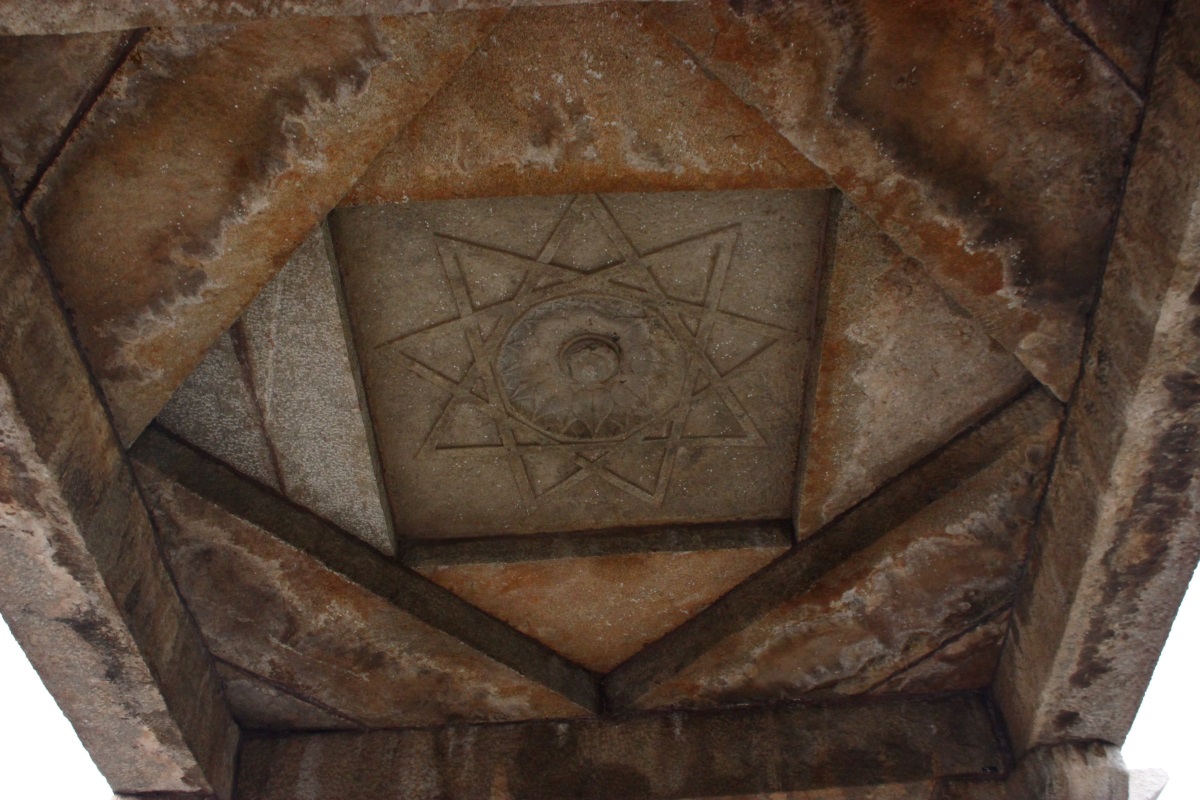
Taking a peek at the mantapa roof which comprises of four layers. At the ceiling center is beautiful nine-pointed star with a lotus in full bloom. This definitely is not a simple mantapa, there was something grand planned which never saw came into being.

Taking a closer look at the star and lotus. The sharp lines / angles and the precision of the work is truly amazing. Wish I'd taken a shot standing directly below it. The precision would be better pronounced in that view.

Truly, our ancient builders and sculptures were extraordinary beings. Simple life, high thinking and amazing deeds.

Right opposite Kallagasi is this palm, peaceful looking isn't it? In the background is a rock hill named Ginger hill. A local mentioned that ancient people known as Ginger lived on this hill hence the name. It seems there are ruins of ancient houses. Something very interesting ..another reason to come back here.

Palms are among my favorites. As a child I'd dreamed of living in a desert growing date palm :)

Anegundi . see you again.
.........