...continued from the ancient temples of Hooli part-1
In the previous part we covered Panchalingeshwara Devastana and Nandikeshwara Devastana. Now are are looking at three more shrines and a Dargah. I don't remember going near the Dargah but it seems like it was a temple originally.
On the way to the shrines we passed by this stepped water tank which was fed by an underground pipeline. I'm guessing this water tank is relatively new, probably made during the Maratha rule. around 500 years ago.

Ningappa wanted me to see this water spout shaped like a cow's head. The tank floor was thick with bushes, many thorny ones but that didn't deter Ningappa. He just went down and moved the long slender branches so that I can get this shot. Isn't it a beautiful creation. This reminds me of the elephant head sculpture inside a water tank at Gajendragad fort. I wish every taluq had a archaeological department responsible for monuments in that taluq. We have countless numbers of ancient monuments, maintaining them would have a positive effect on the younger generation, they are bound to feel good about our heritage.

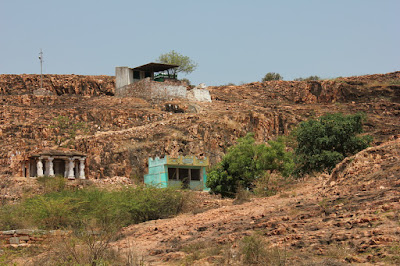
Of the three temples, one is ancient. Sadly the stone pillars have been coated with lime which is harmful to stone. Hope in these ten years, the lime has been washed off. On the bigger of the green painted temple is called Shri Guru Siddananjeshwara Gudi. These shrines are ancient but the structures are new.

The temple is situated near a shallow cleft. On the rock formation are white marks which are caused by flowing water. This is one of the many waterfall spots of this hill range. After a good long rainfall, this spot would transform itself into a piece of paradise.
As seen from the unknown temple. The smooth stretch of slope leads to the fort. The stretch was covered with tractor tire skid marks.

Tractors with trailers are driven up here to haul stone from the fort ruins. No one to stop such people because the fort doesn't belongs to no one in particular. Do anything you want with public property - no one cares but a few people like us.

This is a collage of two photos merged into a collage with an attempt to show how the positions of the temples. Most temples on the slopes are seen here. The three shrines seen earlier are out of view in this picture. #1 is Nandikeshwara Devastana, #2 Banashankari Devastana, #3 unknown, #4 unknown, #5 Dakshina Kashi temple complex, #6 unknown and #7 Maralu Siddeshwara Devastana.
This is Banashankari temple. Its an ancient shrine with heavy makeup... lime, distemper, oil paint! People must realize that makeup is required only for cement plastered walls, stones are better off naturally. Anyway, the temple premises was clean and tidy. The big Ficus next to this temple was home to monkeys. The temple has lot of open space around it (see inset) which is used by village folk to sun dry their agricultural produce. And also for the temple fair.
These are temples #3 (right side) and #4 (left side), are east-facing. Temple #4 is in better condition. Temple #3 was a gambling and drinking den.

Nangappa on temple #4 steps flanked by balustrades which have been broken. Just like Nandikeshwara temple, parts of the roof are missing here. I can't remember if daily rituals were performed.

This piece of sculpture was found near Banashankari Devastana. I feel this belongs to temple #4, it's a part of the wall behind the backrest. This piece has three panels- a young woman, three identical pillars and a flower vase. Below the panels is a strip of flowers and at the base is a series of elephants.

A view through the main entrance. If I'm not mistaken this temple has a Sabha Mantapa, Natya Mantapa, Antharala and Garbhagudi. The space seen here between the entrance and the grand door frame is Sabha Mantapa, the meeting hall. The door seen here connects to the Natya Mantapa, the dance hall. Further inside is the vestibule which connects the Natya Mantapa and Garbhagudi. Sadly I didn't take closeups of the doorframe.

This is the I feel this temple was worth restoring. In fact Ningappa had mentioned that ASI had plans of restoring all temples and if that happened houses of the village needed to be relocated. However, the village is as it is. Going by Google Maps imagery temple #3 seems to be restored.

This is the exterior of temple #3. The Nritya Mantapa floor had been damaged badly by treasure hunters. I think this temple has two or three sanctums.

This highly detailed sculpture is fixed over a passage to one of the Garbhagudis. Ningappa had urged me to see this temple for the sake of this sculpture.

From the twin temples, we go to Dakshina Kashi temple complex, also called Kashi Vishwanatha group of temples, marked as #5. The temple complex is situated right next to the pond. The complex has three or four temples which seem to be of the built more or less the same time as Nandikeshwara or Panchalingeshwara temples.

This is a stepped gateway connecting the temple complex and the water pond. This is for the devotees to bathe in the pond and enter the complex to perform rituals. During our visit water level was low, hence it wasn't right up to the steps of the gateway.

While at Hooli fort Ningappa had suggested we visit Varavi Siddeshwara Kolla. Had we gone by foot, we had to walk 5 km one way. I regret disapproving the idea. Instead I opted to go by car, a 15 km drive one way. May be I'll plan a trip to Hooli, catch up with Ningappa and go for a trek. Because of the plan we decided to cut short Hooli trip. This is another temple in ruins we saw on the way back to the village. If there's a basket of places which had gained prominence during the Chalukyan times, Hooli would be in that basket.
Before we left Hooli, Ningappa took me to a
potters studio. The potter family made water pots, decorative pots & vases and stoves as well. After a short stay we decided to move on to
Varavi Siddeshwara.
.........


