Apr 23, 2022

Sri Siddeshwara Vibhuti Gavi, Gudikotabagi

This cave shrine was discovered while exploring places around Kittur on Google Maps some time Feb 2022. The place listing had one photo of a person standing at the cave's mouth. Since there was no other photo, I was curious about the cave. I planned to visit this cave during a visit to Vakkund. A trip did take place to Vakkund on Feb 16th, the temples I was supposed to see were inaccessible because the site was an island in the waters of Malaprabha river. I would have to make another trip by the end of March by when the water level would drop and the temples would be reachable by foot. So the rest of the morning was spent seeing Ramlingeshwara Devastana at Bailhongal, then back to Dharwad. I started planning the trip to Vakkund in first week April.

April 16, 2022. I left hone by 7-15 and reached Vakkund by 8-45 am. I spent 2 hours seeing & taking pictures of the 3 temples on the hillock. By 11-15 I left Vakkund and headed towards Belavadi. A few kilometers after crossing Malaprabha, at a place called Kenganur I turned towards Sangollli - the village of the legendary Sangolli Rayanna. The terrain got interesting, twisty roads on small hill ranges. A few kilometers after Sangolli, at a cross roads, I turned towards Kalabhavi. The road were interior, hardly any travelers to ask for directions. At Kalabhavi village, I turned towards Gudikotbagi village. This road linking two villages had some traffic, very unexpected for an interior road. Somewhere on this road was the dirt track leading to the Gavi Siddeshwara. A shepherd gave me clear instructions following which I reached the cave easily. That's the mouth of the cave. This spot is at least a kilometer away from the main road and no other soul to be seen.

It was warm, sultry and humid. I parked my car under the Peepul tree close to the mouth of the cave. Some flying insects added to the discomfort caused by the weather. From the looks of the place, I felt this cave was occupied by a person or persons a few years ago.

The cave is a manmade one since this is a source of Vibhuti. The white seen on the walls and floor of the cave is Vibhuti - the reason behind the importance of this cave.

I was cautious while entering... the innards of the cave were dark, a wild animal could be resting inside. I stepped in slowly, trying to be very alert... remembering the experience at Talewadi cave where a mild growl was heard as four of us entered a much larger cave. Talewadi cave has no religious significance to it. As per locals, one has to be careful while entering the cave because it could be occupied by any of the wild beasts like bear, leopard or tiger.

I descended the steps into the cave floor, barefoot. The floor felt soft which is an effect of layer of Vibhuti. This cave has no particular form, people have hacked into the walls & floors randomly in search of the sacred powder.

One of the inner chambers was in shadow, couldn't see anything inside which kept the suspense factor alive. A bear could be asleep inside.. may be no creature ever slept in here. Anyway... isn't it wonderful to be seeing a natural source of Vibhuti. This reminds me of Vibhuti Gavi in the jungles of Ulavi. I've just heard of it but haven't seen it. Of the five caves of Ulavi, I've been to Akala Gavi and Pachalinga Gavi.

A shrine dedicated to the wooden slippers of ascetics who lived here. I feel people flock to this cave on occasions like Mahashivaratri and Amavasya.

Another chamber where Vibhuti seems to be of higher quality. I was imagining how people with pickaxes hacked into the walls and stuffed bags to take it away to their homes or temples.

Mouth of the cave as seen from the cave's belly. In here there's hardly any movement in the air. Despite lack of sunshine, it was warm.

The presence of a cot, an oil lamp box, wooden seats and other things indicate this place was occupied by an ascetic or ascetics. A collapsed single room structure close to the cave's entrance might have been a kitchen & store room. As to water, I think the nearest source is the pond at the base of the hill, or may be a stream close by. BTW, about a 100 meters from here is a government water tank on this hill which is a landmark for those coming in search of this place.

Close to the cot there are two arched niches. The arches have been hacked very carefully, creating this lovely looking pattern of parallel arcs.

Another pattern formed in the process of mining Vibhuti. I think hard stone remains concealed behind the white layer.

This is one of the side walls of the cave's mouth... Vibhuti and igneous rock intersect here. The yellow-red stone seen here can be seen on this hill range. I think this rock is rich in iron hence the oxidized yellow layers.

The arched entrance, the coarse walls and the rough-cut stone steps create a beautiful scene.

Wish I could find more about this place... how old is this cave? who made it? was this cave made by one person or more than one person? was this cave ever used by freedom fighters to escape British law? why is this cave in the state of abandon now? Hope to get answers during my next journey towards Gudikotabagi.

That's the peepul tree, it could be 7 to 8 years old. I feel this place should be protected by local people so that it's sanctity remains unblemished. Hoping some local leader takes interest in maintaining this unique cave.

A partly dry leaf caught my eye.. while most of the leaf is crispy dry, few portions is still wet. The beauty of the leaf is its yellow-beige color combination.

This is the open space which extends from the cave's mouth. The path going uphill meets a larger dirt track, left goes uphill and right downhill towards the main road connecting Kalabhavi and Gudikotabagi.

While on the subject of caves, I would like to close this post with a mention of the rock-cut cave of Amminabavi near Dharwad. This cave is situated in a Rudrabhoomi (graveyard), it is said that a single person hacked the subterranean laterite rock. The cave temple seems as though it was made by an expert in building, such is the quality of the work. Its also a place worth a visit.

.........

Apr 16, 2022

Hubballi Railway Museum, chapter-2

...continued from Hubballi Railway Museum, chapter-1.

In the first part we had covered approximately half the exhibits which includes the two locomotives, a passenger wagon, a goods wagon, water tank wagon, semaphore signaling system and Malaprabha cottage. The cottage building itself is an antique, probably built in the 1950s. Inside the cottage are railway theme artworks, station master's office, ticket booking office, goods booking office, passenger waiting room furniture, railway tools & instruments, communication equipment, safety equipment, and other items. Most of the items are labeled and also there are several infographics. This is the tiled roof cottage in its original livery, only the paved courtyard is a modern touch.

Right besides Malaprabha cottage is a collection of railway axles & wheels. Two axles with spoked wheels belonged to steam locos while the rest are diesel loco axles. There's one with a gear wheel in the middle, that would a mountain railway coach axle.

A small collection of spoked wheels, all belonged to steam locos or stem powered cranes. In the background is an airconditioned coach, the types seen on rails even to this day.

The next item is a "track survey push trolley." I remember seeing this little trolley being pushed by two or three people while two technicians carried out track inspection. Few years later these trolleys came with a propelling system with two levers which was operated by two men. With the new system the men didn't have to run after the trolley, instead they could ride it as they operated the levers. My wish to ride one of these trolleys still remains a wish.

The next item is a mini platform with two coaches. What seems to be two airconditioned coaches are special coaches. One is a theater coach and the other is a restaurant coach. Unfortunately both were locked and even their windows had dark tints, we couldn't see the inside of them. 

From my railway journeys, I remember seeing a kitchen car in Grant Trunk Express which ran between Chennai and New Delhi in the 70s and may be 80s too. That was the first train I saw which had vestibules between bogies. The journey lasted 2 nights & a day. The restaurant car was always busy, cooks and their helpers working on the orders. The kitchen car was the only bogie where stoves were permitted. Later the kitchen car made way for the pantry car. Presently most regular trains do not have pantry cars, I guess the Palace on Wheels are an exception they might have kitchen or panty cars.

Coming to the theatre coach, it must be a part of the touring train item. Ah, this reminds me of touring talkies.

From the station platform we come towards Ghataprabha cottage. Before we enter the cottage we decided to check out the exhibits placed in the open space here. The largest item was an undercarriage. An undercarriage is an assembly of frames, levers, axles, and brake subassemblies. Every railway wagon & coach has two undercarriages. Undercarriages come in different sizes and types depending on the application.

The next important item in railway safety. This device made sure that signals and points are interlocked with each other. I guess these are obsolete since the advent of electronic & digital systems.

This is a railway ticket printing machine. This machine was used until 80s or early 90s to print cardboard tickets. At some point of time cardboard tickets were phased out on the introduction of newer type which was compatible with digital printers. Now most tickets are booked online, use of printed tickets has reduced drastically.

The next item is brass name plates. One of the walls has a collection of nameplates of railway wagon builders between 1901 and 1943. The collection includes brands from England, Hungary, India and USA. Every manufacturer has a unique identity, lot of thoughts & efforts behind the design. In the case below are items relating to rescue teams... brass water containers, medical kits and other stuff.

Here's a collage of closeups of four nameplates.

The three arched doorways emphasize the antiquity of the building.

A 60s radio, Emblem of Mysore State, Emblem of Dolphur State Railway and Scindia State Railway. The Mysore State emblem is made of aluminum, it was cast at the Central Workshop Mysore approximately 50 years ago for the Maharaja's carriage.

Next we have a machine which is very important for all workplaces, its a machine that monitor's employee attendance- Time Punching Machine. On the right is a card holding slot board. The card punching machine is connected to a clock, every employee entering/exiting the premises has to time-stamp his/her card for the day. This data is sent to the human resources department who would process the employee's leaves & salary information. In the present age, mechanical time punching device has been replaced by digital devices which function on employees' biometric info. With this we were done with Ghataprabha cottage and ready to step out for fresh air.

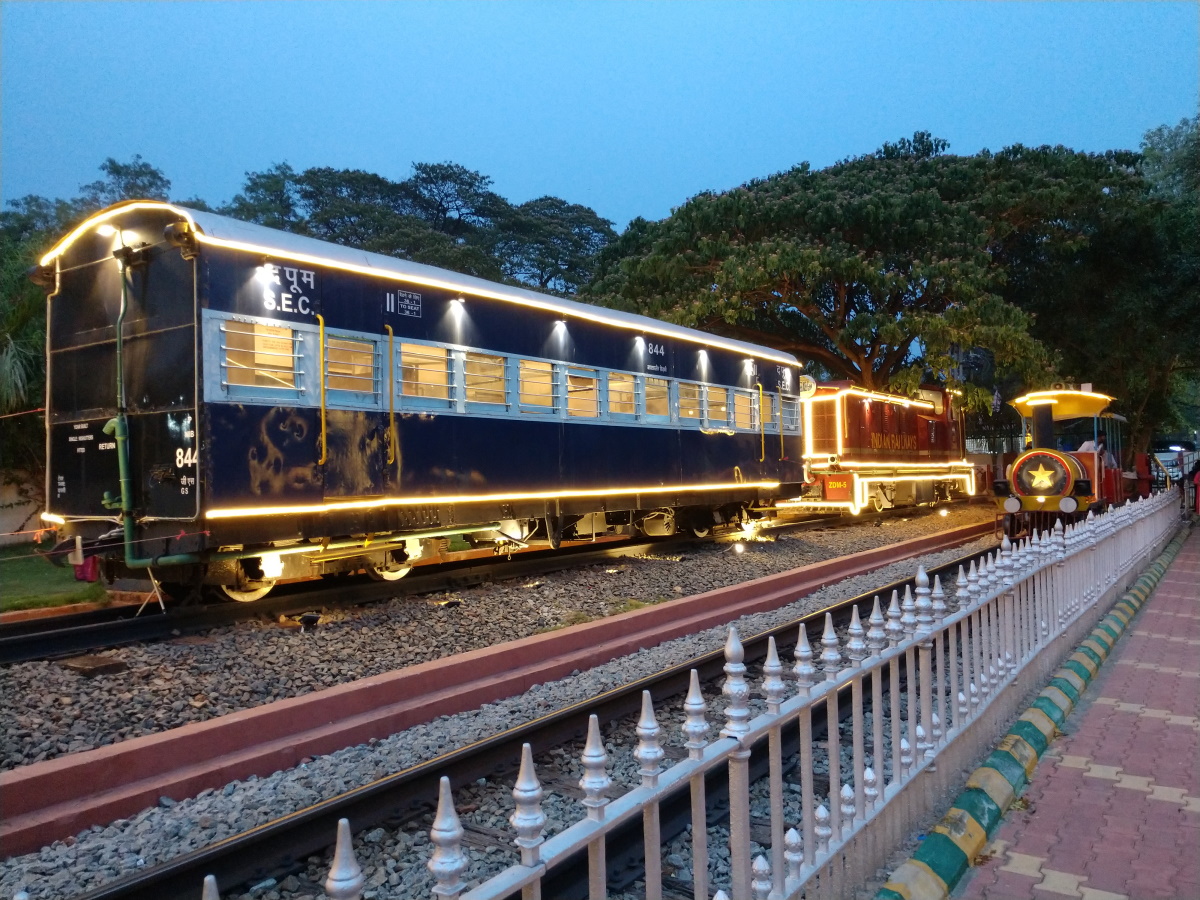
After seeing all the artifacts I was curious if there was a souvenir shop here. I checked with one of the staff members. Apparently the souvenir shop shut down because of lack of sales. I asked if there was an online store. No. Well, it would've been nice to buy a book or painting for memory sake. The museum also had a cafe, again it had shut shop. I'd read there was a children's play area but I don't remember seeing one. One thing I expected to see was a miniature train set. Again a no. Well, seems like this railway museum has a tight budget. Anyway, let this be maintained as it is. While we rested, sun had set, the evening lights had been turned on. We went around taking another look. Here's the Jumbo TC :)

The toy train was busy giving joyrides. The lighting idea is interesting, surely an effective way to attract visitors.

The passenger coach and the classic grill work of Indian Railways.

The lit-up diesel loco. Even the wheels have been outlined. People would love to take selfies with such objects.

The station platform, restaurant coach and theater coach. One has to appreciate the efforts of the team maintaining this little museum. We were done with our tour and mosquitoes had started their shift. We decided to leave.

Last picture of the evening was at the entrance. This is another piece of art. 

The museum is open from Tuesday to Sunday, weekly off is Monday. You can visit it any time between 1 PM and 7 PM. It closes at 8 PM on Sundays and public holidays. Do check it out once, the tour will be educational.

.........