July 17, 2022
This was our first vacation together since we moved into our new home at Dharwad. Our plan was to visit Badami, Pattadakal, Mahakoota, Shivayogi Mandir, Aihole and Siddanakolla. Pushpa hadn't visited any of these historical places and also wanted a break from her work, hence this trip. We left Dharwad around 5-30 am, reached Badami Caves by 8-30 am. Having spent 3½ hours we saw the caves, Yellamma Gudi, Agastya Theerta, north fort & its temples, and the museum. We left Badami around 12-30, went to Mahakoota where we spent about 30 minutes and then reached Shivayogi Mandir around 1-15 pm. This is the main entrance of Shivayogi Mandir premises.
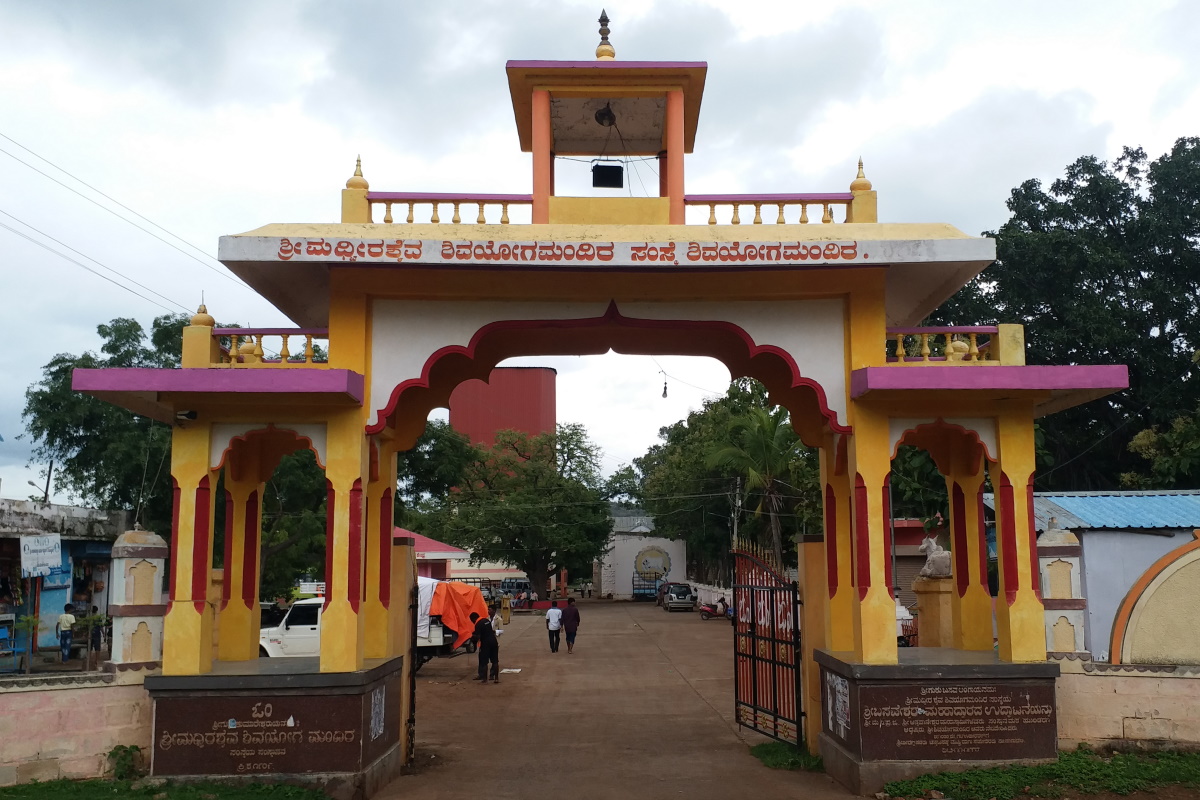
Shivayogi Mandir is situated on the left bank of river Malaprabha. It was established in the year 1909 to protect local breed cows. Today Shivayogi Mandir is better known as an institute which trains Matadipathis i.e. Lingayath and Veerashaiva monastery heads. The institute's library is unique as it possesses Talegari Shasana (scriptures written on palm leaves). It is also known for its Ayurvedic hospital and Vibhuti manufacturing center. Shivayogi Mandir Jatre is very popular and attended by thousands of people to see its Theru (tall wooden chariot). Last but not the least, like almost every Lingayath / Veerashaiva monastery, Shivayogi Mandir also conducts Anna Dasoha.
As we parked the car inside the campus, we realized it was Anna Dasoha time. After the hectic time at Badami we were famished, we decided to partake Prasada first and then go around the monastery. It was a satisfying meal of rice and sambar. Adjoining the lunch hall is the cowpen and the Vibhuti factory. We took a quick look into the cowpen, only Jawari Aakala were present. Cow dung & urine are collected and sent next door to the factory to produce Vihuti.

The Vihuti factory runs on women-power. As I understood local women are employed here, they handle all stages of the process. This heap of dark powdery material is dried & burnt cow dung ash. This ash is stored in a special container for 3 days before bringing it here. In the background mud pots are seen, water is stored in them probably to maintain the water at a certain temperature.

The processed ash and water are mixed well to form a thick paste. The ash paste is pressed into small blocks using a hand powered press.

The blocks are then finished by hand with the aide of a wooden table and spoon like device seen here. The dark colored hexagonal prism shaped blocks are set aside for 24 hours to set & dry. Next the blocks are burnt in a kiln. The heat treatment transforms the color to white which means Vibhuti is ready. As I understand, small and big Vihuti are made and sold to public. Probably larger blocks are made and supplied to temples and matas. There's an exclusive sale counter. Since they are made in limited quantities, one can get only one Vibhuti. We were lucky to get one, we were one of the last three or four people to get the Vibhuti.

Next we went towards the two shrines. This artistic building enshrines Hangal Sadashiva Swamiji's Gaddige.

Weather was warm and humid since morning. A light rain fell for about 10 minutes, which made the weather even more humid.

The ambiance of the place is serene. One could sit here and experience calm vibes. There could be slight disturbance once in a while when large groups come here.

This building enshrines Sri Kumareshwara Swamiji's Gaddige.

In this open hall sits a vendor selling books and souvenir items like finger rings, necklaces, bands, etc.

One has to appreciate the cleanliness of this place, Very neat and tidy.


Next we head to the library enclosure within this campus. This is the view of the shrine we just left, as seen from the library enclosure.

This single floor building is the library for the students who are aspiring to become Matadipaths. In this library are ancient palm leaf scriptures - absolutely invaluable stuff stored in here. This library is out of bounds for general public.

This tower is the parking shed for the Mata's Theru. This building is approximately 50' tall. The chariot must be 40 to 45 feet tall. A pair of channels 150 meters long emerge from the shed, they are tracks for the Theru. This is a great idea considering safety.

Lastly, a quick look at the Ayurveda hospital campus.

The hospital seems to have wards for inpatients as well.

Four or five Ficus trees dominate the hospital campus. These marvelous beings keep the place cool & calm, give shelter to birds and insects. I just wish the staff let the ariel roots take root.

Thanks to this monastery for its service to the society in multiple ways. Next time I'll inquire into its history. One of the online articles mentions Sri Kumaraswamiji of Navilteerth connection to this monastery. This is something that needs to be verified.
From here we head towards Pattadakallu, the coronation center of the Chalukyas.


