Badami, originally named Vatapi, was the capital of Chalukya kingdom from the mid of VI century to VIII century i.e. 540 CE to 757 CE. However, going back in time, the place was active right from early Stone Age. The sandstone hill of Badami, known as Hiregudda was home to prehistoric people. The sprawling hill has a number of natural shelters, streams, ponds, vegetation, plenty of animals for hunting, maybe fish in streams & pond too, and almost everything humans needed back then. As human population increased groups were formed which gradually led to forming territories. The strongest group led by a powerful leader might have taken over smaller territories forming dynasty & kingdoms. Meanwhile, humans had started stone tombs for the deceased. The tombs, though crude formations required immense skill in shaping the stone and positioning them in the required manner. The megalithic tombs, over a period of time, evolved into finer structures. It's my imagination that the megalithic tomb builders graduated to temple builders over centuries. Probably in the IV or V century or early VI century, Chalukya dynasty came into being which led to the establishment of a Chalukya empire. During the Chalukyan reign temple building was a state program. The builders created countless rock-cut cave temples, structural temples, combination temples, stepped wells & tanks and mantapas. Chalukyan temples are just not limited to Badami, builders crafted their creations across the empire. Those creations have withstood the forces of Nature, and destructive forces of human beings. To be visiting centuries old Chalukyan sites one should be fortunate... to see, touch & feel the marvelous creations. They make us wonder how ancient builders worked... how stone was extracted, sculpted and assembled. Probably the team consisted hundreds of members, each having a specific responsibility. Well, we may never know how they functioned but we can definitely see their creations.
Here is a list of things- individual & group -to see while you are at Badami:
Rock-cut cave shrines in south hill - These four cave shrines dedicated to Shiva, Vishnu, Mahavishnu and Jain Thirthankar were made between VI Century and VIII Century CE. They are situated at different elevations of the sandstone rock formation.

Natural cave in south hill - Between rockcut cave-2 and cave-3 is a natural shelter with a triangular mouth. Inside the cave is an image sculpted into a wall. Also there seems to be an inscription near the image. Probably monks inhabited this cave before the manmade caves came into existence.

Ruins of fort on south hill - Badami fortifications are spread over the northern hill and southern hill. In the land between the two hills also has some rampart walls and a gateway. The original fort was built during Chalukyan times. Surely the fortifications would've seen repairs & renovation during subsequent takeovers. However, the major changes happened in the late XVII century or early XVIII century. In facts the two small canons seen here seem to be of XVII century. There are three ways to reach this fort- one are steps starting near cave-3 however the gates have been permanently locked considering tourists' safety. The second path is a bit of adventure that too under a local person's guide. The last route is a huge round about starting near Tattukoti temple group.

Arali Theerta - Located high up on the edge of southern hill is this little rockcut shrine situated within a natural cavern with a pond. The shrine consists of sculptures of a reclining Vishnu who is flanked by other legendary characters including Suryadeva. Also there's an inscription in Devanagari script. Apart from the natural cavern, there's a small simple structure situated at the edge of the cliff. The structure, though there's no deity inside, was meant to be a temple.

Agastya Thirta - Badami's sandstone formation has a bay-like space which is dominated by a waterbody called Agastya Thirta, the ancient rainwater harvesting pond. Though it seems like a manmade tank, I think a natural pond existed here before the stepped embankment was constructed. Rainwater flowing down the cliff flows into this waterbody. In fact after a good rainfall, water gushes down in two great falls. On the eastern bank is Bhootanth temple group and on the embankment is Yellamma Gudi. On the southern of the embankment is a series of small shrines.

Ancient diving stone - On the southern shore is this rock with a projecting rock atop it. The elongated rock could be a natural formation brought from a nearby spot and skillfully placed creating a diving spot. The stone wall seen below is a recent addition. Originally water would fill up partly submerging the massive ribbed boulder. Anyone diving off the stone didn't have to worry about hitting the ground below. I think this is a prehistoric creation,

Yellamma Devastana - As per an inscription found here at this site, Yellamma Gudi was built in 1139 CE by an ascetic named Paramanandadeva during the reign of Kalyana Chalukya king Jagadekamalla II. This temple was originally dedicated to Yoga Narayana hence called Yogeshwara Narayana Gudi.

Tattukoti temple complex - This is a group of four temples on the northern shore of Agastya Thirta. The temples are of same architecture but different plans. These temples are well preserved and maintained. This is a nice place to rest since the temples have comfortable Sukhanasi i.e. seating platform with backrest.

Bhootnath temple complex - Situated at the far end of the bay, this place sees the least number of tourists hence it remains peaceful most times. This group is made of around twelve temples of different sizes. One of the temples here is said to be built during Rastrukuta times, it has an image of Lakulisha the 28th avatar of Shiva.

Rock-cut shrines near Bhootnath group - A stone's throw away from Bhootnath group is a large boulder on which images of Hindu deities such as Boovaraha, Ganapati, Brahma, Maheshwara, Vishnu, Mahishamarshini, Ugranarasimha and a number of Shiva Linga. This group of sculptures are very interesting. Also atop this boulder are two small structural temples however they are out of bound for tourists.

Vishnu Gudi - Here's another rockcut shrine housed inside a natural rock-shelter. The central deity of is Vishnu reclining on Adishesha i.e. Anantashayana.

Kostarayana Gudi - A minute's walk from Vishnu Gudi is yet another rock shelter called Koshthraya Cave. On the rear wall is a relief sculpture of a man seated on a lion-throne under a peepul tree. There are Shankha & Chakra, symbols of Vishnu. Then there is an imaginary creature to the man's left which is seen in Jain shrines.

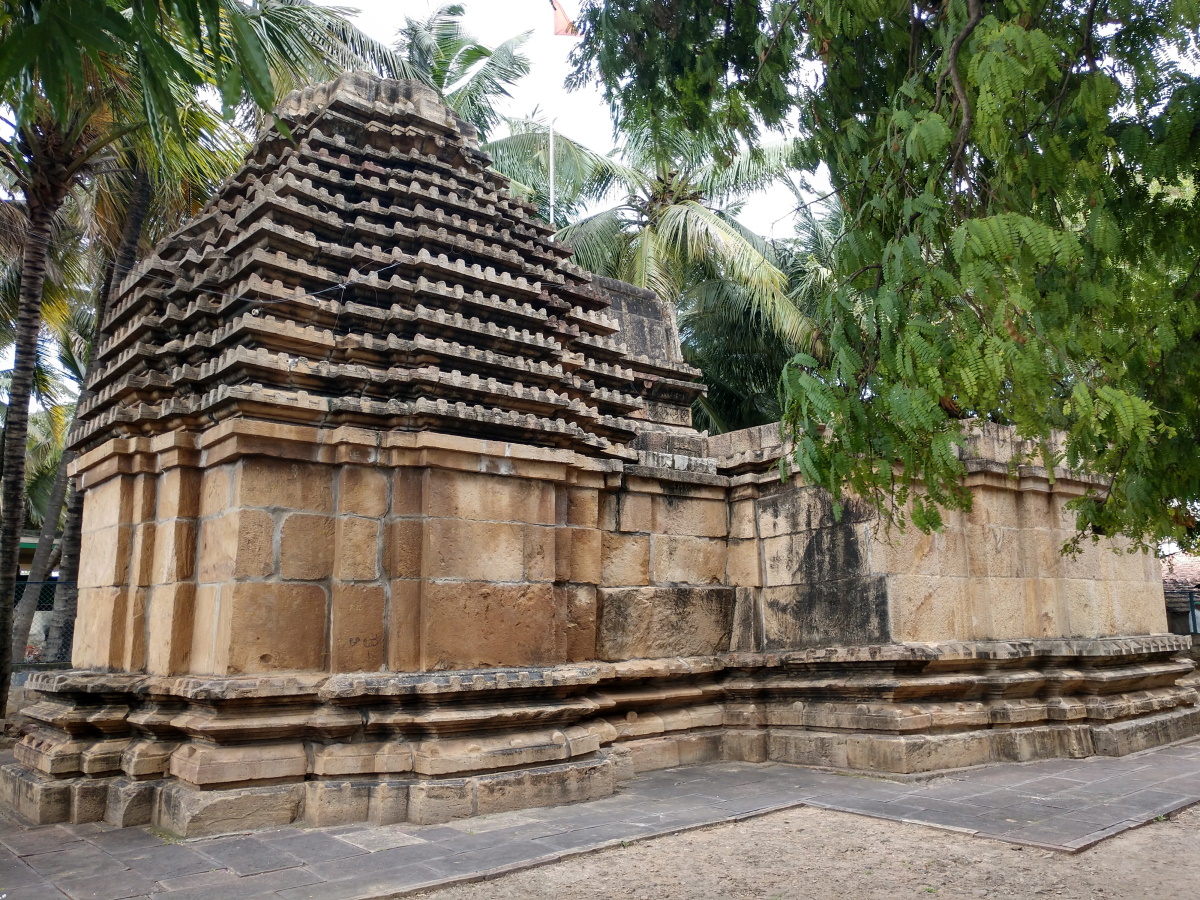
Jambulinga Gudi - This temple is situated amidst the old town settlement. As per ASI booklet, Jambulinga temple was constructed in 699 CE at the behest of rani Vinayavati, mother of Chalukyan king Vijayaditya. Dedicated to Brahma, Vishnu & Maheshwara, this east-facing temple is a Trikutachala i.e. a temple with three sanctums.
Virupaksha Gudi - This XI century temple constructed by Kalyana Chalukya rulers is situated close to Jambulinga Gudi.
Malegitti Shivalaya - Situated on a massive monolith on the northern hill, Malgitti Shivalaya is probably the best preserved structural temple at Badami. This east-facing temple was constructed in the VII Century. As per an inscription here the architect of this temple is Aryamanchi Upadhyaya, and the sculptor is Singamanchi. The exterior is covered with a lot of interesting sculptures depicting human beings and Hindu legendary characters. A few tourists bother to visit this spot hence it is usually peaceful here.

Archaeological Museum - Badami historical museum is one of the most important museums in northern Kaernataka. It's artifacts includes prehistoric tools & implements, historically important sculptures and a scale model of Sidlapadi, the natural rock arch in a remote part of Badami hills. The museum is situated at the base of northern hill, right besides the fort entrance. The museum is a good place to rest after a tiring tour of northern fort.
Inscription of Pulakeshi I - Dating back to the VI Century this is said to be the first inscription of Chalukyas. The lines have been inscribed on a rock face at a significant height inside Badami's northern fort.
Kappe Arbhatta Shasana - This is considered as one of the most important inscriptions of Badami. This inscription is situated close to the museum, at the base of the hill where Badami-Mahakoota footpath begins. This inscription consists of ten lines text and a drawing. As per historians, Kappe Arabhatta was a heroic figure from Chalukyan times. This inscription outlines his personality.

Inscription of Mangalesha - Pulakeshi I's son Mangalesha had his message inscribed on a rock face close to Cave-III. This four-line inscription at Badami is about the grant from the income of a village named Lannjigesara, present day Nandikeshwara.
North fort - Unlike the southern fort which is restricted to regular tourists, north fort is open and tourists can explore the ruins freely. Presently, six gateways can be seen i.e. from the street level to the summit. This ancient fort is 90% natural and remaining manmade. As you see here, a simple wall across the passage was enough to regulate movement within. The only major construction is at the top which happens to be a huge turret with a commanding view of the town and plains on the western side. Within the fort are two Shivalayas, two huge Mantapas, granaries and few other ruins.

Lower Shivalaya - This structural temple was built in the latter half of VI Century CE. It was in a badly damaged state before it was restored to this form. Originally it had an enclosed Pradakshinapatha, now only a column and beam remain of it. As you see the temple is two storied, but there's no staircase to access the upper level. The structure is crowned by an octagonal dome which is said to be made during Vijayanagara period.

King's secure meeting place - Reaching this spot involves a bit of adventure since the path is a narrow slanting passage in the massive monolith. And, that's the only way a normal human being can reach this place. All that pain to see these two Mantapa. Since this place is hard to reach and surrounding rocks are out of earshot, this place is said to be Chalukyan kings' meeting place to discuss secret matters.

Granaries & other ruins - These domes are said to be ancient granaries, two of them have been restored to near original condition, while only a part of the third one remains. Going by their construction these might have been created during Chalukyan times. This is the highest point of northern fort, very close to Upper Shivalaya. In the vicinity of these domes are ruins of living quarters which seem to be of the XVII Century.

Upper Shivalaya - This is the structural temple at the highest elevation in Badami. It may be built in the middle of VI Century CE when Chalukyan kings were worshippers of Vishnu. It is said that the original deity of this temple was Vishnu however the sanctum now has only a pedestal but no deity. A good portion of the structure has gone missing, yet the ruins are beautiful. The exterior walls are decorated with interesting sculptures. On three sides of the platform base are a series of panels depicting scenes from Sri Krishna Charitha and Ganas. On the southern wall is a sculpture of Govardhana Giridhari. On the west wall is Kaliyamardini Krishna. Also the windows of this temple are of different designs.

With this the list of identified or marked spots in Badami comes to an end. However, the boundaries can be stretched which adds three more places spots.
Sidlapadi - Situated in a remote location on the northern side of Hiregudda plateau is a natural sandstone arch. Sidlapadi literally means lightening rock. Apparently a lightening struck this arch which resulted in a small opening in the roof, hence the name. Apart from this arch there are a number of small caves and caverns around Sidlapadi. Archaeological evidence collected from here indicates this was inhabited during prehistoric times. It's an hour long trek to reach this spot.

Guddada Ranganatha Gudi - Here we have an ancient shrine in a cleft situated about two kilometers from Badami town. There are two or three natural sources of water, rainwater stored in pockets in sandstone formations. This shrine dates back to prehistoric times however the structural temple might go back to Chalukyan times.

Prehistoric rock-paintings - One could call this set of paintings as out of the world since they depict alien creatures, a rocket and an astronaut too. The rock is somewhere near Gudda Ranganatha Gudi, known to a few people this remains as one of the least known prehistoric sites.

Apart from these spots & sites, the natural rock formations one can gaze at for minutes on and be amazed. Form a large group and explore the plateau, you'll get to see the natural beauty of sandstone rocks closely. And then maybe you could do Badami-Mahakoota trek.