Apr 3, 2011

Subapur Fort

I'd not heard about Subapur Fort until a week before this visit. After some research and planning, I was all set to visit 5 forts on a Sunday- Subapur, Munvalli, Toragal, Ramdurg and Nargund ...in this order.
March 6, 2011. We grouped near Kala Bhavan around 5-30AM. With barely any traffic we soon passed Saundatti. On the way to Munvalli we saw two handsome looking peacocks but went out our view in seconds. We passed by Munvalli, stopped at Benakatti to ask directions for Tallur, at Tallur we asked for Subapur. The terrain changes- we drive past hills into a valley with a hill with a fort on the top comes into view.

We reached Subapur by 7-15 AM, we got a few surprised looks from the villagers. We asked for directions and coaxed a young fellow to be our guide.

The uphill dirt path was littered with rocks of varying sizes and dirt was loose at places. Wild shrubs stuck out their thorny bushes into the path snagging our tee-shirts.

After 15 mins climb, we were close to the gateway, we paused to catch our breath. That's Subapur village... our guide Fakirappa said it's pronounced Subbapur.

That's the main gateway facing North. As you see the walls and bastions are carefully piled stone walls... nothing binds them.

Wikimapia screen shot marked with few important points we checked.

A - Fort gateway
B - Well
C - Well
D - Well
E - Grainery
F - Bastion
G - Gateway
H - Outer wall
I - Well
J - Palace Ruins

According to Fakirappa this is a grainery. The top of the grainery is the highest point in the fort. We spent some on it. Unfortunately the structure is crumbling badly ...probably we contributed to it's deterioration by climbing up & down.

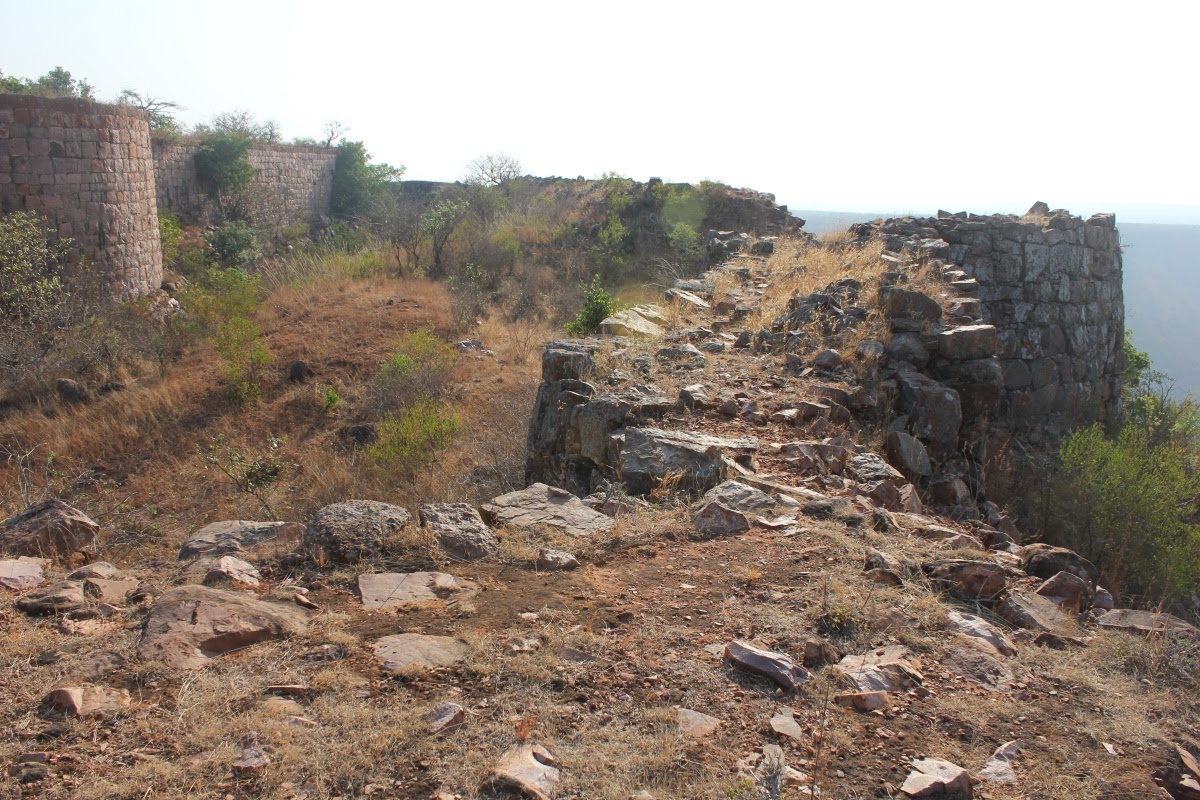
South end of the fort is double walled. Probably there was another gateway here. Beyond the walls is a valley. Subapur hill is undoubtedly the highest in the vicinity.

Another view of the neighboring hill.

As we climbed down the grainery, I noticed this strange looking sign on one of the stones.

Chetan pointed out this bunch of insects ...did not notice if they had wings. Two dots on their backs gives an illusion of a pair of eyes.

We explore the southern wall and bastions.

As you see this wall is at a lower level than the one we are standing on. I guess it's an extension to the main fort wall. If you look carefully you can see 3 black-face monkeys sitting on the rocks. A minute before I shot this picture the group was larger and Fakirappa had pointed out to two of them and said "that big fellow and that small fellow are worst of the lot, they steal groundnuts from our village" :) I'm amazed that Fakirappa could recognize monkeys just like people.

We walked along the wall to our left and standing at the edge. These are probably living quarters for guards.

Fakirappa climbed down easily while I struggled with my Canon hanging from my neck. Neel and Chetan and took their own sweet time posing for pictures. Neel was trying to imitate a pose of some movie actor.

The shallow depression enclosed by the walls probably was used for water storage.

Fakirappa told that government carried out repair work in this fort. I wish more is done to preserve this monument.

Back then construction was environment friendly.
If you take a close look just below root running horizontal you can see two concentric circles... lichens. This plant is common in this fort and likes to grow through gaps in rocks. Wonders of Mother Nature.

This hill range flows right up to Ramdurg.

One of the seven wells in this fort, three of them have proper steps descending into them. Couple of them had water. Whoever planned this fort made sure his soldiers would never go thirsty.

We are balancing on heap of rocks which were walls in their good days, walls of a royal residence with a dozen rooms.

I'm sure Subapur hills would look like paradise after a good rainy season. I made a mental note to visit some time between September and December.

I was happy with Fakirappa's patience... he would talk only when needed. I'm glad meet wonderful people most places I visit :) Going downhill was relaxed but not really easy, we had to watch every step. We said bye to Fakirappa... Srikanth was waiting for us.

Our next destination was Tallur Vaade. Fakirappa told us that Tallur Desai's people visit the fort every year to gather firewood. On a hunch I asked if there's a Vaade at Tallur. Yes. We'll check it out.
That's the route we traveled through the day.

Few videos made at Subapur Fort.
.........

Mar 28, 2011

Sangolli, Turmari and Hunasikatti

continued from Kittur Fort.
The 15 kilometers road to Sangolli was a mix of tarred and dirt patches but not uncomfortable. About a kilometer before Sangolli a direction board at 4-way junction caught my attention. The arrow pointing to the left was for Turmari, the village where many scenes from Shankar Nag's first movie Ondanondu Kaladalli were shot. main location being Turmari Goudaramane. It was a long time wish to see the village and the house but I was not able to locate the village until this moment. Another destination got added.

Sangolli is a small village and the bus-stand happens to be at western end. I stopped at a shop selling cool drinks and tender coconut to inquire if there was any memorial or a museum for Krantiveera Rayanna. No museum but there's one community hall named after Rayanna and a statue just across the street. While the shop keeper pointed out the directions, another person got into the conversation- Mahesh from Kittur, volunteered to show me the statue.

That's Rayanna, with a sword and a shield.

That's the community hall mostly used for weddings. Few villagers were busy washing the floor. I asked for the hose and ran water over my feet and arms ...it was refreshing.

One of the villagers invited us to see the temple dedicated to Rayanna.

That's Rayanna's idol flanked by two wooden weights used for bodybuilding workouts. The one on the right is an ancient one, used by Rayanna himself and the one on the left is a recently to complete the tradition of maintaining a pair of weights. These weights are to be twirled around to strengthen muscles in the wrist and forearms- warriors needed powerful arms to wield sword & shield.

With eyes shut Rayanna seems to be meditating. His face projects a serene expression.

I said bye to the temple caretaker. I mentioned my plan to visit Turmari to Mahesh and he agreed to join me. We headed back to Sangolli bus-stand, had a lime soda at the only cool drink shop and bid bye to Sangolli. We head towards Turmari, 7 kilometers away.

At Turmari we asked our way to our destination, Shri B C Patil's house. As I drove through the streets I tried to recall scenes from Ondanondu Kaladalli ...even though the village has changed over the decades, some remain unchanged, like the stone-walls between houses and streets. Goudaramane is on the village outskirts.

The moment I saw the house lot of scene's from the movie flashed before my eyes...

The cement floor is a recent change, back then it was dirt floor.

That's the main entrance. I introduced myself to two men of the Patil family and asked permission to see their house. The younger member Umesh Patil showed me around the house.

Portions of this 300+ year old two-floor mansio has undergone changes but it's recognizable ...my mind just compares the present to the past. Umesh told that originally the house had 100 doors. I did not bother to ask how many rooms.

Massive teak pillars adorn the center of the house.

Intricate woodwork decorates every beam-column intersection.

We climbed up the wooden staircase to the first floor. A multi-purpose hall. Important part of Ondanondu Kaladalli were shot here. Closing scenes of the story are shot here. This gallery is similar to the gallery in Sirsangi Vaade.

Looking towards the main entrance.

Another staircase (not the one we took earlier). The movie's hero Gandugali, gets stabbed and tumbles down this staircase.

Thanks to Umesh for patiently showing us around. Few members of the Patil family actually live here, most of them have migrated to cities. I'm aware of the difficulties of maintaining such a house... its labor intensive work, yet the house is maintained well. One of the ladies told me that the walls are built of triangular mud bricks. I got to see few where plastering had fallen away. I thanked the members and we left. Mahesh suggested a shorter route to NH4. As we drove, Mahesh told that we could see a Lingayath Mahta at Hunasikatti.

At Hosamath (also called Rudramuni Ashram), a temple dedicated to Lord Shiva, right next Malaprabha river.

Hosamath was cool and peaceful.

That's the sanctum sanctorum. ಶ್ರೀ ರುದ್ರಮುನಿ ಶಿವಯೋಗಿಗಳು ಹೊಸ್ಮಟ್.

Neat sculptures of tortoise and two fish.

Four monkeys but only eight limbs. When you look at individual monkeys, you can see four limbs. There was also a short inscription dated 1912 above the doorway.

Ashram caretaker's son (left), two of his relatives (middle) and Mahesh (right).

That's river Malaprabha flowing South-North. A river flowing South-North direction is considered holy in Hinduism. The place is generally peaceful but buzzes with activity on Amavasyas (New Moon nights).

The Swami told us to visit during rainy season to see Malaprabha. I could imagine the water and the greenery. I've decided to visit sometime between August and October this year ...hopefully.

Under this tiled roof is the grave of the artist who built this temple.

A typical Matta will have a chariot. Hosamat too has one. Those are three of the four half buried stone-wheels which have given way to lighter wooden wheels. In the background you can see sugarcane fields, probably Matta's land.

Thanks to Mahesh, I got to see a wonderful place. However, I missed out seeing Shri Kumaraswamiji's house. We drove to Itagi Cross on NH4 where Mahesh got off and I drove towards Dharwad. Route traveled..

Sangolli Coordinates: 15°43'4"N 74°50'1"E
Hunasikatti Coordinates: 15°42'42"N 74°45'3"E

.........