Showing posts with label geology. Show all posts

Aug 26, 2023

stones embedded in sandstone boulders

Mother Nature is the supreme artist and her creations can be seen everywhere... sky, clouds, mountains, valleys, rocks, water, seas, sand, rivers, lakes, flora, fauna.. it goes on and on. Even the angry side of Nature has its beauty such as lava flowing out from a volcano or a tornado. One of the most stable objects on our planet are stones. Perhaps it won't be an overstatement to call them the most stable?
Stones have been man's best friend since the time man existed. Rocks gave shelter to human beings. Rocks became man's tools and weapons. Then with imagination humans started building shelters using stone. Humans also made graves using stones. In the present day we get to see countless creations of  ancient humans, some simple, some sophisticated. Whatever the creations are they are beautiful. One of the aspects of the beauty is the natural or the raw texture of stone. It doesn't matter what type of stone. It could be marble, granite, sandstone, basalt, slate, limestone, laterite, etc. Each of them have their own characteristics, some my be preferred over the other for  certain physical qualities but when it comes to visual appeal, all are equal - that's the way I see them.

Apart from regular stones i.e. the ones which are homogenous, there are heterogenous types as well. I'm not sure if the terminologies are right but I think they convey the meaning. I've come across the heterogenous types mostly in the sandstone hills of Bagalkot district.

Quoting a couple of lines describing sandstone from a stone manufacturer in Rajasthan:
Sandstones are defined as sand particles cemented together into a rock. These stones are a type of rock made of sediments, and that is why they are called the sedimentary rocks. Sedimentary rock is a name provided to a stone if the cluster arrangement of that stone includes clasts, pieces of minerals, and rocks’ fragments.

Sandstones are formed in a very interesting and two-way process. The first consists of a layer of sand accumulating as the result of sedimentation either from water or air. And secondly, when the sand is accumulated, the sand turns into a sandstone when compacted by the pressure of overlying deposits and cemented minerals filling the pore spaces between sand grains.

Here are a few examples of a different type of stone embedded in sandstone. Geology specialists would know what these examples are called. Laymen can only admire their beauty.

One possible explanation for these embedded stones is that they were caught up during the formation of sandstone which means these are several millions of years old. These stones are the hard types.

A colorful stone... yellow, pink, blue, green, white.

Here we have a red and black pebbles set tightly. This looks like stones set in cement.


Here we have a circular hole in a boulder. The pit's floor & wall are covered with a thick layer of dark matter which looks like iron. This particular formation was seen at Badami and Aihole.

The last picture is about the natural texture of a sandstone boulder. They have interesting textures which looks like animal fur patterns or geometric diagrams. 

The sandstone boulders at Sidlapadi have unique formations which appear like little walls. Read the blog post Sights from Sidlaphadi to see those formations. Also check out the sandstone hill of Kutkankeri as well. Before I end this post I would like readers to see the open air museum of geological samples at Syntheri Rocks.

.........

Jul 17, 2021

pillow lava rocks of Maradihalli

Besides prehistorical and historical monuments, there are geological or geoheritage monuments as well. A unique or rarely seen natural rock formation is of geological importance hence such a thing is called a geological or geoheritage monument. Based on the rareness or uniqueness the monuments are awarded a status by the geological department. There are around two dozen national geoheritage sites across India, of them four sites are in Karnataka. They are:

  1. Peninsular Gneiss, Lalbagh Botanical Garden, Bengaluru City
  2. Columnar Basalt, Coconut Island, Udipi District
  3. Pillow Lavas, Maradihalli, Chitradurga District
  4. Pyroclastic Rocks, Peddapalli, Kolar District

Besides the declared sites, there are other unique sites such as the Yana's crystalline karst limestone rocks, Savandurga's monolith, Badami's sandstone hills, Kutkankeri hill, Mudgal granite formations, acrobatic rock formation near Koppal, boulder strewn hills of Anegundi, and many more.

I'd seen and been on Lalbagh's Peninsular Gneiss countless times since childhood days. Then in early 2000s I happened to see the Basalt columns of Coconut island. Then during district wise research of historical monuments I happened to learn of Pillow Lavas of Maradihalli and Pyroclastic rocks of Peddapalli near KGF recently, probably four or five years ago. Though I drove in the vicinity of Maradihalli, a visit didn't materialize due to several reasons. During the first week of June 2021 a trip to Bangalore was taking shape. During the second week the plan was frozen with a stop over at Maradihalli.

June 22, 2021
Dharwad-Bengaluru journey started at 5-15 am. First stop was at 7-30 at Dodda Bathi Gudda. The break was used for a visit to Revana Siddeshwara temple followed by homemade breakfast. The journey resumed around 8-30, by 10-00 I was at Maradihalli driving through a narrow lane going up the hillock towards the pillow lava. I parked my car where the cement road ended.

A group of boys were playing on a water tank, I approached them with a hope that one of them would oblige to take me to the pillow lavas. One of them was willing but another boy dissuaded him. The dissuader said they had some work. They were conversing in Telegu.. from what I caught, they were wary of strangers. The willing boy gave directions instead.. just go along this dirt road, it'll lead you to the rocks. After couple of minutes on the dirt road, I decided to just cut across. As I got closer to the hill top, the slope was littered with brown to black colored rocks.

My target was to reach the pole atop the hill. I guessed the pillow lavas could be see there.

On the way I happened to notice this rock which was much different from the ones seen earlier on this hill. I guessed this must a sample of pillow lava.

The hill was peaceful. Though cloudy, the air was warm but a mild breeze was a relief. 

At the top were a few dressed granite blocks. They seem to be pillars for an upcoming temple. However work seems to have ceased months ago. A larger rock similar to the one seen minutes ago caught my eyes.

This too is pillow lava but I know this isn't the main rock formation. I kept looking and found smaller rocks. 

A closer look at one of the rocks close to the hill top. It looks like a slice of cheese stuck in between chunks of vegetables.

Pillow lava is seen clearly in this rock. It looks like samples have been hacked away from this rock.

A little below the hill top is this ancient shrine. If I'm not mistaken, this shrine is called Ranganatha Gudi. I'm not sure if these shaped pillars are parts of a proper structure which had existed earlier. A narrow flight of rough cut stone steps is there in front of this east facing temple. This shrine seems to have regular visitors.

The temple as seen from the lower end of the staircase. Semi dressed stones have been positioned to prevent soil erosion by rainwater. From this spot, I could see a fabricated structure.. a frame with two legs grouted into the ground.

The frame was meant to hold an information board but the board was missing. I guessed this was the board about pillow lava rocks. With a little online research I found a picture of the board, its content is given below:

National Geological Monument
Pillow Lava

This hill made up of pillow lava represents an unique feature formed as a result of outpouring of molten rock matter called lava from submarine volcanoes about 12200 million years ago. When the lava comes in contact with cold seawater, pillow like structures develop in by sudden chilling. The study of pillows help establish relative ages of the rock types and the environment of their formation.
These pillow structures are among the best of their kind preserved in the world.

Right behind the board is this rock formation. Good rains have nurtured the vegetation around the rocks, giving the place a lively look. Yes, this is the main rock formation.

A wedge shaped rock clearly displays pillow lava formations.

A closer look at the rocks. The surface is pockmarked at some places.

A few meters away is a larger group of pillow lava. 

This boulder seems like a bunch of smaller boulders have been fused together. It's surface is covered with pockmarks. The following picture is a closer look a the pointed end of this boulder.

Molten lava frozen between lumps of lumps of harder stone.

This is the largest flat surface among all the boulders seen here. The boulder face is approximately 10' feet high. This seems like very liquidly lava froze while in contact with some flat surface.  

Pillows spread across multifaced surfaces. This is close to the base of the 10' tall boulder.

Large to small pillows. I must've shot more than fifty pictures and felt like shooting more. These rocks are very interesting, the more one looks at them the more interesting they get.

I had a journey to continue. I move on reluctantly. A battered stone lying near the board. From here I take the dirt road back to the water tank where my car is parked.

I meet the group of boys were still there including the willing boy and the dissuader. The willing boy was smiling, asked me if I saw the pillow lavas. Yes. Then he pointed me to a footpath and said there are more rock if you go up this path. I told him to come and show it. The dissuader started saying something, I told him to keep quite and asked the willing boy to lead me. It worked, the willing boy lead me to another group of rocks. He said there are many such rock formations on this hill and other hills nearby. He pointed out in the direction of Chitradurga and said there's a big hill with lots of such rocks but there's quarrying activity out there.

This is the willing boy Tarun Kumar posing next to a rust coated pillow lava.

This formation is so beautiful. As I said earlier, one could spend hours here and shoot countless pictures.

In the few minutes we spent here, Tarun's brother Nithin came up. He wanted to make sure his brother was safe. I guess the dissuader failed for the second time :) The footpath seen here goes straight down to the water tank.

We walked back to the car. The dissuader was frowning. I asked him if he finished whatever work he had. No answer. Tarun and I chatted. He was a curious character. Wanted to know how the car lock worked, how the windows worked. I thanked him, said bye and headed back towards Bengaluru.

While on this topic, do check out a related article- the geological museum at Syntheri Rocks.

.........

Jan 9, 2021

the geological museum at Syntheri Rocks

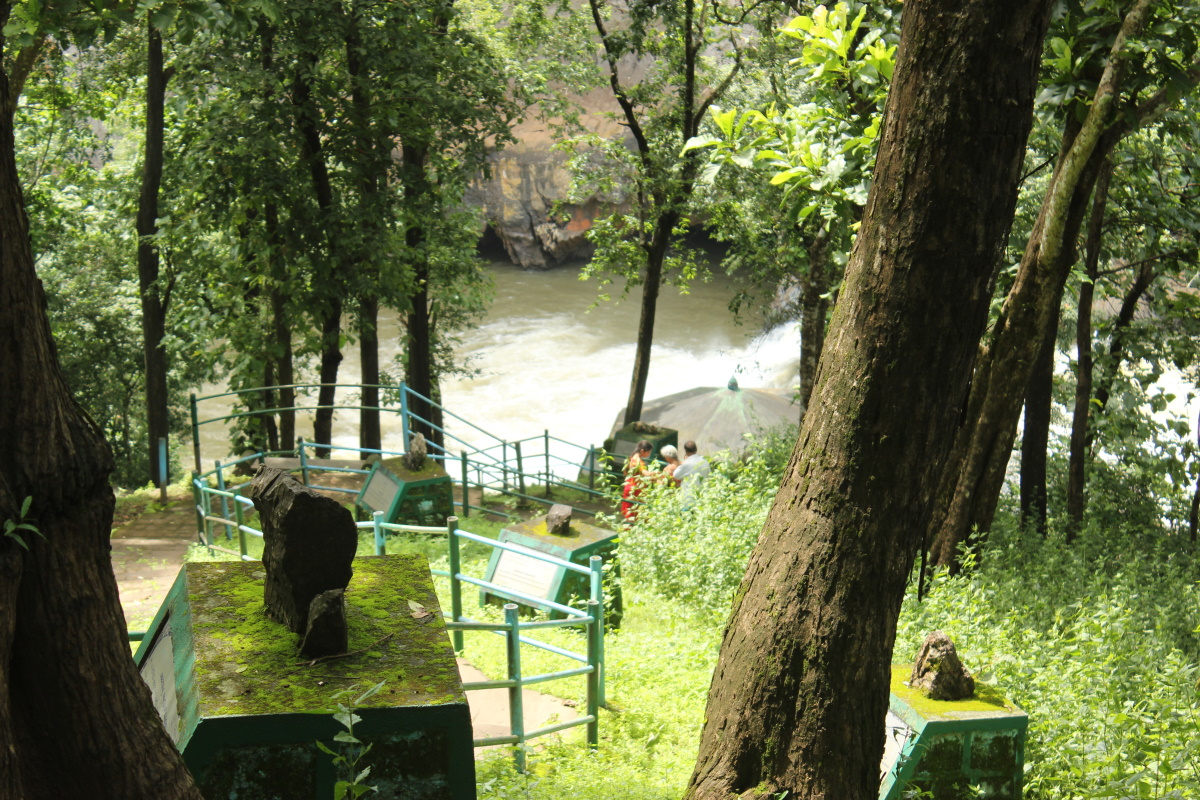
Syntheri rocks is a 300 feet high limestone rock formed due to volcanic eruptions. Its a monolith situated in the Western Ghats. River Kaneri flows next to it's base. This spot was discovered in the XX Century by an English lady called Cinthera hence named after her. The spot is under the protection of Karnataka Forest Department. Since this rock is a geological marvel, KFD found this an apt spot for an open geological museum exhibiting different types of rocks available in and around this spot. The rock specimens are mounted on accompanied by short captions in Kannada and English.
Here are the eleven rock types on display.

ಡೈಕ್ ಶಿಲೆ
ಡೈಕ್ ಶಿಲೆಗಳು ಹೈಪಬ್ಯಾಸ್ಸಲ್ ಅಗ್ನಿಶಿಲೆಗಳು. ಯಾವುದೇ ಶಿಲೆಗಳನ್ನು ಛೇದಿಸಿ ಬರುವ ಲಾವಾರಸವು ತಂಪಾಗಿ ಗಟ್ಟಿಯಾದಾಗ ಈ ಶಿಲೆಗಳು ಉತ್ಪತ್ತಿಯಾಗುವವು. ಇಲ್ಲಿರುವ ಶಿಲೆಯನ್ನು ಪುರಾತನರು ಚಿನ್ನವನ್ನು ಒಳಗೊಂಡಂತಹ ಶಿಲೆಗಳನ್ನು ಅರಿಯಲು ಉಪಯೋಗಿಸಿಟ್ಟಿದ್ದರು.

Dyke Rock
A Dyke is a hypabyassal igneous rock, which cuts across the host rock. The cup like structures in this sample is called "pounding marks" were used by the ancients for grinding rocks rich in gold.


ಸ್ತಂಭಾಕಾರದ ಆನ್ಡಸೈಟ್
ಇಲ್ಲಿರುವ ಶಿಲಾಮಾದರಿಯು ೬ ಬುಜಗಳುಳ್ಳ ಜಿನುಗು ಕಣಗಳನ್ನು ಹೊಂದಿರುವ ವೊಲ್ಕ್ಯಾನಿಕ್ ಅಗ್ನಿಶಿಲೆ. ಈ ಶಿಲೆಯಲ್ಲಿ ಓಲೀಗೋಕ್ಷೇನ್ ಅಥವಾ ಆನ್ಡಸೈಟ್ ಎಂಬ ಫೇಲ್ಡ್ ಸ್ಟಾರ್ ಬನಿಜಗಳಿಗೆ ಹೆಚ್ಚು. ಈ ಮಾದರಿಯ ವಿಶೇಷತೆಯೆನೆಂದರೆ ಇದರ ಸ್ತಂಭಾಕಾರ. ಹಲವು ಸ್ತಂಭಾಕಾರದ ಮಾದರಿಗಳನ್ನು ಜೋಡಿಸಿಟ್ಟಾಗ ಅವುಗಳ ಮೇಲ್ಮೆ ವಿಶಿಷ್ಟ ರೂಪವನ್ನು ಪಡೆಯುವುದು.

Columnar Andesite
This six sided, fine-grained rock is volcanic igneous rock characterized by the presence of oligoclase or andesine minerals. Columnar structure is characteristic of this sample. Many such columns when joined together form a beautiful shape resembling a group of six-sided tiles.


ಗ್ರೇವ್ಯಾಕ್
ಇದು ಮರಳು ಶಿಲೆಯ ಒಂದು ವಿಧ. ಇದು ಆರನೇಷಿಯನ್ ಜಲಜ ಶಿಲೆ. ಇದರಲ್ಲಿ ಕಣಗಳ ಗಾತ್ರ ೧ - ೬.೨ ಎಮ್ಎಮ್ ಮಾತ್ರ. ಈ ಮಾದರಯಲ್ಲಿ ಗಂಧಕವುಳ್ಳ ಅನೇಕ ಖನಿಜಗಳಿವೆ. ಉದಾ: ಪೈರೈಟ್, ಆರ್ಸೆನೋಪೈರೈಟ್ ಹಾಗೂ ಚಾಲ್ಕೋಪೈರೈಟ್. ಅಲ್ಲದೆ ಚಿನ್ನವನ್ನು ಹೊಂದಿರುವ ಬೆಣಚುಕಲ್ಲನ್ನು ಸಹ ಕಾಣಬಹುದು.

Greywacke
Greywackes are detrital aranaceous sedimentary rocks in which particle sizes ranges between 1/16-2 mm. This sample contains different samples like senopyrite, pyrite and chalcopyrite along with gold bearing quartz veins.


ಪೆಂಟೆಗಲ್ಲು
ಇದು ರುದೇಶಿಯಸ್ ಜಲಜ ಶಿಲೆ. ವಿವಿಧ ಶಿಲೆಗಳು ಶಿಥಿಲಗೊಂಡು ಉಂಟಾದ  ಶೀಲಾಕಣಗಳು ನಮೋಹವೇ ಈ ಪೆಂಟೆಗಲ್ಲು. ಇದರಲ್ಲಿರುವ ಶೀಲಾಕಣಗಳು ಬಹುತೇಕ ವೃತ್ತಾಕಾರದವುಗಳಾಗಿರುತ್ತವೆ. ಶಿಲಾ ಕಣಗಳು ವೃತ್ತತೆಯು ಅವುಗಳು ಚಲಿಸಿದ ದೂರಕ್ಕೆ ಸಮಾನವಾಗಿರುತ್ತದೆ. ಇಲ್ಲಿರುವ ಮಾದರಿಯು ಬೇರೆ ಬೇರೆ ಶಿಲೆಗಳ / ಕಣಗಳನ್ನು ಒಳಗೊಂಡಿರುವುದರಿಂದ ಇದನ್ನು ಪಾಲಿಮಿಕ್ಟ್ ಪೆಂಟೆಗಲ್ಲು ಎನ್ನುವರು.

Polymict Conglomerate
Conglomerate is a rudaceous (coarse grained) sedimentary rock formed by the cementing together of various rounded to sub-rounded fragments of pre-existing rocks. Roundness of fragments is proportional to the distance of their transport. A conglomerate with different types of fragments is called Polymict Conglomerate.


ಪದರುಗಳುಳ್ಳ ಮ್ಯಾಗ್ನಾಟೈಟ್ ಬೆಣಚುಕಲ್ಲು
ಈ ಮಾದರಿ ಪದರುಗಳುಳ್ಳ ಹಾಗೂ ಕಬ್ಬಿನಂಶವನ್ನು ಹೊಂದಿರುವ ಒಂದು ವಿವಿಧ ಶಿಲೆ. ಇದರಲ್ಲಿ ಸರದಿಯಾಗಿ ಮ್ಯಾಗ್ನಾಟೈಟ್ ಹಾಗೂ ಬೆಣಚುಕಲ್ಲಿನ ಪದರಗಳನ್ನು ಕಾಣಬಹುದು. ಇದು ಕಬ್ಬಿಣದ ಒಂದು ಅದಿರ.

Banded Magnetite Quart
This is a type of Banded Iron Formation (BIF) showing alternate bands of magnetite and silica.


ಪದರಗಳುಳ್ಳ ಕಬ್ಬಿನಾಂಶ ಹೊಂದಿರುವ ಶಿಲೆ
ಇದು ರೂಪಾಂತರಗೊಂಡ ಜಲಜ ಶಿಲೆ. ಇದರಲ್ಲಿ ಸರದಿಯಾಗಿ ಬೆಣಚುಕಲ್ಲು ಹಾಗೂ ಕಬ್ಬಿಣದ ಅದಿರನ್ನು ಕಾಣಬಹುದು.

Banded Iron Formation (BIF)
This sample of banded iron formation is a metaporphosed sedimentary (meta-sedimentary) rock showing alternating bands of silica and iron. The beautiful folding of the bands in this sample is due to deformative forces.


ಬೆಣಚು ಕಲ್ಲಿನ ಪೊರಾಫೈರಿ
ಇದು ರೂಪಾಂತರಗೊಂಡು ವೊಲ್ಕ್ಯಾನಿಕ್ ಶಿಲೆ. ಇದರಲ್ಲಿ ಅನೇಕ ದೊಡ್ಡ ಗಾತ್ರದ ಬೆಣಚು ಕಲ್ಲಿನ ಕಣಗಳನ್ನು ನೋಡಬಹುದು.

Quartz Porphyry
This sample is a metaporphosed volcanic igneous rock (meta-volcanic) showing rounded to surrounded blebs of quartz.


ಫಿಲೈಟ್
ಇದು ಒಂದು ರೂಪಾಂತರ ಶಿಲೆ. ಇದರಲ್ಲಿ ಅನೇಕ ಬಹು ತೆಳ್ಳನೆಯ ಪದರುಗಳನ್ನು ಕಾಣಬಹುದು. ಇದು ಕಡಿಮೆ ಶಾಖದಿಂದಾಗಿ ಮಾರ್ಪಟ್ಟಿರುವ ಶಿಲೆ.

Phyllite
This is a cleaved metamorphic rock, which is formed by low temperature regional metamorphism.


ಕ್ಲೋರೈಟ್: ಸಿರಿಸೈಟ್ ಶಿಷ್ಟ
ಇದು ರೂಪಾಂತರ ಶಿಲೆ. ಇದರ ವಿಶೇಷತೆಯೇನೆಂದರೆ ಇದರಲ್ಲಿರುವ ಖನಿಜಗಳ ಸಮಾನಾಂತರತೆ. ಈ ಮಾದರಿಯಲ್ಲಿ ಕ್ಲೋರೈಟ್ ಹಾಗೂ ಸಿರಿಸೈಟ್ ಖನಿಜಗಳು ಅಧಿಕವಾಗಿರುವುದರಿಂದ ಇದಕ್ಕೆ ಕ್ಲೋರೈಟ್- ಸಿರಿಸೈಟ್ ಶಿಷ್ಟ ಎಂದು ಹೆಸರು. ಈ ಮಾದರಿಯಲ್ಲಿ ಹಾಲಿನಂತಹ ಬಣ್ಣದ ಬೆಣಚುಕಲ್ಲು ಈ ಶಿಲೆಯನ್ನು ಭೇದಿಸಿಕೊಂಡು ಬಂದಿರುವುದನ್ನು ಕಾಣಬಹುದು.

Chlorite Sericte Schist
A schist is a metamorphic rock characterized by parallel arrangement of bulk of the constituent minerals known as Schitocity, This sample is characterized by the predominance of chlorite and sericite minerals and is intruded by a vein of milky quartz along the foliation (weak zone).


ಚೆರ್ಟ್ ವುಳ್ಳ ಬೆಣಚು ಕಲ್ಲಿನ ವಾಡಿ
ಚೆರ್ಟ್ ಇದೊಂದು ಬೆಣಚು ಕಲ್ಲಿನ ಪ್ರಕಾರ. ಇದು ಗದಗಿನ ಚಿನ್ನದ ನಿಕ್ಷೇಪ ಕೆಲ ಸ್ಥಳಗಲ್ಲಿ ಚಿನ್ನವನ್ನು ಹೊಂದಿರುವ ಬೆಣಚು ಕಲ್ಲನ್ನು ಪತ್ತೆ ಹಚ್ಚಲು ಮಾರ್ಗದರ್ಶಿಯಂತೆ ಸಹಾಯಮಾಡುವುದು.

Chert Band with Quartz Vein
This chert (a form of quartz) acts as a marker horizon for gold mineralization in the central load system of Gadag gold field.


ಲ್ಯಾಟೆರಿಟ
ಇದು ಉಷ್ಟವಲಯ ಹಾಗೂ ಹೆಚ್ಚಾಗಿ ಮಳೆಯಾಗುವ ಪ್ರದೇಶದಲ್ಲಿ ಹಾಗೂ ಅನೇಕ ಕರಾವಳಿ ಪ್ರದೇಶದಲ್ಲಿ ಹೆಚ್ಚಾಗಿ ಕಾಣಿಸುತ್ತದೆ. ಈ ಶಿಲೆಯ ವಿಶೇಷತೆಯೆಂದರೆ ಇದರಲ್ಲಿ ಕಾಣಸಿಗುವ ಅನೇಕ ರಂದ್ರಗಳು ಎದು ಮುಖ್ಯವಾಗಿ ಜಲಜಯುಕ್ತ ಆಮ್ಲಜೀಕರಣವಾದ ಕಬ್ಬಿಣವನ್ನು ಒಳಗೊಂಡಿರುತ್ತದೆ.

Laterite
Laterites are residual deposits formed under hot and humid climatic conditions of tropical regions and occurs mainly as a "cap-rock." Laterites are characterized by numerous spores and essentially consists of hydrated iron oxide.

The rapidly flowing waters of Kaneri has eroded the rocks creating two caverns and splendid looking curves in the rocks. The caves which look like a carnivorous animal's mouth.

This is the smaller of the two caves, the rocks flanking the mouth look like fangs on the upper jaw.

This is the larger cave with couple of broken teeth in the middle.

Just above the 'broken teeth' is a shallow vertical depression inside which is an idol of Hanuman. Some brave people have climbed up the rock and painted the idol saffron. A daring feat given the dangerous location.

The rock face is covered in bands of white, black, grey and yellow formed by water reacting with the minerals. Bees have made this rock their home.

No one could bother the bees up there.

The off-white  canvas covered in bands of black and yellow. The yellow is oxidized iron in the rocks on the supper part of the monolith.

Thanks to KFD for maintaining this place and for the team involved in setting up the open-air museum.

.........