Showing posts with label hoysala. Show all posts

Mar 14, 2026

locations of Hoysala temples

The prominent empires originating from the Kannada lands are Kadamba, Ganga, Western Chalukya, Rashtrakuta, Kalyani Chalukya, Hoysala, Vijayanagara and Keladi Nayaks. Each of these kingdoms patronized arts & culture of our land. The rulers invested significant amount of their resources in temple building and subsequent preservation of those temples. In those times, temples were centers of social activity. Temples are where leaders, prominent members and general people gathered for meetings. It was also a place for education, celebrations and other constructive activities. Rulers had got temples built to celebrate victories in battles, to honor a family members' wish, or to promote arts. The byproduct of temple building was construction sources of fresh water like wells, tanks, ghats on river banks, etc. Then mantapas (pillared halls) for travelers were constructed and development of roads happened. Temples received grants and donations many of which have been recorded in stone inscriptions. Temple building was one of the economic drivers in those times. While newer temples were built the older temples were renovated and repaired. That's how temples built during the earliest periods have survived to this day. For example; temples built during Chalukya times have been renovated in the Hoysala times or Vijayanagara times. That's the naturally ingrained cultural continuity plan of our Dharma. After the collapse of Vijayanagara empire, the empires formed by invaders tried hard to disrupt that continuity but failed. Thousands of our temples were desecrated and destroyed yet we have thousands of them in the present age. It is not luck that our temples escaped destruction, they were protected fiercely. People sacrificed their lives trying to protect our cultural heritage. We, in the present age, are fortunate to be experiencing the freedom of our culture.

It's nice to see people visiting our ancient temples. Unlike the predigital times, today we have the luxury of seeing the sites virtually, not just photos but also the locations. However, everyone may not have the time to research the required info. That's where blogs come to people's help. Here's an embedded map which will show you the exact locations of Hoysala temples, not all temples but a good number have been included. The map will be updated as and when new sites are discovered.

Alternatively you can open this map directly by clicking the linked text here: Hoysala temple locations.

It's my opinion that stone sculpting reached it's peak during the Hoysala times. The creativity and intricate details are bound to leave anyone flabbergasted. Most of the Hoysala temples are active i.e. poojas are performed daily and visitors can participate in the rituals. Many of the deity idols in these temples are original i.e. those idols were the ones installed centuries ago. The few idols I have seen are so beautiful that one cannot take their eyes off the idols. So do plan your trips, visit Hoysala temples and see the exterior beauty along with the inner beauty.

Before closing this post, I would like to add links to earlier map-based posts for the benefit of readers:

.........

Feb 14, 2026

Sri Yoganarasimha Swami Devastana, Baggavalli

When the idea of Sokke visit came up a year ago I had researched the surrounding areas. A Hoysala monument at Baggavalli was discovered which is less than 5 km from Sokke. A year later the trip was finalized and I was looking forward to see yet another Hoysala temple.

Dec 9, 2026

I arrived at Ajjampura railway station around 9-45 am, met my host Sri Rajanna on the platform and we drove down to Sokke. The first thing we did at Sokke was visit Sri Lakshmi Ranganatha Swami Devastana and Ishwara Devastana. While the latter's history goes back to Hoysala times, the former seems to be built during Vijayanagara or Palegar  times. Having visited the two temples of Sokke and with hours of day time ahead my hosts and I headed towards Baggavalli. The road connecting these two villages is flanked by farm lands and plantations, a treat for a city dweller like me. I was dreaming about cycling here.. flat terrain, silent and fresh air ..it would be a wonderful experience.

Sri Yoganarasimha Devastana is situated at the western edge of Baggavalli. We were the only people apart from the caretaker. I go around the temple first. The temple was recently repaired. A few older pictures on Maps were taken during the ongoing reconstruction.

The east-facing temple sits on a star-shaped pedestal, it's front-most section is the pillared hall- Sabha Mantapa -is where village meetings were held.

The structure's outer walls have three tiers, the lowest tier has five layers. Over the walls is the canopy. The rear-most part of the temple which is the sanctum has a pyramidal tower over it called the Shikhara. Such an elegant looking structure.

View of the structure from the west. The same view would be so much more interesting when Sun is closer to the horizon i.e. a couple of hours before sunset.

While I went around the temple, the priest had come and unlocked the doors. My hosts Vinay and Mohan had gone inside. I paused for a few more shots of this hall. This space would look so much different in early morning sunlight when it's lit up in direct light.

In addition the eastern entrance, this hall has two more entrances on its northern and southern sides.

The central dome with a very complicated sculpture of rings, spokes and a hub. This is a signature feature in Hoysala temples- the spoked dome's complexity is proportional  to the temple's grandeur. One must see the domes at Somanathapura Channakeshava Devastana.


Only on stepping into the inner hall I realized this temple is a Trikutachala i.e. a temple with three sanctums. The three deities here are Sri Channakeshava Swami, Sri Yoganarasimha Swami and Sri Sharadambadevi. This is the four-pillared Natyamantapa or Rangamantapa. Hoysala temple builders had mastered the art of turned pillars. The surfaces were polished to such an extent that they were as smooth as mirrors. However, here the pillars are turned but not polished. The idol in the east-facing sanctum is Channakeshava.

Every sanctum is connected to this hall via an Antharala i.e. a vestibule. The Antharala and Garbbhagudi doorways have perforated screens. Every doorway in this hall has Dwarapala i.e. doorkeepers.

Sharadambadevi in the south-facing sanctum.

Yoganarasimha in the north-facing sanctum. Each of the idols are so well made that you can't take your eyes off them. Only dedicated minds can produce such sculptures.

We thank the priest for providing us darshan of the deities and step out. I go around the temple again but this time on the pedestal, checking out the relief sculptures on the walls. Most of the characters seen here are different forms of Vishnu. Then there are a handful of musicians playing drums, since the drum is played by both hands they seem to be mridang.

The left-most figure is Krishna in the act of slaying the dreaded serpent Kalia. The two drum players have different types of drums.

Here the right most figure is Govardhana Giridhari - Krishna in the act of lifting mount Govardhana in one hand. Sculptures in some temples show the mountain being lifted with one finger. Most of the sculptures have been vandalized, several times over.

Here we have another type of drum. On the right hand side is the Madhyama Pandava i.e. Arjuna aiming an arrow at a revolving wooden fish by looking at it's reflection in water below. In the middle is a couple, the male seems to be holding a sugarcane stalk. You think it's a sugarcane stalk?

The most eye-catching sculpture at this temple is Ugranarasimha. Vishnu in his half lion, half man form is in the act of ripping open Hiranyakashipu's belly. Notice that there are no other figures flanking Ugranarasimha. Perhaps it's a way of depicting his rage, it's so intense that no one wants to be nearby.

At the end of Ugranarasimha's wall is Shiva dancing and stomping on Apasmara the icon of negativity. This sculpture depicts the act of Shiva eliminating negative energy.

This is the northern wall next to the northern entrance. Here we have Mahishasuramardhini and two male figures.

One of the pillars of the north-facing entrance has a relief sculpture of Ganapati. With this I've covered the highlights of this temple. We relax for a few minutes and leave.

On the way back to Sokke, we stop at Gondedahalli Siddarameshwara Devastana to check out the inscription stone and memorial stone. However, the temple gates were locked. Vinay and Mohan inquired for the priest's contact number but the efforts were in vain. It was lunch time, it wasn't a good time to bother people, so we left with a couple of shots of the stones through the grilled gates. Mohan feels that Sokke has been mentioned in the edict on the inscription slab. Perhaps it makes sense to check with a historian who has studied this inscription.

On the short way back to Sokke, Vinay mentioned about the ancient temples at Hirenalluru- Mallikarjuna Swami Devatsana and Kalleshwara Swami Devastana. They too seem to be of Hoysala times. Vinay was willing to take me there but I declined. I hope to visit Sokke again and visit Hirenalluru then.

......... 

Nov 16, 2024

Shri Channakeshava Devastana, Arakere

Sept 17, 2024. Sridhar and I were on a day tour of Hoysala temples of the northern part of Hassan district. Before the first temple of the day, we stopped at the historic stepped well called Aiyyana Baavi situated 6 km from Tiptur. The well probably was constructed in the XVI Century CE at the behest of a wandering Veerashaiva monk to overcome water scarcity problems of the village nearby. Next was Chandramouleshwara Devastana at Arasikere followed by Sri Lakshmi Venkateshwara Devastana which is a couple of kilometers from Chandramouleshwara. Then drove to Lakshmi Narasimha Devastana at Javagal followed by Viranarayana Devastana at Belavadi which happens to be part of Chikmagalur district. We had lunch at Belavadi and then started our return journey. 21 km away was Arakere the last place of the day.

Arakere is a peaceful little village with two historic temples- Channakeshava Devastana and Rameshwara Devastana. While the former is at the village center, the latter is situated on the village's pond shore. The locality in front of Channakeshava Devastana is an Agrahara, community of priestly Brahmins. The temple caretaker was present with the temple gates open.

One of the sources says this east-facing Trikutachala dates back to XIII Century CE. It was built by a wealthy merchant named Damodara Setty from Kerala who had settled in this region during the reign of Hoysala king Narasimha II. This is supposed to be mentioned in an inscription present inside the temple.

An inscription slab stands at the temple entrance. The temple's Mukhamantapa is missing but the platform and a couple of columns have survived.


On the left hand side of the temple entrance are interesting sculptures- a young woman, a sitting Ganapati, a woman warrior holding sword & shield. Take a closer look at the young woman's attire- there's a checkered pattern. Folds of flesh have also been depicted beautifully. Sadly layers of the stone has eroded.

A closer look at the woman warrior. Her lower garment too has a checkered pattern. The shield somehow reminds me of Roman army shields. Turning attention to the other sculpture.. whether it's a man or woman, I can't say. On the right leg is a garment which seems like short pants but the other leg doesn't have anything like that. Wondering if this sculpture is incomplete.

Going round the temple in Pradakshina way. This temple's decor is less intense compared to other Hoysala temples in this region. The sculptures are less detailed but effective.

Going left to right: Narayana seated on Adishesha. Next is a man armed with sword and wearing pant like garment. Next is Vishnu's Varaha Avatara.

The man with raised sword and curly hair, holding a bundle in right hand... who could this be? The dancing woman with let out hair seems like a powerful character. I found this sculpture to be the most interesting here.

Here's that dancing woman. Holding a staff in right hand and an unrecognizable object in left hand. Her straight long hair spread out like a fan. Also there's a rope like garment hanging from her shoulder.

Moving on, we have Lakshmi Narayana attended by two ladies with chamar. The standing figure seems like Narayana, features are unclear. Also the faces have been vandalized. The caretaker was with us all the time, he mentioned that people of khommunity come here with ill intentions. They deface sculptures or take demeaning pictures with sculptures. I wonder why those people have such deceptive & destructive mindsets. 

Moving on to the next corner. Here are well built men, probably warriors. The sculptures are damaged.. hands and weapons are missing. Two of them are sporting long hair tied like a ponytail.

Here's a man astride an animal seemingly like a bison. This could be Yamaraj. In the middle, a woman in dancing posture. Despite the damages, finer details are still visible, like the design on the fabric. On the right is a young man.. his posture I don't know what it is. His left hand is upright, like a Abhaya Hasta.

The next corner. The man on the left seems to be drummer.  The middle and left men seem to be a team, their attires are similar, even their hairstyles are same. The other two sculptures depicting a man and woman seem incomplete besides the damages. The woman is holding an object which seems like a corn cob which can be seen at other Hoysala temples too.

At the middle of the next wall is Ugranarasimha. On the right are Garuda and Narayana sculptures, I think. On the left is a gigantic man on whose shoulders are a man and woman. This sculpture seems to be depicting a story from Mahabharata.

The next wall is totally occupied by images of Narayana,

As you see, even the Shikhara is quite simple compared to other Hoysala temples. Strange thing is that not one sculpture of Hoysala is present in this teemple.

The next set of sculptures is to Vishnu's three avatars. Matsya, Kurma and Varaha.

The next corner seems to be continuation of the avatars- Narasimha and Vaman. Next to Vamana doesn't seem to be Parusharama. So who is that? On the other wall is a couple, that could be Rama & Sita. The lone standing figure is Krishna? Not sure. Lastly, the headless sitting figure should be Buddha.

On the foremost northern wall is Krishna dancing on serpent Kalia's head, flanking him are two woman bearing Chamara (fan). On the right edge is a warrior armed with sword & shield. And close to the left edge is a woman with long straight hair.

Side view of the full temple. 

Coming to the last corner. Here we have a woman squatting in birth-giving position. In the corner are two warriors, one of them is holding a severed head and the other one is holding some unrecognizable object.

Two more warriors, while one is armed with spear & shield the other is armed with sword & shield. All warriors seen so far seem to be of royal blood. Assuming that based on the attire featured on them.

Back at the temple entrance. On the facade is Govardhana Giridhari, the act of Krishna lifting a mountain with cattle with his little finger.

The more I look at this temple, the more I feel this may not be Hoysala creation. It could've been built before the Hoysalas, and later the sculptures were added during Vijayanagara rule. Well, that's my thought. If an inscription has mentioned this temple was built during Hoysala reign, that can't be false.

Lastly, before we exit the temple, I noticed the etchings on the well worn soapstone steps. All English letters. One of them is H.G.S 1.10.60. I'm assuming this was engraved in 1960, that's 64 years ago. Someone wanted to make a long lasting impression, and succeeded.

With this we called it a tour and prepared to head back home, to our rural home at Bhogasandra. We reached home just before sunset, that was our plan. No traveling after sunset is our motto and we intend to stick to it as much as possible.

Back home I realized that we missed the second temple at Arakere which happens to be Sri Rameshwara Devastana. Also, we missed out another village completely which happened to be Haranahalli. It was just 9 km south of Arasikere. Anyway, there are a few more ancient sites I unearthed recently. The missed out temples will be covered during a future tour.

.........


Nov 9, 2024

Sri Veeranarayana Swamy Devastana, Belavadi

Sept 17, 2024. The day started with a drive from Bhogasandra to Arasikere with a stop to see the ancient stepped well called Aiyyana Baavi near Tiptur town. Then we proceeded to Arasikere where we had breakfast, then visited Sri Chandramouleshwara Gudi and proceeded to Sri Lakshmi Venkateshwara Devastana. Then we drove up to Javagal and spent an hour at Sri Lakshminarasimha Devastana. Until now all temples were uncrowded, it was relaxing, got good darshan of the deities. Belavadi is a short drive from Javagal. Even Viranarayana Devastana wore a deserted look, hardly any tourists.

As per one of online sources, Belavadi was known as Ekachakranagara. It is said that Pandava stayed here during their exile and Bhima slayed the man eating demon Bakasura here. Also it is said that Sri Narayana killed a demon named Shakhasura here.

As we step into the well kept premises, we see a huge gateway concealing the temple. It is an ancient practice to conceal grand structures from a direct view by building a Dwara or Mahadwara the front. This gateway may not be a Mahadwara but it is a grand structure by itself. The Dwara has two a large open hall with two doorways.

The sloped roof flat topped Dwara and the open space between the gateway and temple. Every doorway is flanked by a pair of elephant idols.

These elephants are placed at the inner doorway of the Dwara. Elephants had a special place in Hoysala culture hence one gets to see so many elephant idols. I guess each of these idols were dedicated to a real life creature during the Hoysala times.

The gatekeepers. At  Javagal Lakshminarasimha Devastana, the gatekeepers names are Jaya and Vijaya. Not sure if the ones here have names. For that matter, there's no historical information board here. The presence of Shankha & Chakra is a clear indication of Hoysala rulers affiliation to Vaishnava culture.

An unfinished elephant idol gives an idea of the sculpting process.

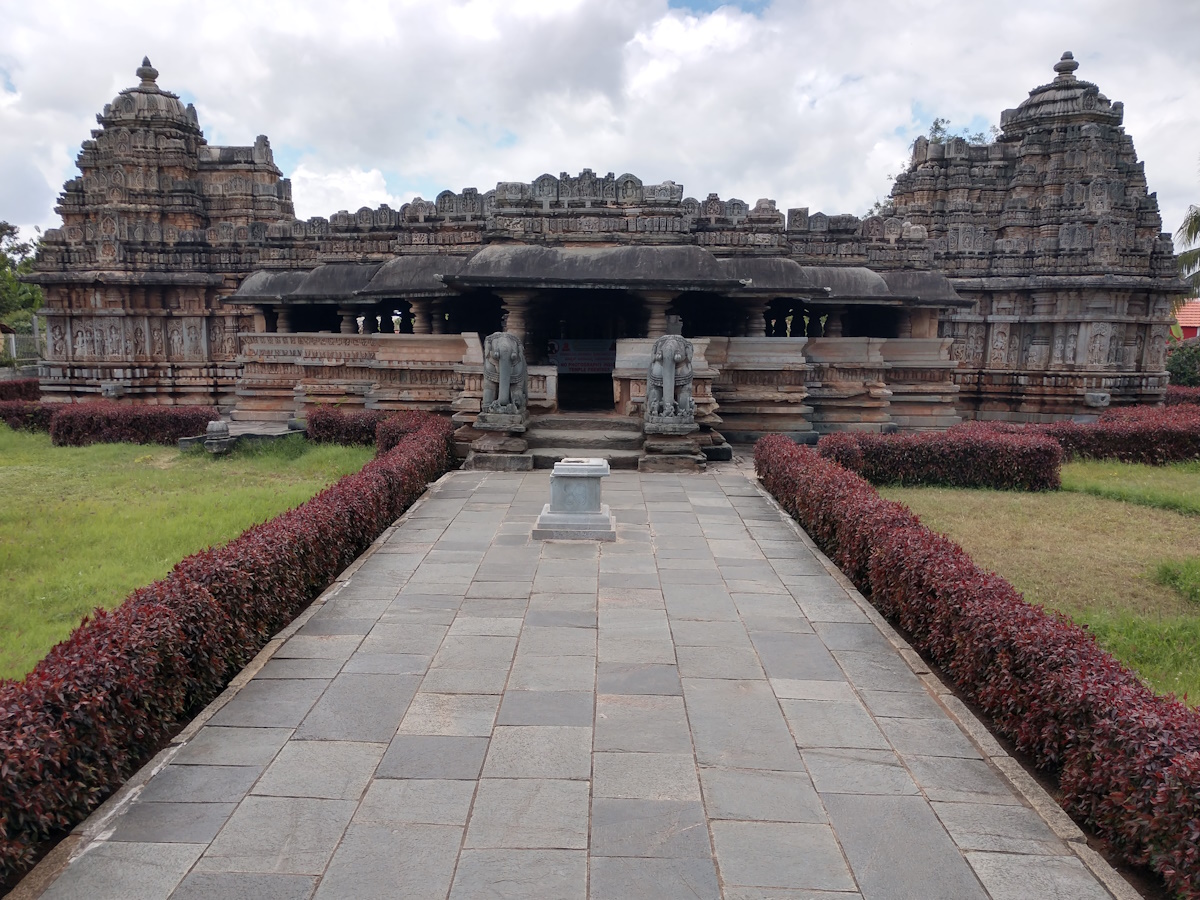
That's the main temple. In this view we see two Shikharas which means there are two sanctums. At the entrance of this east-facing temple is a pair of elephants.

The structure is really stunning, the kind of eye-catching details is so great that it makes us wonder how this was made. This is one huge assembly of smaller sculptures. Sculpting individual parts is is one matter but assembling them perfectly is another matter.

A closer view of one of the elephants. Surely elephants of the royal stable of those times were decorated with jewelry... could be brass, silver or possible gold too.

Before going around the temple, it would be helpful to know it's plan. Here's a screen-shot from Bing Maps. The temple is 58 meters long and 31 meters wide. If the Dwara is included the length goes up to 90 meters. As you see the temple is a large T in plan, three sanctums are placed at each end of the T. So this is a Trikutachala. The three Garbhagrihas are connected by a series of pillared halls. Going by the looks of the temple, the plan and side elevation, this temple was a smaller temple with one sanctum, and it has been extended over years adding two more sanctums. Historical sources say this temple was first built by Hoysala king Veera Ballala II and later it was extended by king Narasimha Ballala.

At the temple's main entrance a board warns tourists to refrain from photography inside the temple which was quite disappointing. Disappointing because the pillars are a sight, together and individually the turned & polished columns with floral embossing are a wonder. Here we noticed few tourists like us. The sanctums were shut, the caretaker asked us to look around until 1 PM by when the Archaka was expected. So we stepped out for a tour of the exterior. The Shikhara seen here sits over the southern sanctum.


This is one of the backrests which go around the temple. 

The outer walls are covered with idols like these, most of them forms of Chaturbuja Narayana meaning four-armed Vishnu. Here are two forms, each having Shankha & Chakra in different positions. In the middle is Garuda with palms joined. I you look closely, the idols faces have been marred with a hard blunt object. Same is the case with all idols here, and same goes for most Hoysala temples. It's no big secret who vandalized the idols systematically.

The stout figure here seems to be Vamana, one of the ten avatars of Dashavatar. I'm not sure who the young woman depicts. In her left hand is an object which looks like corn cob, it could be anything else. She's attired in heavy jewelry, hair tied into a bun and holding a torch in her raised right hand. Notice the size of the ear pendant and a ring on her right thumb. On the right is Narayana, front right arm is missing.

This is the outer wall of the southern sanctum. At the lower level is the opening for the Abhisheka liquids to flow out. The symmetric idol arrangement has Narayana in the middle and on the flanks are attendants and other characters. The middle idol could be Veera Narayana. It features Varada Hasta, right hand fingers pointing downwards, a hand gesture that represents the act of giving boons or gifts. The stout character, as mentioned earlier, seems to be Vamana avatar and on the opposite side is a seated figure which seems like Buddha. Flanking this symmetric arrangement is Gopalakrishna on the left and Narayana on the right.

Moving on, there's another symmetric arrangement which features Mohini, Garuda and Krishna dancing on Kalia's head. All idols feature elaborate headgear and massive ear pendants. Some say that these headgear weren't ordinary, they depict some sophisticated gadget of advanced technology.

Now we are looking at the rear most part of the temple. The seemingly stepped wall seems to be a support to the damaged structure. Here is where I got the feeling the original temple has undergone a lot of additions, some joints are clearly out of sync. Restoring such a structure must be tougher than repairing a structure built in one go.

On the sanctum's side walls are idols of Govardhana Giridhari, Arjuna aiming the target by looking at the target's reflection in a bowl of water or oil and forms of Narayana. There's another idol of the woman with torch and corn cob. 

The next picture seems like a black & white shot. It isn't. This is a portion of the upper level but the lowest part of the Shikhara. Here the attraction is Hoysala emblem- warrior Sala fighting a lion. The emblem is flanked by Kirtimukha which is supposed to ward of evil eyes. By the way, the building bocks of this temple is soapstone.

This is a side view of the three tiered Shikhara on the southern sanctum. At the middle in every tier is Narayana and Garuda. Here we can see another type of Kirtimukha, the type with popping eyes. Every tier base is decorated with hanging jewelry. Sculpting those delicate parts and then assembling the parts at that height must one challenging work.

A closer look at the ancient repair job, a stepped support wall. This portion is painfully out of sync with the rest of the building. As you climb the steps you step into a long pillared hall. 


This is one of the bays attached to the main sanctum. At the top is Venugopala, that's Krishna playing flute. The simple looking canopy is supported supported by turned pillars through a self-aligning mechanism. In fact all pillars have the self-aligning mechanisms to keep the structure stable in case of ground movement caused by seismic activities. Structure can be disturbed due to thermal expansion-contraction of stones. Ancient builders built flexible structures, that's why they remain standing for hundreds of years and repairable.

Coming to the rearmost part of the temple. The plain walled portion is the original temple in my opinion. Even the pillared hall attached to it is an extension.

The northeastern view. This portion seems to have survived without any damage. It's the extended parts which have suffered damages and repaired more than one time.

We sent around the temple completely but I haven't posted pictures of the northern side. 

It was a warm day, the floor was unbearably hot and tummy was signaling hunger. As we completed the Pradakshina it was 1 'O clock, the Archaka arrived promptly. The Archaka made his way to the main sanctum and the fifteen off tourists followed him. For a spacious temple as this, fifteen is nothing, all of us got clear view of the deity Sri Veera Narayana. The five feet high idol is made of dark stone, it was a sight to behold. Its beauty was mesmerizing. Then the Archaka led us to the northern sanctum where the deity is Sri Venugopala. This idol too was stunningly beautiful. It had an hypnotizing effect on the entire group. Lastly the Archaka showed us the deity in the southern sanctum- Sri Yoganarasimha. This idol too mesmerized the group. I could hear whispers of admiration. The Archaka performed Arti to all three deities and offered Prasada to the group. I could feel the vibes of satisfaction of having peaceful Darshan. I won't forget the experience for a long time.

Done with the temple tour, we were back at the car. Hunger was knocking hard. I walked to a small shop opposite the temple and inquired if there was any mess serving ragi mudde lunch. A tourist guide who was accompanying one of the groups overheard me and suggested to try the Brahmins mess a stone's throw away. Like Javagal, this locality too was a Agrahara, the community of priestly class Brahmins. The simple little eatery run an elderly woman offered hot meals. The entire hall could hold just a dozen customers at a time. It was clean and tidy, no odor whatsoever. Lunch consisted of rice, sambar, kosambari, papad, pickle & curd. Every morsel was relished. The best part of the meal was Sridhar ate heartily. Fresh food at the right time, it was so satisfying. 

After resting for a few minutes, we headed to Udbhava Ganapati Devastana, a minute's drive away from Veera Narayana Gudi. The temple doors were closed, I took a few pictures and we left Belavadi. Our next and final destination of the day was Sri Chennakesava Devastana at Arakere.
.........