Two days after my previous visit to
Lalguli I got introduced to Raghavendra Bhat Lalguli over phone. I planned another visit the coming Sunday. This time the group members were Vidya, Neel and me.
Sunday morning we left Dharwad around 4:45. Like the previous trip we took Dharwad-Haliyal-Yellapur Road. By 6:45 we were at Lalguli. Raghu had told water tank as a landmark... we had stopped close to the rear entrance of their house. A dog started barking and Raghu was out to greet us. The house, a tiled roof structure, is built at the edge of their arecanut plantation. We got introduced to Raghu's grandfather Anant Bhat, father Narayan Bhat and his mother. Raghu said we could leave after breakfast. We went around the house. A raised L-shaped arecanut drying-platform is right next to the house. We could see nuts spread out for drying. Area below the platform is also used for drying and other activities like peeling and sorting the fruit. All work involving harvesting except plucking arecanut bunches from the trees is handled by the family. Climbing arecanut tree and plucking bunches is a tricky job.
The kitchen and the dining area was simple, clean and tidy. Mats and plates were placed on the floor. I had one of the best breakfasts in my life.
Neerudose (translates to water dosa), coconut chutney, curds,
raap (liquid jaggery) and tea were served with affection.

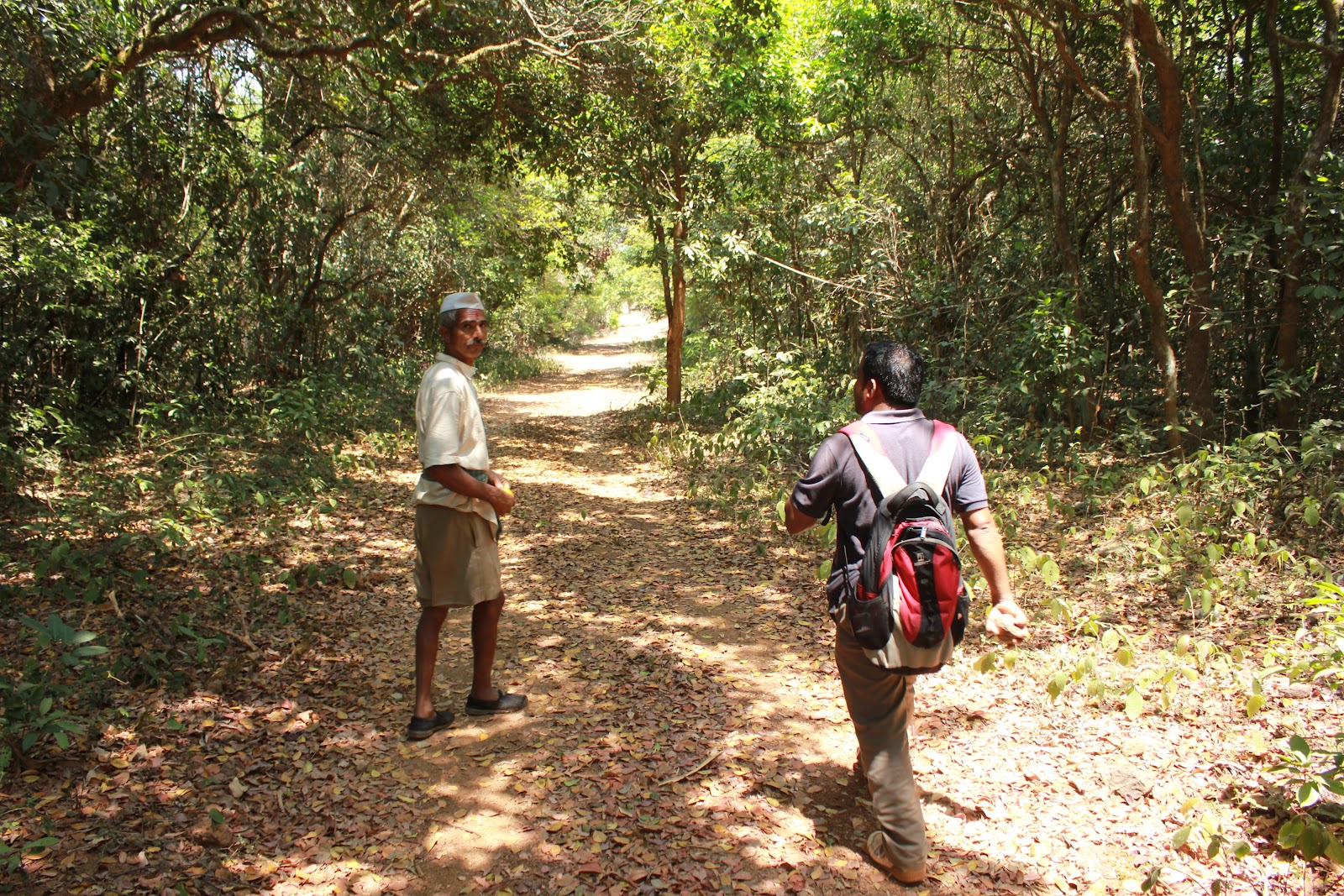
Around 8:15 we set off for the trek into the jungle in search of Lalguli Falls. Raghu's cousin Sriram joined us.

Raghu told that this jungle is actually teak plantation belonging to Karnataka Forest Department. Most of the jungle in and around Lalguli are teak plantations. Wild animals such as bear, wild dog, boar, deer, elephant and even tiger live in these jungles. Cattle go deep into jungle and return after days. Cowherds with their cattle camp in jungle for 2 or 3 days at times. About 15 days back one of the villagers was attacked by an elephant. His dog bit the elephant's ear, that's when the elephant backed off and the cowherd escaped being crushed.


A fallen tree resting on another tree. About 2km from Lalguli... this stream flows across our path.

We took some time crossing it even though it was knee-deep. The stream bed was covered with slippery rocks and pebbles. We had place our feet between rocks to get some hold. The water was clear and cool.

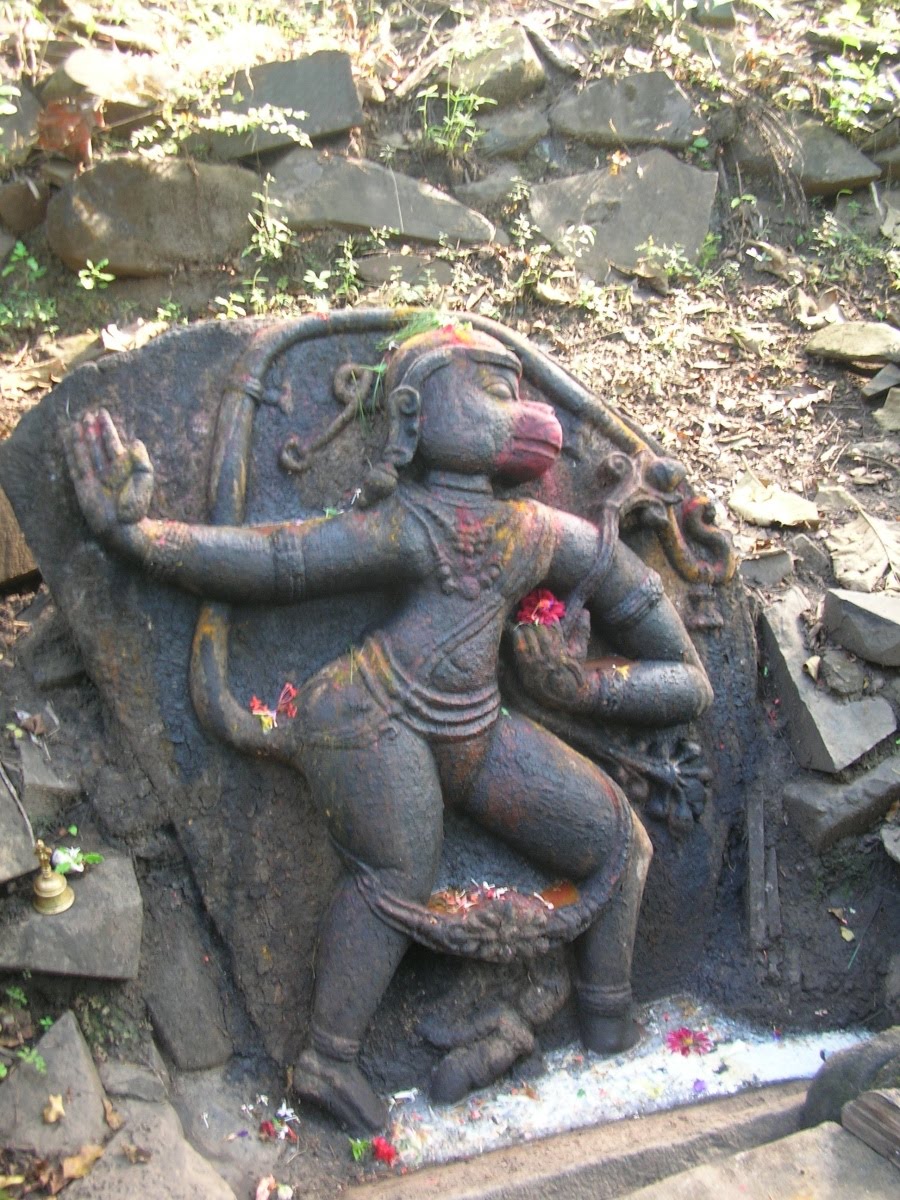
Few feet away from the stream sits a stone grinder in the middle of the path leading up the hill. It seems to be an ancient one. 10 minutes walk up the hill we came to ruins of a fort wall and a statue of Lord Hanuman.

Raghu's family members visit this open air temple every Saturday to perform pooja except during rainy season. It is said that one of the queens of Sonda dynasty had got this statue installed here after banning killing of monkeys. The fort wall- seems as though the construction was abandoned half-way through. The location is strategic; on a hill between a stream and River Kali. The stream joins river Kali short distance from here. Effectively the fort is surrounded by water on 3 sides.

A little Basavanna sits amidst other stone idols. About 200 feet from this temple is a small open well which is supposed to have been created same time as the fort. A short distance from the fort, we took a right turn. We were now going downhill towards river Kali.

Mosquitoes attacked me... some how those pests did not bother others. Raghu showed us so many types of plants. One of the plants had minute pests on the underside of it's leaves. if our skin happened to brush against it, we would itch after 2 or 3 days. We had friendly plants too. Raghu pulled out a small creeper by it's root, cut the root in the middle and held to my nose- it smelt just like Bournivita. We got to see few wild banana plants too.
Here it is- Kalinadi! Looks daunting even without water.

These rocks must have taken few million years to take this form.

Looking towards west. Kalinadi flows west to join Arabian sea at Karwar.

Vidya shooting rocks with her Canon Rebel T1i. Mine is Nikon Coolpix 5100.

Fresh water gushing through rocks. We could never tell how deep the water ran. We had to be extremely careful here. Smooth rocks and water is a deadly combination. beauty fraught with dangers.

We found an interesting rock. Rock with a window and small chamber inside. Raghu sitting on the window sill.

Sriram and I joined Raghu. All three of us could fit into it. It was warm inside and we were sweating like crazy.

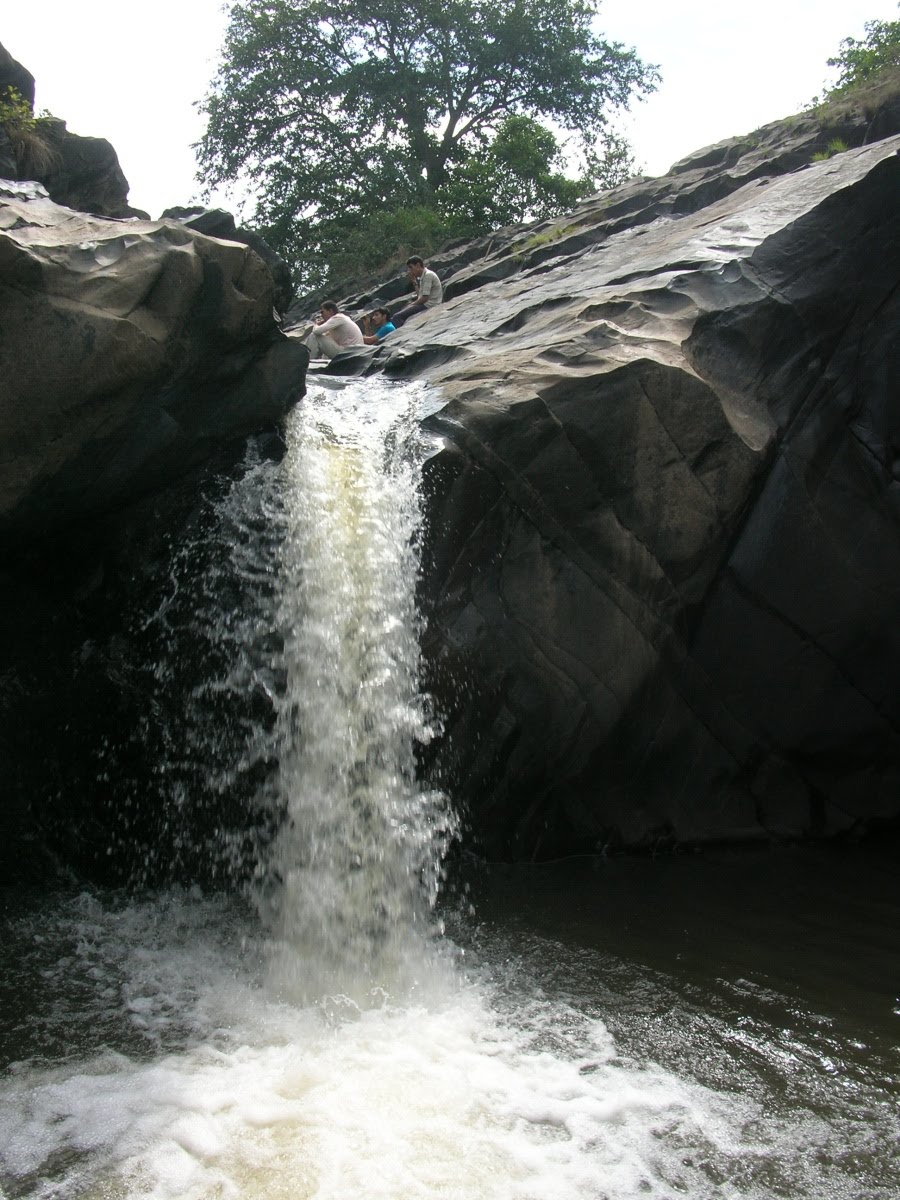
Now we are looking east. We went up this way for about 60 meters to check out this cascade.

This part of the river is friendly. Sriram finds a nice spot at the top.

More art work. How on Earth was this formed? Amazing!

Some kind of marks on rocks. The rock is originally whitish. The grey matter is probably dried moss.

Signs on man's hand on these rocks...

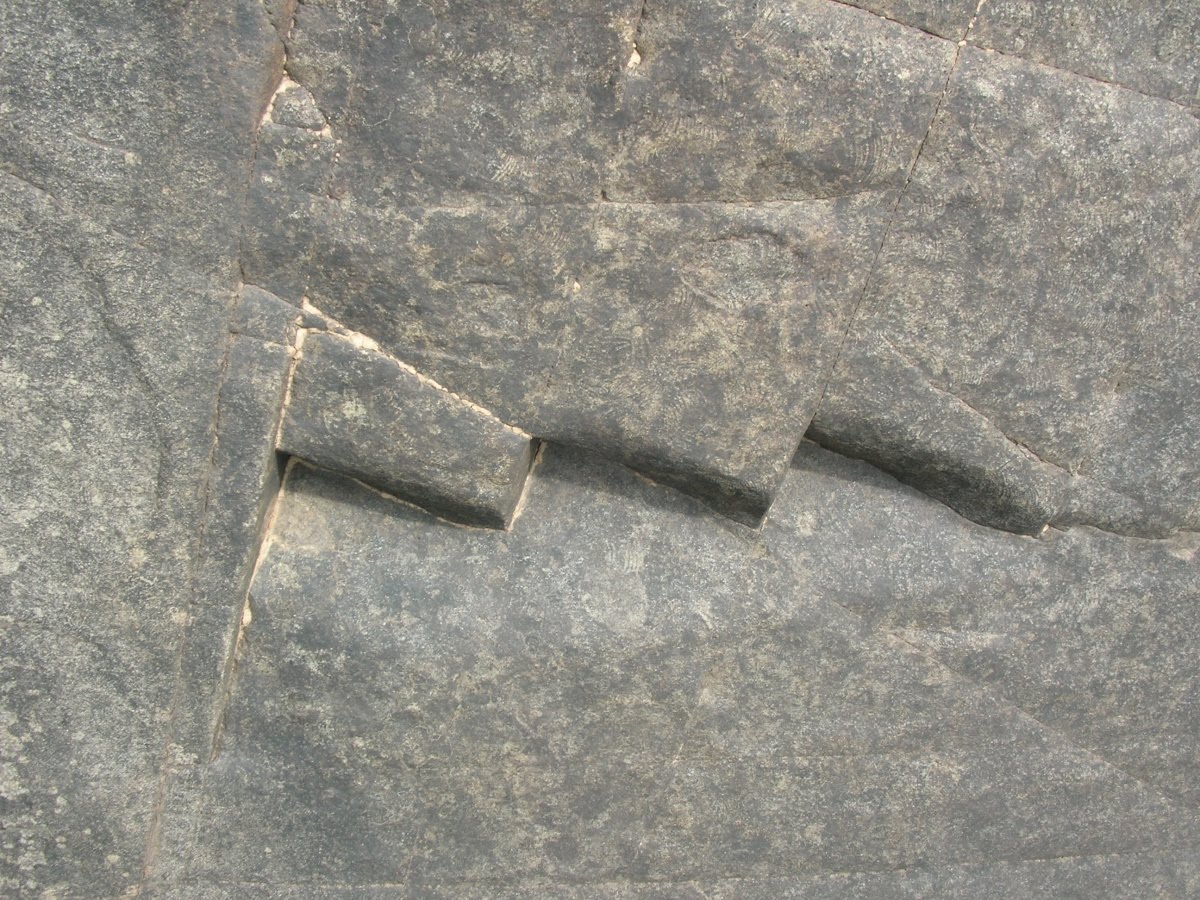
Here are geometrically shaped rock slabs. I feel these were being shaped and sized to b used for building the fort and temple. These rocks are perfectly flat and edges are straight lines. They were probably cut out from...

...this massive rock. Sriram strikes a nice pose with a stunning back-ground.

We turn back, we had plans to go down the river to find spot which is called Lalguli waterfalls. Neel was sitting in meditation pose for quite some time.

Neel was tired of the heat. In fact all of us were feeling the heat from all directions. The Sun blazing above and the rocks rocks radiating heat. These rocks' slipperiness increased as they heated... the grey powdery stuff would come off easily.

Now this Google Map screenshot would be to explain our movements.

Now we are point C. This is where we rested, had guava and water.
A - we entered the river bed here
B - cascade and farthest we went east
D - farthest we went west
E - destination only Raghu went

Water flows rapidly into a hole behind me with a loud roar. The mist kicked up by the fall cooled the surrounding air.

From here Raghu, Sriram and I went towards point E.

The going got tough... rocks were steeper and more slippery. Moving every meter would need effort here. At times we would have to balance on a narrow strip flanked by steep faces. Our energy sapped out by the heat. We paused at point D. Raghu went ahead with the Canon. At least we would have few pictures to see. While Sriram and I waited, I was little worried... Finally after about 20 minutes I was relived to see Raghu back with us. He had taken some pictures but that's not Lalguli Falls. We failed again.
We regrouped again at point C. Time we headed back home... I mean Lalguli. We still had a uphill climb ahead through the jungle of us. Even as we went up Raghu would keep telling us something or the other. I envied his stamina. Soon we were back at the fort, we stopped by to pay respects to Lord Hanuman for a safe trip, crossed the stream, this time it was easier and my feet felt great to be cool cool water. Back on flat terrain, we trekked slowly chatting away.
Wild boar jaw?

It was a relief to back home... it was almost 2pm.

Raghu's folks had had lunch and waiting for our return. I took a quick bath and changed into fresh clothes. It felt great! We all sat down for a delicious meal of rice, green pepper chutney, curds, buttermilk and another dish. Most of the items were home grown. I relished every morsel of rice. Raghu spread couple of beds for us to lie down. I did while Neelkant preferred to sit. I did not fall asleep but felt good to lie down after all the exertion. Vidya spent time inside with the ladies.

After while we had tea. Raghu and his grandfather showed us their arecanut plantation and paddy fields. We learnt that Lalguli farming community has adopted organic farming. Lalguli is known as Saavayaava Graama ~ ಸಾವಯಾವ ಗ್ರಾಮ. It was interesting to learn how they recycled waste such as arecanut peels to produce manure. Every family member would contribute. In fact while we went around the farm, Raghu's father was busy hauling areca bunches from the plantation to the house. His mother was peeling them. Life is so simple and beautiful. We people living city lead such complicated lives.

Grandfather and grandsons.

We visited Sriram's home. His parents were away. That's his grandparents and sister. Here we had spoke more about Lalguli Falls. It seems there's a falls near Tatval locally known as Saat Patte ~ ಸಾತ್ ಪಟ್ಟೆ ...seven falls. This is the same place which Khaitan Degasiddi has told us during previous visit. It's become quite a mystery. Where exactly is it? Raghu and I decided to do more digging... he would speak to Siddi people who know every square inch of the jungle here. We would plan another trip and go exploring.

I wanted to stay back... I promised Raghu to come back. We left Lalguli by 5:45. By the time we hit Haliyal-Yellapur road it was almost dark. We met three foxes at three different places within a span of two kilometers. What a place! Such nice people! And a wonderful day!
Do check out
Lalguli videos.
.........

 The waters of Cudnem river after the falls. The steps seen on the left is the temple's bathing ghat. During one of the previous visits, the water level of this river was at least four feet more than the present.
 Barely half hour outside the airconditioned car, the warm & humid Goan weather had hit Pushpa. She decided to rest while I took a few pictures.
 The stubby columns in waters are flow controllers, I think they reduce turbulence. Also there's a cross-over along those columns. Anyone wanting to cross the stream could go there. To my knowledge, crossing the stream with this flow is not advisable. May be when the water level is much lower.
 This Rudreshwar Mandir, a temple dedicated to a form of Shiva. I had been inside the temple during an earlier visit.
 This is the rear view of the grand temple. Goan temple structures are different, most of them have an open hall attached to the temple. The sloped roof portion is the temple, the dome is right over the sanctum. The extension in the front is an open hall which is used for cultural events. Most temples in Goa and Western ghats are in the same format, only the size and design will vary. Two other major temples of Sanquelim are Radha-Krishna Mandir and Dattatreya Mandir.