August 20, 2011.
We were driving towards Gudibande after the good Andhra style lunch stop at Bagepalli. We had to travel about just 20+ kilometers yet we decided to take a break under a tree just outside one of villages. We stretched out flat on a platform built at a Baniyan tree base. The rest did help us recharge our batteries for the upcoming climb. There it is- Gudibande as seen from the East. Looks like a Shivalinga and reminds me of Shivagange.

Gudibande, a multi-level hill fort was built 400 years ago by a local chieftain Byre Gowda. It is said that Byre Gowda looted the rich to help the poor.

We start our climb with Durga and me leading Mom, Deepi and Gulli. I wasn't expecting mom to climb since she refused to the relatively easier climb at Gummanayakanapalya. Post lunch & rest Durga was fully charged. She's depicting a soldier heralding a king's arrival ...blowing one of those long curved wind instruments :)

Massive walls. Happy to see them well preserved. It's a long steep climb but steps make the climb easy.

In the background, behind this temple is a gateway we just passed through. We met two men on their way down. They were praising the fort and mentioned that one should be have the good fortune to see such places in person. ...I guess that remark is true to an extent.

A pair of wheels, perhaps used for for grinding food grains into flour. Durga spotted a grasshopper on the wheel under the shrub.

An example of plant life's versatility. This tree looks as though its grown out of those rocks. Indeed most of its roots are anchored to those rocks.

The second gateway.

Floral motifs in brick and mortar decorate the gateway.

One of the three underpasses.

Underpass with a ninety degree turn.

A sentry room.
 The turret at the first gateway offers a good view of the town and surrounding plains.

Another turret, similar to the one below dominates the upper portion of the fort. Without these granite slab steps climbing here during rains would be dangerous. I wonder how many men slogged and how many years went by in converting this rocky hill into a hill fort.

Steps leading to the third gateway.

More brick and mortar construction.

A small idol of Lord Hanuman embedded in a wall close to the gateway.

The gateway opens into an open area with ramps and flights of steps connecting its multiple levels. Two turrets dominate this level of the fort. This is the ramp leading up to the southern turret. The turret provides a commanding view of the fort below & above and also Gudibande village and its surrounding plains ...right up to Varlakonda.

That's the summit and the core Gudibande Fort.

Looks as though slabs were used to build these walls to save material and time. However handling slabs would have been required little more effort than handling smaller stones.

View of the summit from the northern ramp.

Closer look at the wall and its base. Tricky piece of construction!

I climb up the steep steps leading up to the gateway to the core. The opening is to the left but hidden.

A place for tired climbers to get rest or was a security office? This door opens to a small dark chamber. The second door, on the other side of the chamber gives access to the core. Elaborate security system.

The Northern turret & it's ramp and sentry rooms to the right.

Rest of the gang had reached the summit much before me. As I stepped into the core, I saw a rain water pond to my right.

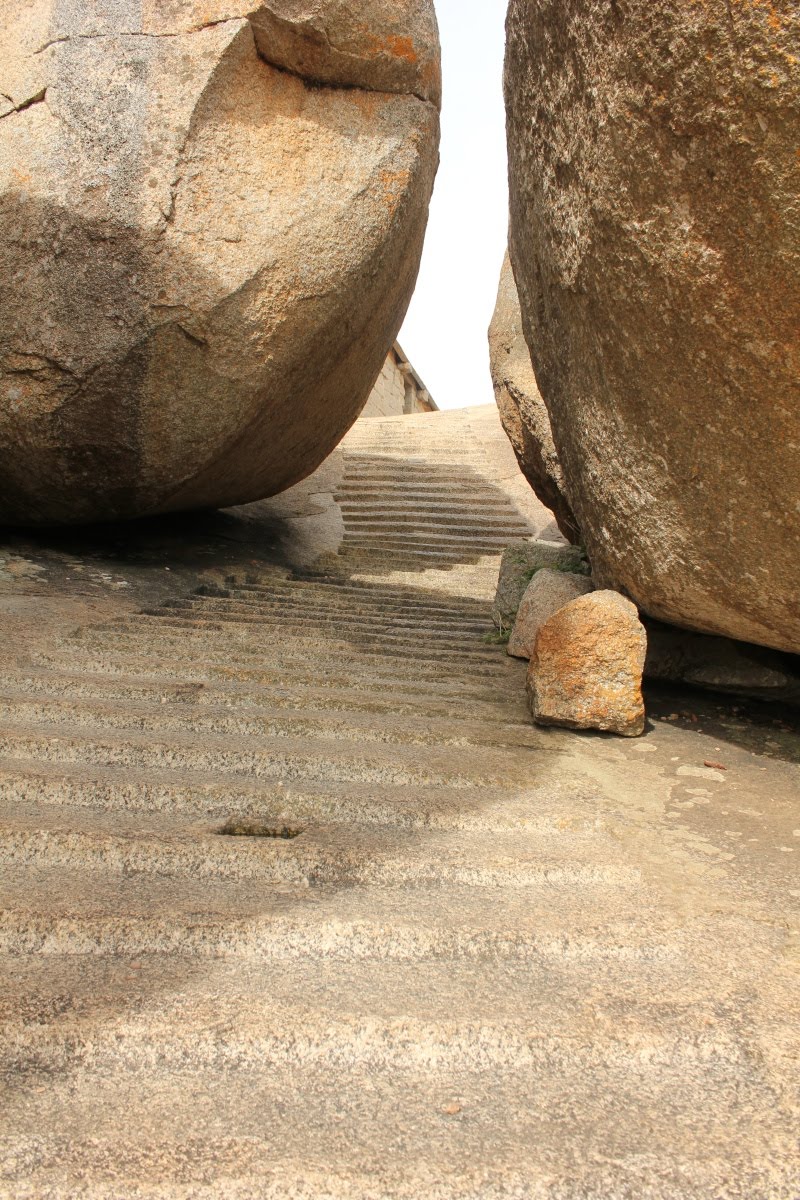
It is said that 19 ponds existed to harvest rain water. Steps hewn out of rock bed leading to the a small courtyard.

On our left is a shelter for sentries. Straight ahead, out of view is another rain water pond and to the right is a temple.

This structure's slanting base makes it unique. The sentry room has plenty of room inside, I would have been happy to stand inside but for all the trash- paper plates, cups, bottles. Some people are just too insensitive!

This Shivalinga in this temple is believed to be one of the 108 Jyotirlingas. Pillars inside the temple feature Vijayanagara architecture. A tall monolithic sixteen sided pillar with a finely sculpted square base has images on all four faces; Bedara Kannappa, Nandi and Shanmugha. I couldn't recognize the fourth image.

The legendary Shiva Bhakta- Bedara Kannappa in the act of gouging out his eye for Lord Shiva.

Varlakonda hill stands out prominently on the horizon. That was my third destination for the day but doubtful if we'll make it there while its still light.

A series of videos shot while descending Gudibande Kote.
.........

 Sharif Saheb's compositions are in spoken Kannada, they carried deep meanings. His songs, like Vachanas. are easily understood and hence accepted by people. However, humans remain ignorant.

 Care takers do work hard to keep this platform clean and tidy but the visiting devotees litter the place.
 The temple, a recent construction is a memorial to Guru Govinda Bhatta and Sishya Sharif Saheba.
 The temple was untidy, there was a heap of flowers, paper and plastic sheets. The floor was a mess, looks like it wasn't washed for days. Sad to see the condition.
 Inside the temple was this hoarding showing Guru Govind Bhatta and Sharif Saheb. I'm not sure if these are actual photographs of them.
 A collage of pictures tells the story of a miracle at Kurutkoti Devi temple. Shishuvinahala Sharif Saheb and Navalgund Nagalinga Ajja reach Kurutkoti during a thunderstorm, both are drenched when come to the Devi temple. The Devi appear before the duo and gives them food. After eating the duo break the Devi idol and make a fire to warm themselves. The next morning when people hear about Devi idol, the Pachayat have Nagalinga Ajja whipped. However every time the whip is lashed, instead of Nagalinga Ajja, the Poojari received the lashes. The Poojari realizes the duo's significance, he begs to be forgiven. The duo rematerialize Devi's idol and pronounce that this would be it's last Pooje.
 Inside the temple's are two open chambers, each has an idol of the master and his disciple.
 I wish people develop civic sense and respect for public places, more so for places of worship.