Nov 9, 2024

Sri Veeranarayana Swamy Devastana, Belavadi

Sept 17, 2024. The day started with a drive from Bhogasandra to Arasikere with a stop to see the ancient stepped well called Aiyyana Baavi near Tiptur town. Then we proceeded to Arasikere where we had breakfast, then visited Sri Chandramouleshwara Gudi and proceeded to Sri Lakshmi Venkateshwara Devastana. Then we drove up to Javagal and spent an hour at Sri Lakshminarasimha Devastana. Until now all temples were uncrowded, it was relaxing, got good darshan of the deities. Belavadi is a short drive from Javagal. Even Viranarayana Devastana wore a deserted look, hardly any tourists.

As per one of online sources, Belavadi was known as Ekachakranagara. It is said that Pandava stayed here during their exile and Bhima slayed the man eating demon Bakasura here. Also it is said that Sri Narayana killed a demon named Shakhasura here.

As we step into the well kept premises, we see a huge gateway concealing the temple. It is an ancient practice to conceal grand structures from a direct view by building a Dwara or Mahadwara the front. This gateway may not be a Mahadwara but it is a grand structure by itself. The Dwara has two a large open hall with two doorways.

The sloped roof flat topped Dwara and the open space between the gateway and temple. Every doorway is flanked by a pair of elephant idols.

These elephants are placed at the inner doorway of the Dwara. Elephants had a special place in Hoysala culture hence one gets to see so many elephant idols. I guess each of these idols were dedicated to a real life creature during the Hoysala times.

The gatekeepers. At  Javagal Lakshminarasimha Devastana, the gatekeepers names are Jaya and Vijaya. Not sure if the ones here have names. For that matter, there's no historical information board here. The presence of Shankha & Chakra is a clear indication of Hoysala rulers affiliation to Vaishnava culture.

An unfinished elephant idol gives an idea of the sculpting process.

That's the main temple. In this view we see two Shikharas which means there are two sanctums. At the entrance of this east-facing temple is a pair of elephants.
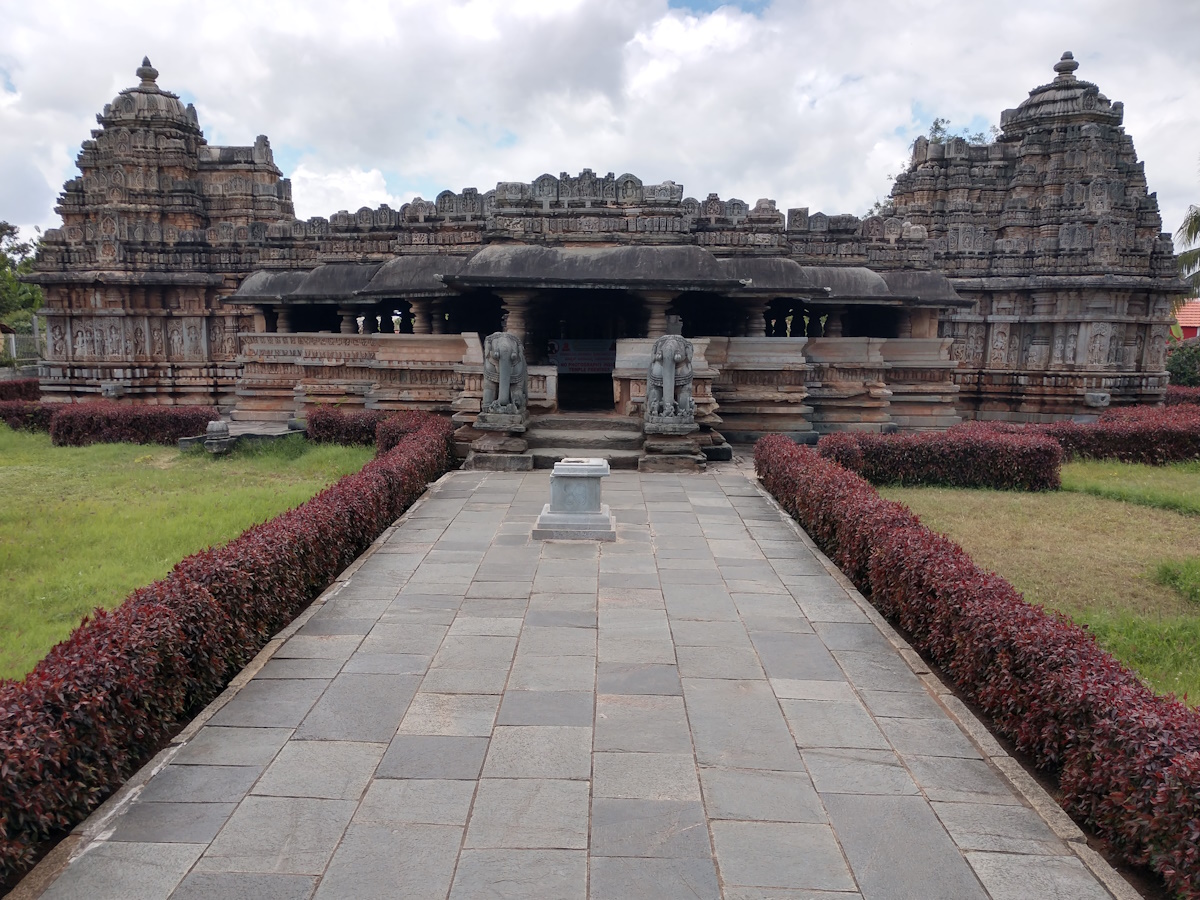
The structure is really stunning, the kind of eye-catching details is so great that it makes us wonder how this was made. This is one huge assembly of smaller sculptures. Sculpting individual parts is is one matter but assembling them perfectly is another matter.

A closer view of one of the elephants. Surely elephants of the royal stable of those times were decorated with jewelry... could be brass, silver or possible gold too.

Before going around the temple, it would be helpful to know it's plan. Here's a screen-shot from Bing Maps. The temple is 58 meters long and 31 meters wide. If the Dwara is included the length goes up to 90 meters. As you see the temple is a large T in plan, three sanctums are placed at each end of the T. So this is a Trikutachala. The three Garbhagrihas are connected by a series of pillared halls. Going by the looks of the temple, the plan and side elevation, this temple was a smaller temple with one sanctum, and it has been extended over years adding two more sanctums. Historical sources say this temple was first built by Hoysala king Veera Ballala II and later it was extended by king Narasimha Ballala.

At the temple's main entrance a board warns tourists to refrain from photography inside the temple which was quite disappointing. Disappointing because the pillars are a sight, together and individually the turned & polished columns with floral embossing are a wonder. Here we noticed few tourists like us. The sanctums were shut, the caretaker asked us to look around until 1 PM by when the Archaka was expected. So we stepped out for a tour of the exterior. The Shikhara seen here sits over the southern sanctum.


This is one of the backrests which go around the temple. 

The outer walls are covered with idols like these, most of them forms of Chaturbuja Narayana meaning four-armed Vishnu. Here are two forms, each having Shankha & Chakra in different positions. In the middle is Garuda with palms joined. I you look closely, the idols faces have been marred with a hard blunt object. Same is the case with all idols here, and same goes for most Hoysala temples. It's no big secret who vandalized the idols systematically.

The stout figure here seems to be Vamana, one of the ten avatars of Dashavatar. I'm not sure who the young woman depicts. In her left hand is an object which looks like corn cob, it could be anything else. She's attired in heavy jewelry, hair tied into a bun and holding a torch in her raised right hand. Notice the size of the ear pendant and a ring on her right thumb. On the right is Narayana, front right arm is missing.

This is the outer wall of the southern sanctum. At the lower level is the opening for the Abhisheka liquids to flow out. The symmetric idol arrangement has Narayana in the middle and on the flanks are attendants and other characters. The middle idol could be Veera Narayana. It features Varada Hasta, right hand fingers pointing downwards, a hand gesture that represents the act of giving boons or gifts. The stout character, as mentioned earlier, seems to be Vamana avatar and on the opposite side is a seated figure which seems like Buddha. Flanking this symmetric arrangement is Gopalakrishna on the left and Narayana on the right.

Moving on, there's another symmetric arrangement which features Mohini, Garuda and Krishna dancing on Kalia's head. All idols feature elaborate headgear and massive ear pendants. Some say that these headgear weren't ordinary, they depict some sophisticated gadget of advanced technology.

Now we are looking at the rear most part of the temple. The seemingly stepped wall seems to be a support to the damaged structure. Here is where I got the feeling the original temple has undergone a lot of additions, some joints are clearly out of sync. Restoring such a structure must be tougher than repairing a structure built in one go.

On the sanctum's side walls are idols of Govardhana Giridhari, Arjuna aiming the target by looking at the target's reflection in a bowl of water or oil and forms of Narayana. There's another idol of the woman with torch and corn cob. 

The next picture seems like a black & white shot. It isn't. This is a portion of the upper level but the lowest part of the Shikhara. Here the attraction is Hoysala emblem- warrior Sala fighting a lion. The emblem is flanked by Kirtimukha which is supposed to ward of evil eyes. By the way, the building bocks of this temple is soapstone.

This is a side view of the three tiered Shikhara on the southern sanctum. At the middle in every tier is Narayana and Garuda. Here we can see another type of Kirtimukha, the type with popping eyes. Every tier base is decorated with hanging jewelry. Sculpting those delicate parts and then assembling the parts at that height must one challenging work.

A closer look at the ancient repair job, a stepped support wall. This portion is painfully out of sync with the rest of the building. As you climb the steps you step into a long pillared hall. 


This is one of the bays attached to the main sanctum. At the top is Venugopala, that's Krishna playing flute. The simple looking canopy is supported supported by turned pillars through a self-aligning mechanism. In fact all pillars have the self-aligning mechanisms to keep the structure stable in case of ground movement caused by seismic activities. Structure can be disturbed due to thermal expansion-contraction of stones. Ancient builders built flexible structures, that's why they remain standing for hundreds of years and repairable.

Coming to the rearmost part of the temple. The plain walled portion is the original temple in my opinion. Even the pillared hall attached to it is an extension.

The northeastern view. This portion seems to have survived without any damage. It's the extended parts which have suffered damages and repaired more than one time.

We sent around the temple completely but I haven't posted pictures of the northern side. 

It was a warm day, the floor was unbearably hot and tummy was signaling hunger. As we completed the Pradakshina it was 1 'O clock, the Archaka arrived promptly. The Archaka made his way to the main sanctum and the fifteen off tourists followed him. For a spacious temple as this, fifteen is nothing, all of us got clear view of the deity Sri Veera Narayana. The five feet high idol is made of dark stone, it was a sight to behold. Its beauty was mesmerizing. Then the Archaka led us to the northern sanctum where the deity is Sri Venugopala. This idol too was stunningly beautiful. It had an hypnotizing effect on the entire group. Lastly the Archaka showed us the deity in the southern sanctum- Sri Yoganarasimha. This idol too mesmerized the group. I could hear whispers of admiration. The Archaka performed Arti to all three deities and offered Prasada to the group. I could feel the vibes of satisfaction of having peaceful Darshan. I won't forget the experience for a long time.

Done with the temple tour, we were back at the car. Hunger was knocking hard. I walked to a small shop opposite the temple and inquired if there was any mess serving ragi mudde lunch. A tourist guide who was accompanying one of the groups overheard me and suggested to try the Brahmins mess a stone's throw away. Like Javagal, this locality too was a Agrahara, the community of priestly class Brahmins. The simple little eatery run an elderly woman offered hot meals. The entire hall could hold just a dozen customers at a time. It was clean and tidy, no odor whatsoever. Lunch consisted of rice, sambar, kosambari, papad, pickle & curd. Every morsel was relished. The best part of the meal was Sridhar ate heartily. Fresh food at the right time, it was so satisfying. 

After resting for a few minutes, we headed to Udbhava Ganapati Devastana, a minute's drive away from Veera Narayana Gudi. The temple doors were closed, I took a few pictures and we left Belavadi. Our next and final destination of the day was Sri Chennakesava Devastana at Arakere.
.........

Nov 2, 2024

Sri Lakshminarasimha Devastana, Javagal

Javagal was the fourth item of our sunrise to sunset tour of Sept-17th. It was quarter past eleven when reached Sri Lakshminarasimha Devastana. While one source says this temple was built by the ninth Hoysala king Veera Someshwara between 1240 and 1260 CE, the ASI board says it was built by king Vishnuvardhana. But it's a Hoysala monument, that's for sure.

Here's the temple's Mahadwara, a typical feature of Vijayanagara times. Probably this gateway was erected during Vijayanagara rule. The gateway is large enough to let an elephant pass through speaking of which check out the stone elephants flanking the door.

A closer look at the elephant idols featuring heavy jewelry.

Sridhar and I go around the temple enclosure which consists of our structures- two temples and two mantapas. This is the rear view of the secondary temple.

A diagonal view of the secondary temple.

This is a view of the main temple which happens to be a Trikutachala. The structure has all the features of a Hoysala creation... built on a platform, richly decorated layered walls and a pyramidal Shikhara.

To the right edge of the enclosure is this pillared hall which could be a Kalyana Mantapa i.e. a wedding hall.

At the northwestern corner of the enclosure is this small ancient structure which seems to be a shelter for travelers. The structure's design is close to the main temple i.e. the platform and pillars seem to of that time.

After a quick walk around we enter the enclosure. The Mahadwara is an imposing structure. Also there are two Stambhas here, Garuda Stambha between the Mahadwara and the main temple, and the second one to the side.

A front diagonal view of the secondary temple. We didn't really check this out. I feel this is an inactive temple.

Here's the main temple. The entrance is guarded by doorkeepers Jaya and Vijaya. 

A board planted here describes the monument as follows:

ಆಯುಕ್ತರು ಪ್ರಾಚ್ಯವಸ್ತು ಸಂಗ್ರಹಾಲಯಗಳು ಮತ್ತು ಪರಂಪರೆ ಇಲಾಖೆ ಮೈಸೂರು
ಶ್ರೀ ಲಕ್ಷ್ಮೀ ನರಸಿಂಹ ದೇವಸ್ಥಾನ ಜಾವಗಲ್, ಅರಸೀಕೆರೆ (ತಾ) ಹಾಸನ.
ಜಾವಗಲ್ನ ಶ್ರೀ ಲಕ್ಷ್ಮೀನರಸಿಂಹ ದೇವಾಲಯವು ಹೊಯ್ಸಳರ ಕಾಲದ ಪ್ರಮುಖ ದೇವಾಲಯಗಳಲ್ಲಿ ಒಂದು. ಈ ದೇವಾಲಯವನ್ನು ಹೊಯ್ಸಳ ದೊರೆ ವಿಷ್ಣುವರ್ಧನ ನಿರ್ಮಿಸಿದನು. ಈ ದೇವಾಲಯವು ತ್ರಿಕೂಟ ದೇವಾಲಯವಾಗಿದೆ. ಈ ದೇವಾಲಯವನ್ನು ನಕ್ಷತ್ರಾಕಾರದ ವೇದಿಕೆಯ ಮೇಲೆ ನಿರ್ಮಿಸಲಾಗಿದ್ದು, ಇದು ಮೂರು ಗರ್ಭಗೃಹಗಳು, ನವರಂಗ ಹಾಗೂ ಮುಖಮಂಟಪವನ್ನು ಹೊಂದಿದೆ. ಇಲ್ಲಿ ಮುಖ್ಯ ಗರ್ಭಗೃಹದಲ್ಲಿ ಕೇಶವ, ಬಲಭಾಗದ ಗರ್ಭಗೃಹದಲ್ಲಿ ಗೋಪಾಲ, ಎಡಭಾಗದ ಗರ್ಭಗೃಹದಲ್ಲಿ ಲಕ್ಷ್ಮೀನರಸಿಂಹನ ಮೂರ್ತಿಗಳನ್ನು ಪ್ರತಿಷ್ಠಾಪಿಸಲಾಗಿದೆ. ಅಧೀನ ದೇವಾಲಯದಲ್ಲಿ ಇರಿಸಲಾಗಿದ್ದರೂ ಲಕ್ಷ್ಮೀನರಸಿಂಹನನ್ನು ಮುಖ್ಯ ದೇವರೆಂದು ಪರಿಗಣಿಸಲಾಗಿದೆ. ಈ ದೇವಾಲಯದ ಮುಖ್ಯ ಗರ್ಭಗೃಹದ ಪಕ್ಕದಲ್ಲಿರುವ ದೇವಕೋಷ್ಠಗಳಲ್ಲಿ (ಗೂಡುಗಳು) ಗಣೇಶ ಮತ್ತು ಮಹಿಷಮರ್ಧಿನಿಯ ಶಿಲ್ಪಗಳನ್ನು ಕೆತ್ತಲಾಗಿದೆ. ಇಲ್ಲಿನ ಮುಖಮಂಟಪದಲ್ಲಿನ ಕಣಶಿಲೆಯಿಂದ
ಮಾಡಿದ ಮಹಾದ್ವಾರ ಹಾಗು ಲಕ್ಷ್ಮೀ ದೇವಾಲಯವನ್ನು ಮುಖ್ಯ ದೇವಾಲಯಕ್ಕೆ ಸೇರ್ಪಡಿಸಲಾಗಿದೆ. ನವರಂಗದ ದ್ವಾರದಲ್ಲಿ ದ್ವಾರಪಾಲಕ ಶಿಲ್ಪಗಳಿವೆ ಮತ್ತು ನವರಂಗದ ಉತ್ತರಾಂಗದಲ್ಲಿ ಕಾಳಿಯ ಮರ್ಧನದ ಕೆತ್ತನೆ ಕಂಡುಬಂದಿದೆ. ದಕ್ಷಿಣದ ಗರ್ಭಗೃಹದಲ್ಲಿ ಆರು ಅಡಿ ಎತ್ತರದ ವೇಣುಗೋಪಾಲನ ಮೂರ್ತಿ ಇದೆ. ಉತ್ತರದ ಗರ್ಭಗೃಹದಲ್ಲಿ ಗರುಡ ಪೀಠದ ಮೇಲಿರುವ ಲಕ್ಷ್ಮೀನರಸಿಂಹನ ಮೂರ್ತಿಯನ್ನು ಹೊಂದಿದ್ದು ಇದರ ಮುಂದೆ ಗರುಡನ ಮೂರ್ತಿಯನ್ನು ಕೆತ್ತಲಾಗಿದೆ. ಗರ್ಭಗೃಹವು ಒಂದೇ ಚಪ್ಪಡಿಯಿಂದ ಕೆತ್ತಿದ ಕಮಲ ಗುಮ್ಮಟವನ್ನು ಹೊಂದಿದೆ. ಮತ್ತೊಂದು ಗರ್ಭಗೃಹದಲ್ಲಿರುವ ವಿಷ್ಣುವಿನ ಶ್ರೀಧರ ಮೂರ್ತಿ ಪೀಠದ ಮೇಲೆ ನಿಂತಿದೆ ಅದರ ಮುಂದೆ ಗರುಡನನ್ನು ಕೆತ್ತಲಾಗಿದೆ. ದೇವಾಲಯದ ಹೊರಗೋಡೆಗಳ ಮೇಲೆ ಪೌರಾಣಿಕ ಕಥೆಗಳನ್ನು, ರಾಮಾಯಣದ ಕಥೆಗಳನ್ನು ಇನ್ನು ಅನೇಕ ದೃಶ್ಯಗಳನ್ನು ಪಟ್ಟಕೆಗಳಲ್ಲಿ ಕೆತ್ತಲಾಗಿದೆ. ದೇವಾಲಯದ ಮಹಾದ್ವಾರವು ಸುಮಾರು ಅಡಿ ಎತ್ತರ ಹಾಗೂ ೭ ಅಡಿ ಅಗಲವಿದ್ದು ಕಣಶಿಲೆಯ ಚಪ್ಪಡಿಗಳಿಂದ ಮಾಡಲ್ಪಟ್ಟಿದೆ. ಈ ದೇವಾಲಯದ ಕುರಿತಾಗಿ ಉಲ್ಲೇಖವಿರುವ ಆರು ಶಾಸನಗಳಿವೆ. 
ಆಯುಕ್ತರು ಪ್ರಾಚ್ಯವಸ್ತು ಸಂಗ್ರಹಾಲಯಗಳು ಮತ್ತು ಪರಂಪರೆ ಇಲಾಖೆ ಮೈಸೂರು

Sri Lakshminarasimha temple, Javagal, Arasikere,
the Lakshminarasimha temple is a triple-shrined temple built by Hoyasala King Vishnuvardhana. It houses the sculpture of Kesava in the main shrine, Gopala to the right and Lakshminarasimha to the left shrines. Although placed in a subsidiary shrine, Lakshminarasimha is regarded as the main deity this Vishnu temple comprises figures of Ganesha and Mahishamardini in the niches by the side of the main shrine. The Mukhamantapa, the granite Mahadvara and the Lakshmi temple constitute the additions of the main temple. The Navaranga doorway bears on its lintel, Dvarapalas and Kalimardana the south cell contains a 6 feet high statue of Venugopala, while the north cell has the idol of Lakshminarasimha on a Garuda pedestal, with Garuda carved in front. The sanctum has a lotus dome carved out of a single slab. The image of Vishnu as Sridhara stands on a pedestal with Garuda carved in front. The Mahadvara about 18 feet heigh and 7 feet wide, made up of granite slabs is typical of Vijaynagara period construction. There are six inscriptions about the temple.
Commissioner Dept. of Archaeology Museums & Heritage, Mysore

This is the Mukhamantapa, meaning the porch. Portions of this temple have been restored, for example the balustrade flanking the steps seem to be quite recent. The two idols flanking the entrance are the doorkeepers Jaya and Vijaya.

The temple Archaka, a young man clad in traditional attire did Arti and offered it to us. We got good Darshan of all three deities. Here I have to mention that the locality in front of the temple seems like an Agrahara, a community of Brahmin families. Agrahara is where Vedic traditions are taught and practiced. This reminded me of the Agrahara at Turuvekere which is known for Hoysala temples like GangadhareshwaraChennigaraya SwamyMoole Shankareshwara and Beteraya Swamy.

Photography inside is banned in most temples. However, I was let to take pictures as long as I didn't take pictures of the deities. Here are two pictures just to give an idea of the interior.

A view of the central dome. It's a three tier dome with spokes projecting out from the hub. This piece of complicated artwork is not there just for decoration. Surely it has some function like concentrating cosmic energy.

Stepping out, we go around the temple. According to one source, the external walls have 140 wall panel sculptures. There are 24 different forms of Narayana each having four arms (Chaturbhuja) holding Shankha, Chakra, Gada and Padma (conch, wheel, mace and lotus). The notable ones are Lakshminarasimha, Ugranarasimha, Rama & Lakshmana, Badrinarayana, Govardhana Giridhar and Anantapadmanabha. Also there are idols of Ganesha, Brahma and Saraswati.

LakshmiNarasimha | Narayana

Varaha Avatar

Goverdhana Giridhari | Vamana Avatar

Lakshminarayana

Narayana | Brahma

Saraswati | Garuda

Ugranarasimha | Garuda | Narayana

Anantapadmanabha

Next is a collage of two interesting sculptures. On the left is a six armed form of Vishnu holding Shankha, Chakra, sword, shield, Japamala and a container like object. I'm guessing this is Mohini holding nectar. The other image shows two characters. On the left is a woman holding on to a serpent, seemingly a cobra. On the right is a voluptuous woman wearing sandals and holding a serpent. These two could be Vishakanya.

Another interesting sculpture is the four armed female form holding a Trident & Damaru in the rear hands. In the front right hand was a sword which is missing and in the left hand is a severed head. This could be Kali, the female counterpart of Shiva.

Lastly, we have Natya Ganapati. And, that's Sridhar known for his handlebar mushtache.

One must spend a lot of time here and study the images closely. There's so much to learn about Hindu culture from these sculptures.

Lastly, a closer look at the Mantapa next to the Mahadwara. This little structure is so much like the one at Sri Lakshmi Venkateshwara Devastana, Arasikere.

A board in front of the temple gives timings for those who wish to get darshan:

ದರ್ಶನ ಸಮಯ
ಸೋಮ, ಭುದ, ಗುರು, ಶುಕ್ರ, ಭಾನುವಾರ ಬೆಳಿಗ್ಗೆ 8 ರಿಂದ 11 ಗಂಟೆವರೆಗೆ 
ಮಂಗಳ, ಶನಿವಾರ ಬೆಳಿಗ್ಗೆ 8 ರಿಂದ ಮಧ್ಯಾನಃ 1 ಗಂಟೆವರೆಗೆ
 
Temple hours
8AM to 11AM on Mon, Wed, Thurs, Fri & Sundays
8AM to 1PM on Tue & Saturdays

Done with Javagal, we head towards Belawadi to see Sri Veeranarayana Swamy Devastana.

.........