Showing posts with label rock hills. Show all posts

Oct 16, 2021

Basavanadurga, the lower fort of Savandurga

For those who've seen Savandurga, its a huge monolith. In fact the largest monolithic hill in Asia. The monstrous size of the rock is so dominant that the ruins of fort on the hill goes into the background. If you focus on the fortification aspect of the hill, one can be surprised. The fortifications are spread across a wide area and elevations. The fortifications are spread over the two hills and also over the sprawling rock-bed on the southern side of the peaks. The elevation of the rock-bed is hardly 15% of the main peaks. The rock-bed is quite uneven with a few naturally formed water ponds. Unlike the main hill exploring these ruins is not a strenuous activity.

My visit here was some time 2003 or 2004, a colleague Rajesh had accompanied me. We reached Savandurga Cross around 3-00 pm. About half a kilometer from Savandurga cross is a point where we parked my car and started the exploration y foot. The rock surface is like a ramp, steep at places, the ramp levels out into a sprawling area which is a mix of flat surfaces, slopes and shallow valleys. Spread over this area is a fort called as Basavana Durga.

This is a cleft in the ramp. Day would be a safe time to explore this area. At night, the steepness of surfaces cannot be judged properly hence it may not be safe.

Here's a screen-shot from Google Maps of the area. On the bottom left corner are the farm lands through which we walked to reach the rock. Following is the index of the points marked on the map-

A - Cleft in the rock
B - Gateway in rampart walls
C - Natural water pond
D - Rectangular enclosure
E - Entrance to the enclosure
F - Natural water pond
G - Ancient temple

That's Savandurga hill in the background as seen from the plateau. In the midground is a line of rampart wall with bastions at regular intervals. The wall running from east to west is about 950 meters. Close to the eastern end of the wall is a gateway - marked B in the screenshot. On the right is a hillock with a walled enclosure.

This is the gateway in the wall. The fort builders have taken care not to expose the opening directly, a screen wall conceals the opening so that anyone entering has to slow down in the zigzag path. These walls seems to be built by the Palegar rulers, probably during Kempe Gowda's time. The condition of the walls are good.

Close to the gateway is a natural pond - marked as C on the screenshot. Rainwater from the hillock collects here. The rampart wall continues up the slope.

From the gateway, half a kilometer towards the left the temple can be seen - marked as G. As you see the temple is situated close to the main hill of Savandurga.

The temple is simple, has one Shikhara over its sanctum. The Shikhara is a brick & mortar creation. Going by the design of the Shikhara, it seems like Vijayanagara architecture. Since the Palegars were vassals of Vijayanagara kings, the same architecture was followed by them. In the early 2000s I had a aim-n-shoot Yashica. Every roll had 36 shots, so photography was rationed. I don't think I shot a closeup of the full temple.

This is Savandurga's Biligudda i.e. the white hill. The other peak which is called Karigudda i.e. black hill is concealed in this view.

This is the view of the hillock from the valley in front of the temple. Atop the hillock is the walled enclosure with four bastions and one entrance.

This is the north-western bastion. The walls are approximately 20' high. This enclosure is approximately 50 meters wide and 125 meters long. Within the enclosure is plain ground. Probably this was the arms and food grains depot.

Close to the enclosure entrance is this magnificent sculpture of a balustrade. Balustrades are fixed on either sides of steps of a temple or a mantapa. Looks like the construction work remained incomplete for some reason.

Close by was a broken piece of another balustrade. While the broken balustrade's surface is almost clear, the intact one is coated with a yellow layer - even though they are lying a few meters from each other.

Rajesh attempts to climb the wall. I think this is the south-eastern corner of the enclosure. I'm not sure if that's a niche or a escape passage.

This is not the wall of the enclosure but the kilometer long wall. According to local stories, this area was covered in a thick forest of bamboo. So this fort had a natural defense system in place.

Next to the enclosure is this natural pond (marked as F in the screenshot) measuring 90m x 14m at its longest and widest points. The pond seems to be 10' at its deepest point. We found clumps of elephant dung. Going by the dryness, it must be several weeks old. A caution if one is planning to camp here in the nights. Water ponds are normally visited by wild animals in the night, may not be a good idea to close to them.

The pond close to the gateway.... as seen from a bastion in the wall on the hillock. The wall is built on a slope which has quite a gradient. Also, notice the wall design, the lower half is dressed stones upon which sits a rammed earth wall. This type of walls can be seen at Chitradurga fort, Gurmitkal fort, Chandriki fort, and many other forts.

The wall standing on the slope for at least four and half centuries. As far as I know, the rammed earth is cast on top of the stone wall using centering and scaffolding. Looking at this wall, I wonder how the engineers fixed the centering sheets. Truly amazing creation.

Another view of the wall and a bastion. I wish the bastion was free from vegetation, it would've been interesting to see the base of those walls.

The beautiful profile of Savandurga hill... five peaks. On the second peak from the right, is the Basava Mantapa. Inside the four pillared shelter is a statue of Nandi looking towards south. Our plan is to reach that Mantapa in the morning.

On the eastern side of the enclosure is a bastion positioned on the edge of a rock formation. Those days we had no Google Maps, so we didn't know the extent of the ruins without a guide's help. Having explored the area in Google Maps, I know how much is yet to be seen. Hopefully I'll go to Savandurga one more time just to explore the lower hills. 
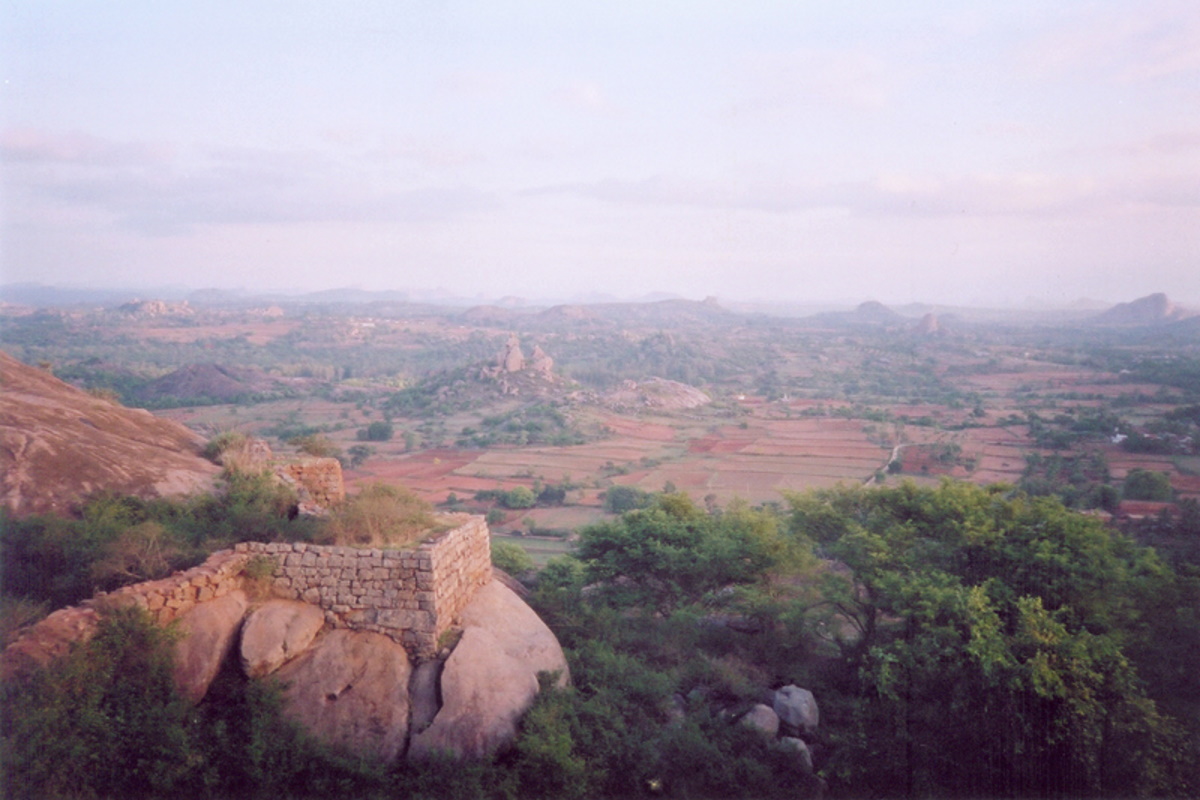
The day was drawing towards its end. Sunsets are lovely here... viewing them from high ground and through clear air.

Rajesh and I went to Veerabhadra Swamy Devastana. The priest's house was in the temple's premises. He was kind enough to provide us food and shelter for the night. We woke up early and climbed the hill in cool weather. As always it was an awesome experience.

Here's a post dedicated to an overnight stay atop- Savandurga - overnight stay five.

.........

Mar 6, 2021

Savandurga - overnight stay five

I'd almost forgotten about this trip until I stumbled on the pictures which brought back memories of the day.

December 8, 2007

I'd been on a visit to Bangalore. As usual Deepak, Gulveer and I met up which somehow resulted in planning a trip to our beloved hill- Savandurga. For a change we decided on night camping on the hill. We left Bangalore after lunch. We took Bangalore-Magadi-Savandurga road instead of Bangalore-Dodda Alada Mara-Savandurga. The latter is much more scenic but the former is quicker. We stopped for a short break when the monolith appeared on the horizon, as if it was welcoming us. This stretch of the road was flanked by paddy fields, crop almost ready for harvest.

We went into the "battada gadde" to take a closer look at the plants. Rajesh poses for a picture of himself with Batta and Savandurga. The green-yellow shade is a treat to the eyes. A month ago the field would have been thoroughly wet and the plants greener.

We reached Savandurga by 4-30. Parked our car at Veerabhadreshwara Devastana, had a word with the priest about our plan to stay at the top. It's always good that locals knew of our stay. This is one of the few surviving ancient temples still in the original condition. The architecture is Vijayanagara. These temples were built by Palyegar rulers who were vassals of Vijayanagara empire. 

Each one of us had a backpack loaded with mats, blankets, jerkins, food, soft-drinks and water. Climbing with load is usually slower than bare climbing. I think we reached the top around 5-30 pm, started collecting dry wood for fire. As usual we set camp at the guard house, the only closed shelter on this hill. Dusk sky was a lovely combination of blues, greys, gold and a touch of pink.

Sunset can be seen from Nandi Mantapa i.e. the summit but not from the guard house which are about half kilometer apart. This view is more towards westerly direction where as the previous picture is towards south.

The eight pillared shelter is a stone's throw from our camp i.e. the guard house. The shelter is slightly elevated and gives a good view of the eastern and southern surroundings. The columns are also Vijayanagara style. This is the most basic version pillar, the more advanced are seen in taller shelters and temples.


As expected the December night was cold, and windy which upped the chill factor. We could not build a fire that would last, we gave up. We talked, cracked jokes and laughed as we sipped soft-drinks and nibbled on potato wafers. Our dinner was chapathi, avare kalu palya and shrikhand. Sleep was on and off but we were comfortable. Morning the air is laden with moisture which kind of dampens the blankets. We woke up just before dawn, the day started with this lovely sight of sunlight trying to crck through low level clouds. Whatever light made it through the clouds was promptly reflected off the calm surface of Manchenbele lake.

The two columns are the pillars of Nandi Mantapa. As soon as I reach the summit, the first thing I do is climb on to the Mantapa, circle Nandi three times, and offer a Namaskara. Of all the sunrises seen here, this is probably the most spectacular one.

The unhindered view: The golden orange glowing ball peeking through the space between the horizon and cloud laden sky. The entire horizon is aglow with orange. What a mesmerizing sight!

Nandi Mantapa sits on the edge of the hill. Nandi's sight is aligned to south-easterly direction. I feel this Nandi keeps a watch over Veerabhadreshwara Devastana, a temple dedicated to a form of Shiva. This picture has a peaceful feel. However, if you stand there you would be pushed around by freezing wind.

Gulli and Deepak gazing in silence.

Suryadeva breaks through the clouds. Deepak and Gulli are still fixed with their gazes towards east. The electric pole standing here has its own little history. A electric line was drawn on Savandurga in 1960s. One of the engineers involved in the project happened to be our neighbor in Bangalore. The gentleman had retired from service when we first met early 1990s. The poles and cables are intact but never saw any of the lamps working in my five overnight stays.

Of all the plants on Savandurga, the most beautiful are the Frangipani trees. As one climbs, the first trees can be seen at the first gateway and then at the top, close to the summit. When in full bloom these trees are a lovely sight and the pleasant aroma of the flower hangs in the air around the tree. To reach the summit, one has to clamber over the branches of a big tree. Frangipani wood is relatively soft, breaks easily. Here are few pictures of broken branches and base of the tree where the trunk transitions into root.

Here are few other plants commonly seen. This tiny plant actually grows into a small tree, it doesn't seem to flower. The compound leaves plant must be a type of fern. The green carpet must be moss. The last one is some kind of fruit, can't recall the plant that shed this beauty.

Savandurga is home to several types of grasses, to my knowledge about five or six types which includes tall and short. Some are seasonal and some evergreen. This clump of grass is the evergreen type. I don't remember seeing it flower. Its blades are thick, narrow and dark green. I'll move on to rocks.. this hole is a sign of ancient quarrying. Granite must've been quarried here to build some of the structures. Plants have taken over the walls of ancient house. A natural crack in the rock due to hot and cold cycles. 

On the way back.. Rajesh swings from a branch while Deepak makes a video. Though its sunny, its was still cold and felt colder because of the wind.

We stopped at the guard house, our night camp site, for breakfast. I think we had come bread, peanut butter and jam.

Down the slopes of Savandurga. The effect of downward forces is mostly felt in the knees and in the toe nails. One good way to tackle slopes, ascending or descending, is to zigzag.

Another collage of a cactus, a Ficus, streams of water trickling down a rocky slope and insect trap pits.

This is one of favorite pictures of this trip. A cut end of a Frangipani. Despite the radial cracks, the age rings are clearly visible. When a live branch is broken, white sticky sap starts dripping from the broken ends. Unlike other trees, Frangipanis have a soft skin instead of bark.

On the way back, somewhere between Tavarekere and Bangalore, we happened to notice two hero-stones in a field. Both herostones had Kannada lines inscribed on them. Probably the text mentioned the names of the warriors who gave up lives in some daring act.

Its been ten years since my last visit to Savandurga. I hope the monolith, the fort walls, Nandi Mantapa, Hanuman idol, guard house, ponds are well preserved; and the trees and plants are thriving. Also hoping to see the Nandi Mantapa again.

PS: The earlier overnight stays on Savandurga happened between 1996 and 2002. Here are the links to those four posts: 

Overnight Stay One,

Overnight Stay Two,

Overnight Stay Three,

Overnight Stay Four,

Overnight Stay Five.

.........

Feb 13, 2021

life on Savandurga

August 17, 2011

These pictures were shot during a visit with Deepak. As usual we had reached Savandurga early morning. The rains had given a fresh look to the rocks and vegetation. It was a partly cloudy day, weather was cool and the air felt fresh. The climb was slower than usual because of the wet slippery patches, we had to tread through them careful. The sights were amazing.. everything on the hill was beautiful, perfect, no chance of flaws in the creations of Mother Nature. Here are few pictures from Nikon Coolpix 5100.

This fallen leaf was seen near the first gate. The tree has grown on a four-pillared sentry post on the fort wall. Just after the rainy season the leaves are green but during a dry season the young leaves are red. And the end of their lives, the leaves turn pale yellow and fall off.

A shallow valley near the second fort wall and gate. Stored rain water trickles down in a tiny stream which collects into a small pond at the base of the slope which further flows down another slope to the base of the hill. The stream gurgles down gracefully, if one paid close attention, the music of water could be heard. The water is clear and cool, fresh enough for drinking without a worry.  

A large patch of man high grass. Each of the plants are at the peak of their lives, so tall and heavy that a strong wind makes them lean creating domino effect. I had a habit of pulling out a stalk from the base and chew on the lower end. I believed the sweet sap from this grass boosted my energy level. 

Little pearly water droplets hold on to young Peepul leaves. I think this tree is on the brick wall which runs along the edge of the slope going up from the second gate. The roots of this plant cling on the brick wall tightly, they look like serpents.

A lonely snail. Except for a gentle movement of its antenna, it was still. It must've crawled all night moved a few meters. I wonder how its to be that slow. Anyway, its shell is one of the most beautiful things in nature. The involute which spirals out is perfect. Such is the power of chemical and physical programming of Mother Nature.

This cactus is quite common on Savandurga and surrounding rock formations. The cactus is relatively mild in terms of thorns which are short and stubby. They grow tall, sometimes upto 8 to 10 feet high. During one of our night camping here, we had collected some dried out plants as fuel for fire. They burned like paper.. it must be the case with all dead cactus since they are bags of water when alive.

This is the eight pillared mantapa a stone's throw from the guard house. This mantapa sits on a rock besides a small pond of fresh water. The ancient builders made sure rainwater was harvested which would remain fresh and lasted until the next season. On this hill are one big and four or five smaller ponds. During one of our visits we used this water to washup, the water was clean enough.

This picture was shot at the top, the stretch between the guard house and Nandi Mantapa. These grass stalks are almost eight feet. The footpath would have tunnels in between.. every time I went through a tunnel I would expecting a wild beast encounter. Notice the loops in the flowery part of the grass? I guess its done by some insect.

Those graceful curves in soft greens and yellows is a pleasant sight. Isn't it? Wondering is this grass when dry is used to make brooms. At this point sun was trying unsuccessfully to break through clouds and layers of mist.

This plant is all leaves, never seen any flower on it. The leaves are thick, even in hot weather they don't show a hint of dryness.

This is an example of plants' versatile nature. They just nooks and crannies to send in roots and cling on firmly. There's hardly any loose soil on this rocky hill but the small granules in the cracks are enough for some to thrive. The clump of grass must be living there for couple of millennia.

On this humongous monolith called Savandurga are countless number of individual boulders shaped by the forces of wind, water and temperature. Many of them have shed weight with time, small granules get separated due to erosion caused by wind and water. Those granules form the little loose soil which is sucked by plants.

A very artistic window framed by two boulders and the monolith. The artistic feel is enhanced by the presence of crisscrossing blades.

The two mountain hounds kept us company all the way up and down. The little one had also come until a slip scared the life of it. It gave up and turned back as we watched it without a clue on how to motivate it to continue the climb.

This beetle is one of the most beautiful ever seen with my eyes. It's shape and color reminds me of Lamborghini. The insect was still even though I was shooting it closely. Insects are less active in cold weather which would be best time to shoot them. This wonderful creature gets all the attention but do check out the beauty of the rock on which it sits. Zillions and zillions of small granules of white, pink, grey remain bonded together to form this monolith granite.

The next four pictures were shot on the way back. This shorter variety grass has occupied a manmade gutter. See the circular lichen just above the grey patch. Grass prevents expansion of cracks as they plug the gaps and keep them sealed.

The little ponds on the monolith are small ecosystems by themselves. Most times they are dominated by a single type of plant but a variety of insect life thrive in the water. Usually the water surface is still in cold weather since the insects are inactive. The mirror like surface reflects the sky, mist and plants beautifully.  

Lastly, a set of real and virtual arcs on the edge of a pond. In the sky is a hint of mist or low clouds.

.........