Dec 10, 2022

Baobab tree of Lalbagh, Bengaluru

People are attracted to Lalbagh for different reasons... for fresh air & silence, for a brisk walk or a energizing run, to see greenery & winged creatures, private moment with a special one, to look for rare plants or to simply look at the gigantic forms of trees like silk cotton. Quite often I'd come to Lalbagh just to enjoy the silence and to see the towering silk-cotton trees. One of the silk cottons is not so towering, rather it is spread out like an octopus. Even that is an amazing sight. Of the rare trees, Krishna Ficus is one variety one gets to see here. I discovered the Krishna Ficus of Lalbagh in December 2014 during a meetup with primary school friends. That's the time I wondered if there was a baobab as well. In February 2019, a comment was posted on Gigantic Silk-Cotton Trees of Lalbagh which said "There is a Baobab tree in Lalbagh near the fish tank building." Following this comment, I visited Lalbagh to look for the baobab but I simply couldn't locate it. It was very disappointing and I never made another attempt to look for it and gave up on it.

October 29, 2022. A message posted by a high-school days' friend Anil Prasad in Whatsapp was a pleasant surprise. He had located the baobab of Lalbagh. I'm not sure if it was an accidental discovery or an intentional one, but the elusive tree had been found. Superb news. I had a phone call with Anil while he was still at Lalbagh, asked for more pictures of the tree which were promptly sent to me. So here's the rare tree.. the three stemmed Baobab of Lalbagh.

It looks like three trees but it is actually one. It seems the plant grew branches close to the ground which competed with the stem to the extent they look like triplets now. Going along with my theory, the limb on the right is the stem and the 'stems' emerging up from the main stem are branches. Below is a diagonal view of the tree.

It's a good thing that horticulture department has labelled many trees in Lalbagh and Cubbon Park too. Surely students and people interested in plant life will find the information handy. The bark of this baobab is similar to the baobabs seen at Savanur, Bijapur, Hyderabad and Nalagonda.

Besides the smaller labels, horticulture department has also planted a board stating a few basic facts of baobabs. Below are the transcripts of the board in Kannada and English.

ಆನೆ ಹುಣಸೆ 
ಸಾಮಾನ್ಯ ಹೆಸರು: ಆನೆ ಹುಣಸೆ ಬೇಯೋಬಾಬ್ 
ಸಸ್ಯ ಶಾಸ್ತ್ರೀಯ ಹೆಸರು: ಅಡನ್ ಸೋನಿಯಾ ಡಿಜಿಟಾಟ
ಸಸ್ಯ ಸಾಂಕ್ರಿಯ ಕುಟುಂಬ: ಬಾಂಬಕೆಸಿ 
ಮೂಲ: ಆಫ್ರಿಕಾ ದೇಶ 
ಈ ಮರವು ಪ್ರಪಂಚದಲ್ಲೇ ಬಹಳ ಬೃಹದಾಕಾರವಾಗಿ ಬೆಳೆಯುವ ಮರ. ಈ ಮರವು ೨೦೦೦ ವರ್ಷಗಳೂ ಮಿಗಿಲಾಗಿ ಜೀವಿಸುವ ಚೈತನ್ಯವುಳ್ಳ ಮರವಾಗಿರುತ್ತದೆ. ಇದರ ಕಾಂಡವು ಉಬ್ಬು ತಗ್ಗುಗಳಿಂದ ಕೂಡಿದ್ದು. ಬಾಟಲಿನ ಆಕಾರದಲ್ಲಿರುವ ಕಾಂಡವು ಬಹಳ ದಪ್ಪವಾಗಿದ್ದು ತುದಿಯಲ್ಲಿ ಮೊನಚಾಗಿ ನಂತರ ಕವಲೊಡೆದು ದಪ್ಪ ಕೊಂಬೆಗಳಾಗಿ ಬೆಳೆಯುತ್ತದೆ. ಇದರ ತವರೂರಿನಲ್ಲಿ ಹಳೆಯ ಮರಗಳ ಕಾಂಡಗಳು ಟೊಳ್ಳಾಗಿ ಸುಮಾರು ೧೨೫೦ ಲೀಟರ್ ನಷ್ಟು ಮಳೆಯ ನೀರನ್ನು ಸಂಗ್ರಹಿಸುವ ಸಾಮರ್ಥ್ಯವಿರುತ್ತದೆ. ಭೀಕರ ಬರಗಾಲದಲ್ಲಿ ಈ ನೀರನ್ನು ಜನರು ಕುಡಿಯಲು ಉಪಯೋಗಿಸುತ್ತಿದ್ದರು ಎಂದು ಉಲ್ಲೇಖಿಸಲಾಗಿದೆ. ಇದು ಒಂದು ಅಲಂಕಾರಿಕ ಮರವಾಗಿದ್ದು ಇದನ್ನು ದೊಡ್ಡ ಉದ್ಯಾನವನಗಳಲ್ಲಿ ಬೆಳೆಸುತ್ತಾರೆ. ಇದರ ಕಾಯಿಗಳು ಹಗುರವಾಗಿದ್ದು ಮೀನು ಹಿಡಿಯುವ ಬಳೆಗಳಿಗೆ ಉಪಯೋಗಿಸುತ್ತಾರೆ.

Baobab tree
Common name: Baobab Tree, Monkey Bread Tree
Botanical Name: Adansonia digitata
Family: Bombaceceae
Origin: Tropical Africa

It is a curious looking giant tree, thought to live more than 2000 years with a swollen bottle shaped trunk suddenly tapering upwards and dividing into a number of large branches. In its native country, the trunk of older trees get hollowed to such an extent to hold rain water as much as 1250 liters, by tapping which people survive over long drought periods. Leaves deciduous, flowers white and scented with purplish stamens. An ornamental tree planted in parks. Dry fruits are used as floats for fishing nets.

The Baobab inside Golconda fort is locally called as Hathiyan, meaning elephant tree. The texture of the bark does resemble elephant skin. The color and folds of elephant hide can be seen on Baobabs.

Lets take a look at the leaves. For a huge tree, the leaves are small. The leaves of this baobab definitely resembles the leaves of other baobabs.... color, shape, size, etc.

Coming to the base of the trunk, a warty texture is a feature in most baobabs.

With this picture one should be able to locate the tree at site. This is near the aquarium buildings, situated between the clock and band stand. This spot is equidistant from West gate and Main gate.

For the reader's benefit, I'm posting a list of known Baobab trees of India-
  1. Hilltop Nightclub, Vagator, Goa
  2. Cabo Raj Bhavan, Dona Paula, Goa
  3. Quepem, Goa
  4. Bamboo Motels, Goa
  5. Mahalakshmi Gudi premises, Martur
  6. near Ibrahim Roza, Bijapur, Karnataka (this tree died a few years ago)
  7. near the tombs of Yogapur, Vijayapura
  8. Dodda Hunashe Matha, Savanur, Karnataka
  9. Attapur, Hyderabad
  10. Purana Qilla, Golconda Fort, Hyderabad, Telangana
  11. Vansthalipuram, Hyderabad, Telangana
  12. near Chappel Road, Hyderabad, Telangana
  13. Ranganath temple at Nanakramguda Hyderabad, Telangana
  14. Uppal in Chengicherla Reserve Forests, Hyderabad, Telangana
  15. Shivalaya on Balachandruni Guttalu, Nalagonda, Telangana
  16. Nellore, Andhrapradesh
  17. Theosophist Society Gardens, Chennai, Tamil Nadu
  18. The American College campus, Madurai, Tamil Nadu
  19. Chinmaya Vidyalaya's campus, Ilanthope, Rajapalayam, Tamil Nadu
  20. Mangaliawas near Ajmer, Rajasthan
  21. Vadodara, Gujarat
  22. Dayapur, Gujarat
  23. Kutch, Gujarat
  24. Bhanagar, Gujarat
  25. Baroda, Gujarat
  26. Victoria Garden, Ahmedabad, Gujarat
  27. Mulund, Mumbai, Maharashtra
  28. Byculla zoo, Mumbai, Maharashtra
  29. Outside the Vasai fort, Maharashtra
  30. Tilak road and Ghole road, Pune, Maharastra
  31. near Aurangabad, Maharashtra
  32. Mandavgad or Mandu, Madhya Pradesh
  33. near Sangam, left bank of the Ganga, Prayag, Uttar Pradesh 
  34. Sanjay Gandhi Biological Park, Bihar
.........

Dec 3, 2022

Megalithic burial chambers of Konnur

The prehistoric site of Konnur was on my list of items for a few years. My efforts to locate it on Google Maps went in vain. The only way to locate it was to inquire with at Konnur. Quite often remotely situated prehistoric monuments are lost mainly due to human interference. So I wasn't sure if I'll be able to locate it all.

September 23, 2022
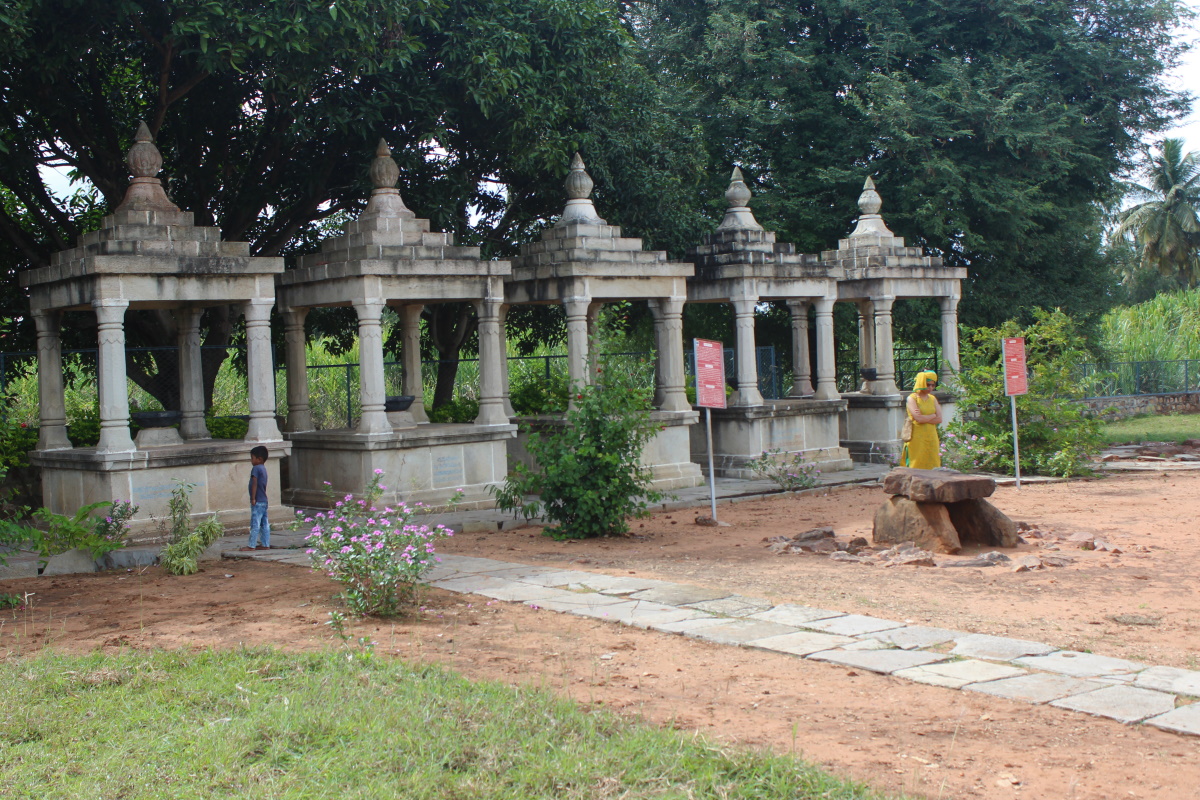
We arrived at Konnur around 2 PM. There were two items to see here- 1. a Chalukyan temple named Chikaleshwara Gudi and 2. Prehistoric megalithic tombs. We drove through the narrow streets of Konnur asking directions to the temple and parked our car at a junction. As we were inquiring about the temple, a shopkeeper noticed the temple caretaker and hailed him. The caretaker was friendly, he and his son lead me to Chikaleshwara Gudi. After a quick tour of the temple I inquired about the dolmen. Apparently the megalithic tombs are called as Munivasada Guhegalu (caves used by ascetics) or Shantisagar Gufa. The caretaker, Shankar Jiddimani, appointed his son Shivu to take us to the site. The site is situated a couple kilometers from the village. Shivu was familiar with the locale and we reached the site in a few minutes. The site is protected with a fencing wall around it, and has just one entry point. The caretaker of this site, Ravi welcomed us with a respectful smile. The site is L-shaped, the megalithic tombs are situated at the far end, rest of the area is just open ground with a few trees. Within this enclosure are tombs of Jain Munis as well. The little stone shelter in front of the five mantapas is one of the tombs.

I was so happy to be here, looking at another group of megalithic tombs. These are as rough as they can get, like the ones at Aihole, Rajan Kollur, Kutkankeri, and other remote locations. This rough little structure, despite its primitive form, has an artistic look. The sloping faces of the side slabs defines its stylish looks. The inside is dim, the floor is dirt. According to Ravi, the inside is a pit filled with dirt washed in by rainwater. The rocks buried around the tomb may not be there naturally, they have been fixed in a circle around the tomb. This is the first time I'm seeing a stone circle around a megalithic tomb although it is a feature of prehistoric tombs. Lets call this tomb #1.

Moving on to another tomb, let us call this tomb #2. Compared to tomb #1, tomb #2 slightly bigger. There are other differences as well. Their orientation; tomb one facing east and this tomb below is facing south. Also this tomb vertically fixed slab in the front. I think originally it was a pair of vertical slabs, now one of them is missing. Then there is a U-shaped extension to its right. Ravi said that during the recent rains, flowing rainwater deposited dirt in the tomb's chamber. Else we would've seen a square pit inside.

This is the rear view of the tomb. Going by its size, this could have been a tomb of a small child i.e. assuming the body was buried. However, it is possible that bodies were cremated and ashes buried in a tomb, in which case the size of the tomb doesn't matter.

Next to the western edge of the enclosure is this particular tomb. The slabs are granite, also it is larger and construction is slightly different.

The next one is a much larger one. Also it has a large chamber inside, large enough for an adult man to sit inside it. I think the stones piled up next it originally formed a circle around the tomb.

Konnur megalithic site details are available in ASI Dharwad Circle website. I'm quoting the description as it is: At Konnur, near the Gokak Falls, are extensive group of dolmens scattered in the fields. Like those of Aihole over the hill, these have also been enclosed with slabs but unlike them, they all face the south. The sherds of pottery and ash have been found. An interesting architectural element is, in front of their southern entrances, are set up two flat slabs on edge leaving a narrow lane of approach between them. The cells vary in size, but average about four feet square inside, and are proportionately high. Locally these tombs are called as Pandava houses while the Jaina call them as Munivasada Guhegalu.

This particular tomb is the largest of all in this enclosure. However it has been modified in the process of reconditioning it. The slabs forming the lane seem to be in original positions. The chamber inside(see inset) is much larger compared to the previous tomb. An adult of average height could easily step into the pit and sit comfortably.

Since this site has a Jaina connection, this tomb might have been used by Jaina ascetics to do Dhyana in isolation. Ascetics are known to vow silence & fasting for a certain period, so during that period they keep bare minimum contact with others. People serving the ascetics normally bring water, milk and fruits once a day, place them at the entrance and retreat. The stone masonry wall seen on the right is a recently built structure. Ravi said there's a tomb inside it.

This is the inside of the building . The little doorway on the right is the passage to an underground chamber. The chamber is large enough to accommodate 2 or 3 adults. The walls of the chamber are rough-cut slabs like the ones seen earlier. What I feel is this place was (may be still is) for performing Sallekana. Its a vow taken by certain Jaina ascetics who fast until death. Its my guess this room served that purpose. That's just a guess, my guides didn't mention that, they just said that Jain Munis lived here. This little fellow is Ravi's son Basu. A silent, energetic and active kid.

We had seen all the tombs in the enclosure. Ravi mentioned about a few more tombs behind a farmhouse opposite the enclosure entrance. The farmhouse and the adjoining farmland were owned by a Gowda, a village headman. Ravi said its okay to take a look. There were three tombs of which one was large and in good condition. In fact this is the largest seen here. The parallel slabs are akin to outstretched arms, as though the tomb is beckoning those looking at it. This tomb was 4 to 5 feet tall. A person of average height could easily pass through the doorway. Despite the crudeness of the structure, its has a certain quality, sturdy, stable and unshakable.

Fifteen-twenty feet away is another tomb, approximately the same size. This is where it flashed to me that all tombs were facing south except tomb #1.

That's the farmhouse and my guides- Ravi and Shivu. Ravi is pointing towards the sugarcane plantation on the other side of this house where there are a few more tombs, rather ruins of tombs.

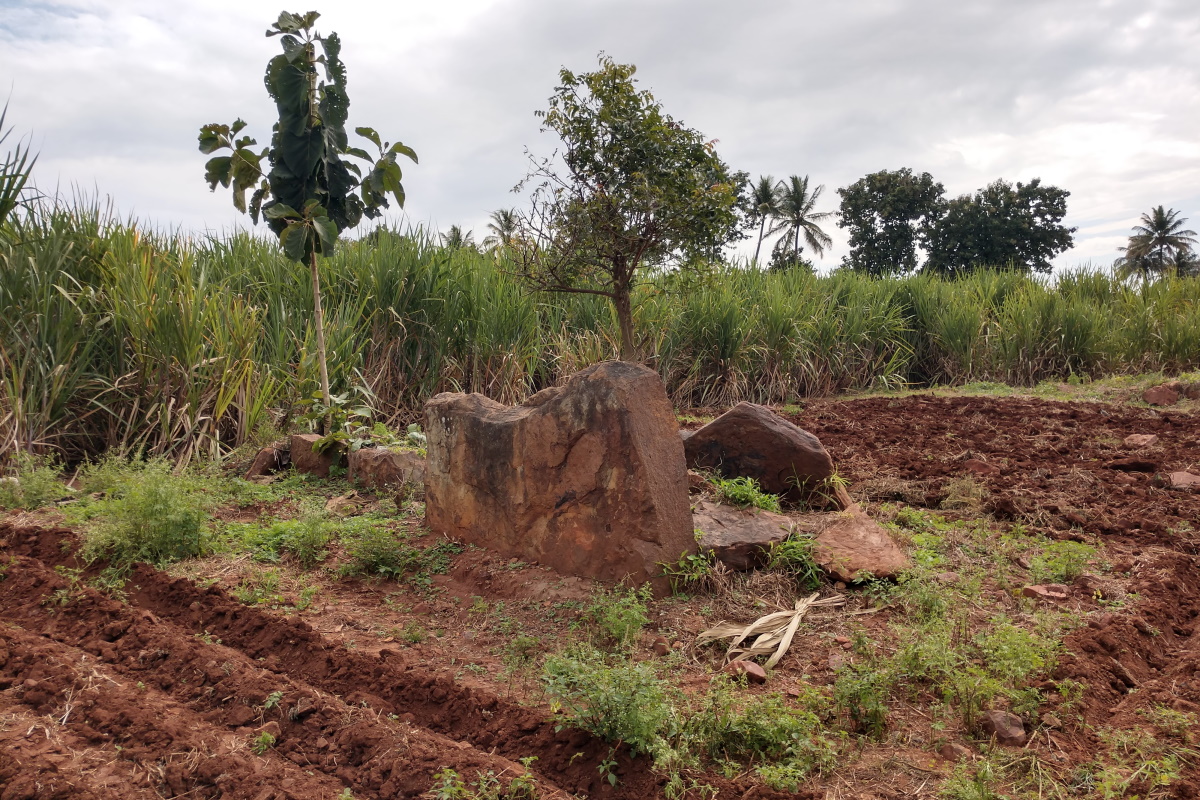
This plot was recently tilled by a tractor, walking through this uneven land requires twice the effort. Like I said before these are ruins of what were beautiful structures. There's little doubt that human hands were behind the mutilation. Probably a few years later the ruins would go missing.

This must have been a really big one. The capstone and rear slab are missing. On its front (the other side) is one of the partially buried slabs.

Within the same tilled plot is another set of three tombs, again all have been disturbed, several parts of the tombs are missing.

Of the three, this is the best preserved one. If we assume this as the original form, then this design is different compared to other tombs here.

With that tomb, we were almost done with this site for the day. Time for a group photo. As an exception, I joined the group, all because of our little friend Basu. See how he's holding a corn cob in his little hand, probably that's his lunch or afternoon snack.

Basu and I with the last tomb of the day. When I lifted Basu, I hardly felt this mass, feather light guy.

We thanked our friends for showing us the tombs patiently. We said bye to Ravi & Basu. As we drove towards Konnur - Gokak waterfall road, Shivu pointed towards another tomb in a sugarcane field. That tombs has been converted into a Devi shrine. That shrine is visited by people and rituals are performed regularly. We decided to skip that tomb, may be next time. We dropped off Shivu at the main road and headed towards Dharwad via Gokak waterfall. As I was thinking about these tombs, I felt the tomb building technology gradually evolved into temple building technology. What do you think.

.........