The word dolmen was familiar to me since my early childhood days. Memories of seeing a dolmen in "Asterix and the Golden Sickle" are fresh to this day. Asterix and Obelix are in search of a dolmen in a forest, it starts raining, they take shelter a dolmen unaware that's the very dolmen they wanted to find. Back then I would imagine how it would be see a real one and I thought dolmens were made for shelter. Decades later, I stumbled upon real dolmens and the possible reasons behind their creation. The first dolmen I saw was the one near Bachangudda hill near the World Heritage Site Pattadakal. Around that time I came across sources which evoked deeper interest in prehistoric sites which led to more research & explorations. The sources include historical books, online portals and people. One person I have mention here is Ramadasa of Sanganakallu village near Bellary. Ramadasa's interest & knowledge of prehistory is at another level, it combines archaeology and astronomy. Then there were accidental discoveries while exploring forts. At this point, I have mention that there's a strong connection between prehistoric sites and forts, only some forts based on topography. Here's are brief writeups on each of the dolmen sites I happened to visit, followed by the sites I've heard and have intentions of visiting them.
Dolmen of Bachangudda: My first visit to this site was Dec 2011 during a solo tour of Badami, Pattadakal & Aihole. The dolmen is situated about 2 km from Pattadakal on Badami-Pattadakal road. It's situated right besides the road and surrounded by farm lands on three sides. I've stopped here at least half a dozen times since 2011 when it was unfenced.

A few years ago the site was fenced and a writeup was posted. Below is the transcription of the writeup:
This megalith-a dolmen-is a burial or memorial burial belonging to 1st Millennium BCE to 3rd Century CE. It is a rectangular chamber formed by four large and thick orthostats on the sides. Bearing a larger capstone at the top. The side orthostats. At both the ends project laterally across the edges of the orthostats on the front and rear. The south-east facing front orthostat has a rectangular opening larger than a normal port-hole. On the front side. In continuation of the western orthostat. Is seen only the broken edge of another orthostat. There are three other huge fallen slabs in front of the chamber. These originally formed probably another north-south oriented compartment of the extant chamber. The present front slab with the rectangular opening is likely a segmental orthostat dividing the chamber into two compartments. Traces of cairn packing of stone rubbles and earth enclosing the chamber are visible on the northern side but this is a vague indication that the chamber was originally surrounded by a stone circle.

Of all the sites, this dolmen seems to be the most advanced in terms of design and finish. Also personally I feel this structure is an early form of Hindu temple.
During second or third visit here, local people told us about ancient stone structures about 230 meters towards Bachingudda village. There are three megalithic burial chambers, all have been vandalized badly. This is one of the three and that's Malatesh my travel partner for a few years. Compared to the previous dolmen these three are quite primitive, and similar to the ones at Aihole and Guledgudda.

Dolmens of Aihole: I discovered Aihole dolmens during my fourth or fifth visit i.e. in September 2012. This is one of the largest sites with close to eighty dolmens, many of them in ruins. The site is a sloping plateau overlooking the valley where river Malaprabha flows. Ever since this discovery I've come here again four times. I wanted people to see this site. On the same hill are natural rock shelters where you can see ancient paintings, mostly hyena fur pattern. This place gives a tiny glimpse into ancient practices. Here are a few sample burial chambers. The general design is four slabs placed vertically forming a square, the fifth slab is placed horizontally on top of the standing four. However, here most of them are vandalized, one or more slabs are removed or missing.
The first picture here, this burial chamber is the most stylish, it has an attitude. This one is about 3' high. Inside remains of red soil is seen. Originally the inner space was packed with red soil and a corpse, maybe more than one. The idea behind this elaborate arrangement is to protect the mortal remains from scavenging beats like hyenas which seemed to thrive here in those times. Maybe this kind of burial was reserved for tribe leaders and their families.

The second one here is shorter to the one above. This is not more than 2' high. This too is vandalized but the red soil inside is almost intact. Going by its height, this one might've contained one corpse. I'm wondering if archaeologists have run tests on this red soil. Surprisingly this site is unprotected. There's no declaration usually found at archaeological sites.

The third one is the largest dolmen of Aihole site. It's almost 4½' high. Going by its volume this could contain four or five bodies. In the background is Meguti Gudi which marks the end of this plateau.

Dolmens of Hire Benakal: Now we are talking about the largest megalithic site of Karnataka state, hoping I'm not wrong in saying this. I'd visited this site in July 2012. Situated on a range of hillocks near Koppal, the site is spread over a large area which could be marked off as three clusters. We reached the site with just an hour left for sunset, so we spent most of the time at the main part of the site, just walked through another cluster and missed one cluster completely. Local people call them Moreyara Mane which roughly translates to dwarves houses. I feel that's not case, they are meant to be burial chambers.
The below pictures are part of the first cluster which consisted of smaller burial chambers with and without port-holes. Some of the burial chambers were smaller. As you see most of them had been vandalized. I just hope the destruction of these invaluable artifacts has stopped hence.

Moving on to the main cluster. The sight of these huge structures left us wondering, surprised and admiration for those ancient builders' talents. These dolmens are assembly of granite slabs of uniform thickness. The construction is similar to dolmens of other sites except for minor differences. Here we have four trapezoidal slabs placed vertically which form the walls, and a circular slab forming the cover. The smallest dolmen was maybe 5' high and the tallest almost 10'. The extent of damage is evident - broken pieces of slabs strewn between the dolmens. As per archaeologists there were around 300 dolmens in this particular cluster however the numbers were much lesser during our visit.

Coming to the purpose of these huge structures, I'm little confused. Unlike the smaller dolmens there's no loose soil under the larger dolmens. No packed soil inside any of the dolmens. So wondering how the burials were done.

Before moving on to the next site, I would like to add that there are a number of rock paintings close to these dolmens. Also, there one sculpted stone known as the kettle drum which is about a meter in diameter. Apparently the stone drum emits a boom when struck with wooden club. I'm keeping my fingers crossed wishing the kettle drum- which is one of it's kind in Karnataka -is safe and untouched.
Dolmens of Rajan Kollur: I learned about this site in Philip Meadows Taylor's "Megalithic tombs and other ancient remains in the Deccan." Taylor had called Rajan Kollur a major megalithic site of Karnataka. Indeed it is. Based on my knowledge, Rajan Kollur is third largest, Aihole site is second largest and Hire Benakal is the largest. There's another site near Konnur town in Belagavi district. Size of the site is one matter but dolmen size is another. The larger dolmens here beat the largest dolmen of Aihole. Yes, some of the dolmen are massive, the slabs are seriously bulky.

While most other places dolmen are called Moreyara Manae, people of Rajan Kollur call them Buddara Manae. I'd visited this site in November 2013, it was well protected and an infographic posted near the entrance gave out detailed archaeological findings of this site. I hope the site is well maintained. Besides the main enclosure, there are a few more dolmens in an open ground 200 meters to east.

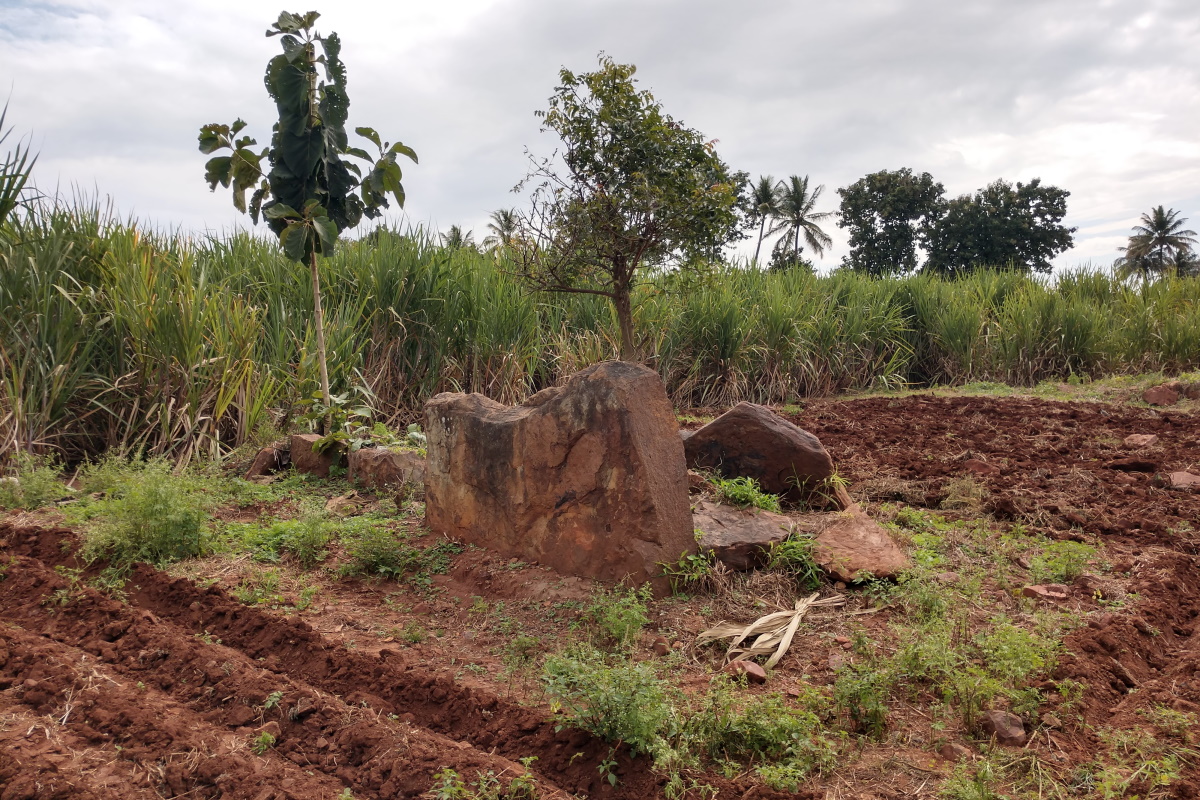
Remains of Brahmagiri dolmens: This prehistoric burial site is situated at the base of Brahmagiri hill at Ashoka Siddapura village in Chitradurga district, about 2.3 km from the village bus-stop. I'd visited this site in December 2013. I was expecting to see dolmens similar to Hire Benkal. I was shattered seeing the broken remains of granite slabs sticking out from the ground. Apparently local people 'harvested' the slabs for construction work. A local man told us there were hundreds of them scattered in fields, people just removed them to clear their fields. The slabs were either sold off or used as construction material. This is a lost site.

The sites where dolmens are made of granite are Hire Benakal, Kumathi and Brahmagiri. Maybe sites in southern Karnataka too. At sites in the northern parts like Aihole, Rajan Kollur, and others dolmens are made of sandstone blocks or other darker harder stone types.

Dolmen of Hanamasagar hill: This little dolmen was an accidental discovery while exploring the ruins of the fort on Hanamasagar hill in November 2012. Within the fort is a temple dedicated to Venkateshwara popularly known as Abhinava Thirupathi. After seeing the inner space of the small fort, I was going around the walls checking out for ruins on the slopes and I bumped into this little structure, barely 2'x2'x2'. A few meters away there was a damaged dolmen of similar size. As I remember only two dolmen were seen here. I'd read that a stone circle existed in the plains near the hill but I couldn't find it. Made of rough cut blocks, this dolmen could be from the same period as dolmens of Aihole, Konnur and Rajan Kollur.

Dolmens of Konnur: I read about this site on ASI Dharwad website but failed to find the site's location online. A few years later I happened to travel towards Konnur and located it with the help of local person's help. A couple of kilometers away from Konnur, the site is hidden among farm lands. As per the two local guys who showed us around, dolmens here are known as Munivasada Guhegalu. First Moryara Manae, then Buddara Manae and now Munivasada Guhegalu.
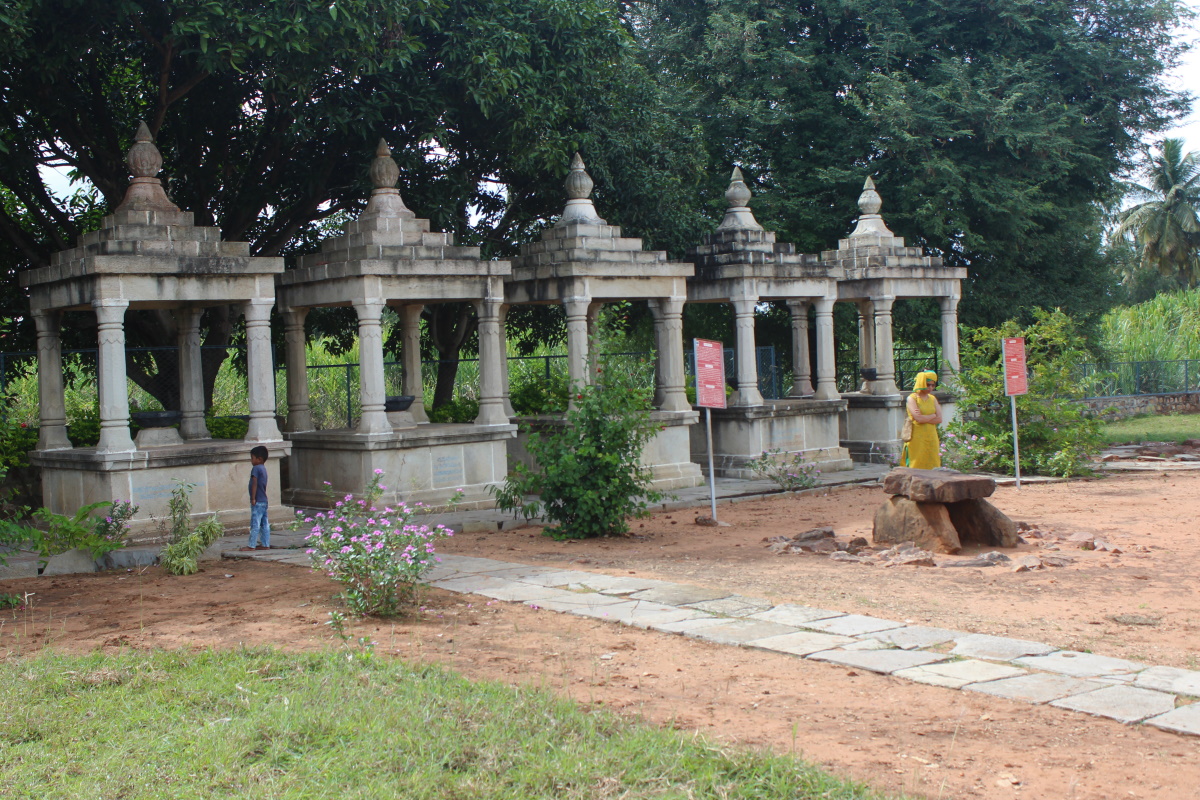
A group of cist graves are in an enclosure along with five tombs of Jaina ascetics. The group consists of 2' high dolmen to larger ones spacious enough for an adult human. It is possible that Jaina ascetics used these dolmen to meditate hence they are called as Munivasada Guhegalu, meaning ascetic's cave.

The cist graves have been built using rough-cut sandstone blocks. Their build and looks are similar to the ones at Aihole, Hanamasagar and Rajan Kollur. It's possible all are from the same period. Some of the dolmen have been altered to increase inner space. For example; the one below. This one is perfect for a meditating monk.

While the fenced enclosure has a dozen or so structures, there are another dozen larger dolmens outside the enclosure. One unique feature seen in Konnur dolmens is the pair of horizontally buries slabs in front of the opening. Small or big, many of them have it.. let's call it a crude form of balustrade. One common feature of dolmens of Aihole, Konnur, Rajan Konnur, Hanamasagar- all are south facing.

After the tour of this site our guides said that many more dolmens in the hillocks not very far from here. Since we were out of time, I told our guides that would for another day. I'm yet to follow up on that.
Remains of Kutkankeri cist graves: Kutkankeri hill is situated 8 km to the north of Badami. I read about rock paintings at this prehistoric site on The Megalithic Portal. On these hills are fairly well preserved rock painting of Indian hyena fur pattern, an outline of a hand, an alien creature similar to human form and few other things. I'd visited Kutkankeri in September 2012. Though I was not expecting to see dolmens here it wasn't a surprise to see about eight dolmens but completely vandalized. These dolmens were made of sandstone blocks, the type of stone which is available easily here. I think there were stone circles as well around the dolmens.

Among all the ruins, below is the least damaged one. It was sad to see these invaluable monuments torn apart for petty gains.

Prehistoric graves of Guledgudda: Guledgudda is about 23 km northeast of Badami. The name Guledgudda roughly means nomad's hill. The objective of my visit was to see the fort ruins atop the hill. The hill is barren and has plenty of rock outcrops. We did find ruins of a fort and also ruined houses built of stone blocks. As we explored we found several dolmen and stone circles. Most of the artifacts were vandalized except for one stone circle which seemed perfectly preserved.

Here's the well preserved stone circle. In the background, there's stone arc, maybe it was a circle before a few stones went missing.

This looks remains of a cist grave.

I wish I had paid more attention to prehistoric graves. Perhaps I must visit this site again.
Dolmen in the jungles of Bandipur: This was another accidental discovery. I was traveling by cab to Ooty with a colleague. It's my habit to look out and study places. Somewhere in the jungles of Bandipur I spotted this dolmen. Since stopping was prohibited, I requested the driver to slow down for a couple of pictures. The dolmen was a hundred feet away from the road, used telephoto lens to shoot this picture. The dolmen is made of granite slabs. Like I said earlier, dolmens in southern Karnataka are made of granite slabs. I wonder if any more dolmens have survived here.

Ruins of a dolmen at Kumathi: I learned about Kumathi from my friend Ramadasa of Sanganakallu village. He had read a newspaper article about a dolmen at Kumathi. However, it so happened that Ramadasa was talking about two prehistoric anthropomorphic statues, and we at Kumathi located the remains of a dolmen. Here's our first discovery- a ruined dolmen made of granite slabs, with one of the slabs having a porthole. Had this been intact, this would've been similar to the dolmens of Hire Benakal.

The second discovery of that day was anthropomorphic statues, each 10' from the ground level. These two ancient creations are simply wonderful. Our day was made. Prehistoric people, like Mother Nature, keep springing surprises. Just to get an idea of their creations, do take a look at the
Dolmen like structure of Wakkandurga: If I remember correctly, I located Wakkandurga fort on Wikimapia.org. I had noted location details of some six forts in this region and targeted to visit them all by the end of the day. Wakkandurga was the second fort of that morning. I was expecting to see a fort but the fort sprang a surprise- a dolmen like arrangement of stones.

A huge boulder of irregular shape is balanced on smaller boulders creating a shelter beneath. The capstone seems natural enough but the way its balanced on smaller boulders seems manmade unless. Not saying that it's not possible naturally because Nature is capable of anything.
- Arasinaguppe, Chikkamagaluru District
- Chikkajala, Bangalore Urban District
- Doddamalthe, Somvarpet Taluk, Kodagu District
- Gamangatti?
- Hejjala, Ramanagara District
- Hujagal, Magadi Taluk, Ramanagara District
- Hunkunda, Kolar District
- Kallur Naganahalli, Mysore District
- Kittur, Mysore District
- Managondanahalli, Bangalore Rural District
- Palli, Karkala Taluk, Udupi District
- Savandurga, Ramanagara District
- Sulimolathe, Somvarpet Taluk, Kodagu District
- Thalavadi Betta (fort), Ramanagara District.
- Timmappana Betta, Ramanagara District
- Valpady, Dakshina Kannada District